What Makes a DeFi Strategy Actually Sustainable?
--
DeFi is full of yield.
New strategies launch every week. APYs spike. Capital floods in.
And then, almost as quickly, it all fades.
Yields compress. Liquidity rotates. Opportunities disappear.
If you’ve spent any time in DeFi, you’ve seen this cycle play out again and again. It’s predictable at this point — almost structural.
Which raises a more important question:
Why do most DeFi strategies fail to last?
And more importantly:
What actually makes a strategy sustainable?
The Pattern We All Recognize
The lifecycle of most DeFi strategies is short and intense:
- A new protocol launches with attractive incentives
- Early users capture high yields
- Capital rushes in chasing APY
- Returns dilute as liquidity grows
- Incentives taper off
- Capital exits in search of the next opportunity
This isn’t a flaw — it’s how many early-stage systems bootstrap liquidity.
But it also reveals something critical:
Most yield in DeFi is temporary by design.
Which means chasing the highest APY is often chasing the shortest-lived opportunity.
Redefining “Sustainable” in DeFi
A sustainable DeFi strategy isn’t the one with the highest returns this week.
It’s the one that continues to generate risk-adjusted yield over time.
In simple terms, sustainability means:
- Consistency: Returns that persist across weeks, months, and cycles
- Independence from incentives: Not relying purely on token emissions
- Adaptability: Remaining viable across changing market conditions
This is about durability — not hype.
Real Yield vs Temporary Yield
Not all yield is created equal.
At a high level, DeFi yield comes from two main sources:
1. Real Yield (Economic Activity)
- Trading fees
- Lending interest
- Arbitrage opportunities
- Market-making spreads
This type of yield is tied to actual usage and demand. As long as users trade, borrow, or interact with markets, it exists.
2. Temporary Yield (Incentives)
- Token emissions
- Liquidity mining rewards
- Bootstrapping incentives
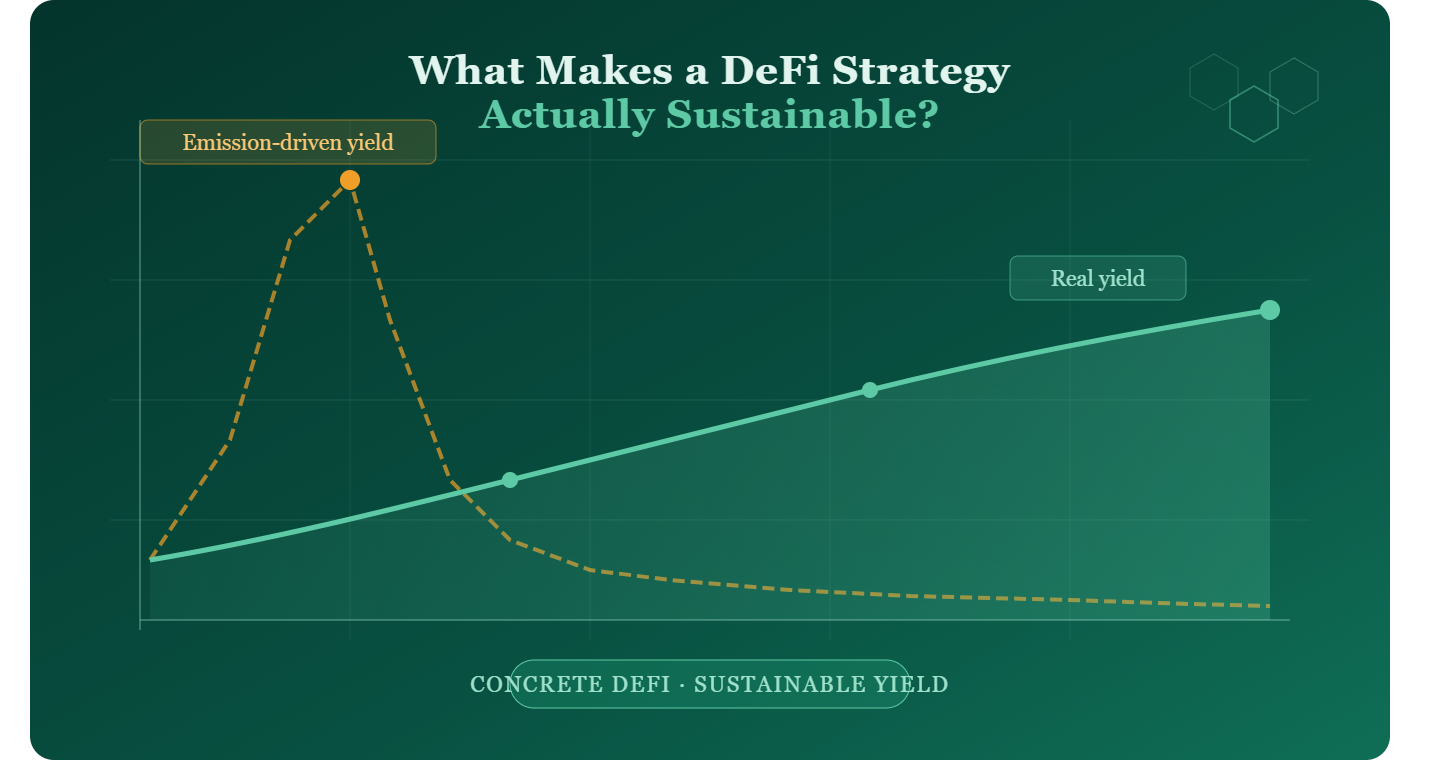
This yield is powerful — but finite.
Over time:
- Emissions decrease
- Token prices fluctuate
- Rewards lose attractiveness
Which is why emissions-driven yield tends to decay, while activity-driven yield tends to persist.
Sustainable strategies prioritize the latter.
Liquidity, Demand, and Market Conditions
Sustainability doesn’t exist in a vacuum — it depends on the environment.
Key factors include:
- Liquidity depth: Thin markets increase slippage and reduce efficiency
- User activity: More activity = more fee generation
- Volatility: Some strategies thrive in high volatility, others don’t
- Demand: Without demand, even well-designed strategies fail
Some DeFi strategies only work under very specific conditions.
Others are built to adapt.
The difference often determines whether a strategy lasts weeks — or years.
The Hidden Drag: Costs and Risks
A strategy might look great on paper — but reality is more complex.
Over time, performance is shaped by:
- Execution costs
- Rebalancing frequency
- Slippage
- Gas fees
- Changing correlations between assets
These factors quietly erode returns.
Which is why net yield matters more than headline APY.
True sustainability accounts for friction — not just opportunity.
From Opportunities to Systems
As DeFi matures, strategy design is evolving.
Instead of chasing isolated opportunities, sustainable approaches focus on:
- Diversification across strategies
- Continuous monitoring and adjustment
- Dynamic allocation of capital
- Focus on risk-adjusted yield, not peak returns
This is where DeFi begins to resemble traditional portfolio management — just executed onchain.
It’s less about reacting to the market, and more about building systems that operate within it.
The Role of Managed DeFi and Vaults
This shift is driving the rise of managed DeFi.
Rather than manually rotating between strategies, users can allocate capital into DeFi vaults that:
- Source yield from multiple protocols
- Optimize allocations dynamically
- Adapt to changing market conditions
- Reduce reliance on short-term incentives
This is where Concrete vaults come in.
They are designed around a simple idea:
Prioritize sustainable yield over temporary spikes.
By actively managing capital and focusing on durable strategies, vaults aim to provide a more stable DeFi experience.
A Practical Example: Stability Over Hype
Take Concrete DeFi USDT as an example.
- Targets up to ~8.5% yield
- Focuses on stable, activity-driven returns
- Avoids over-reliance on emissions
At first glance, it might not seem as exciting as triple-digit APYs.
But over time, consistency often outperforms volatility.
For long-term capital, predictability matters more than peaks.
This is what attracts more serious, institutional-aligned flows into DeFi.
The Bigger Shift in DeFi
DeFi is evolving.
We’re moving from:
- Short-term yield chasing
- Incentive-driven participation
- Fragmented opportunities
Toward:
- Long-term capital strategies
- Risk-aware allocation
- Sustainable yield generation
In this next phase, the winners won’t be the protocols offering the highest APY today.
They’ll be the ones building infrastructure that lasts.
Because in the end:
Sustainable strategies don’t just perform — they endure.
Explore Concrete at: https://app.concrete.xyz/earn