What Makes a DeFi Strategy Actually Sustainable?
 Faramade4 min read·Just now
--
Every week, a new protocol launches with eye-catching APYs. Capital floods in fast. Social timelines light up. Liquidity follows momentum, and for a brief moment, the numbers look unstoppable.
Then the cycle repeats.
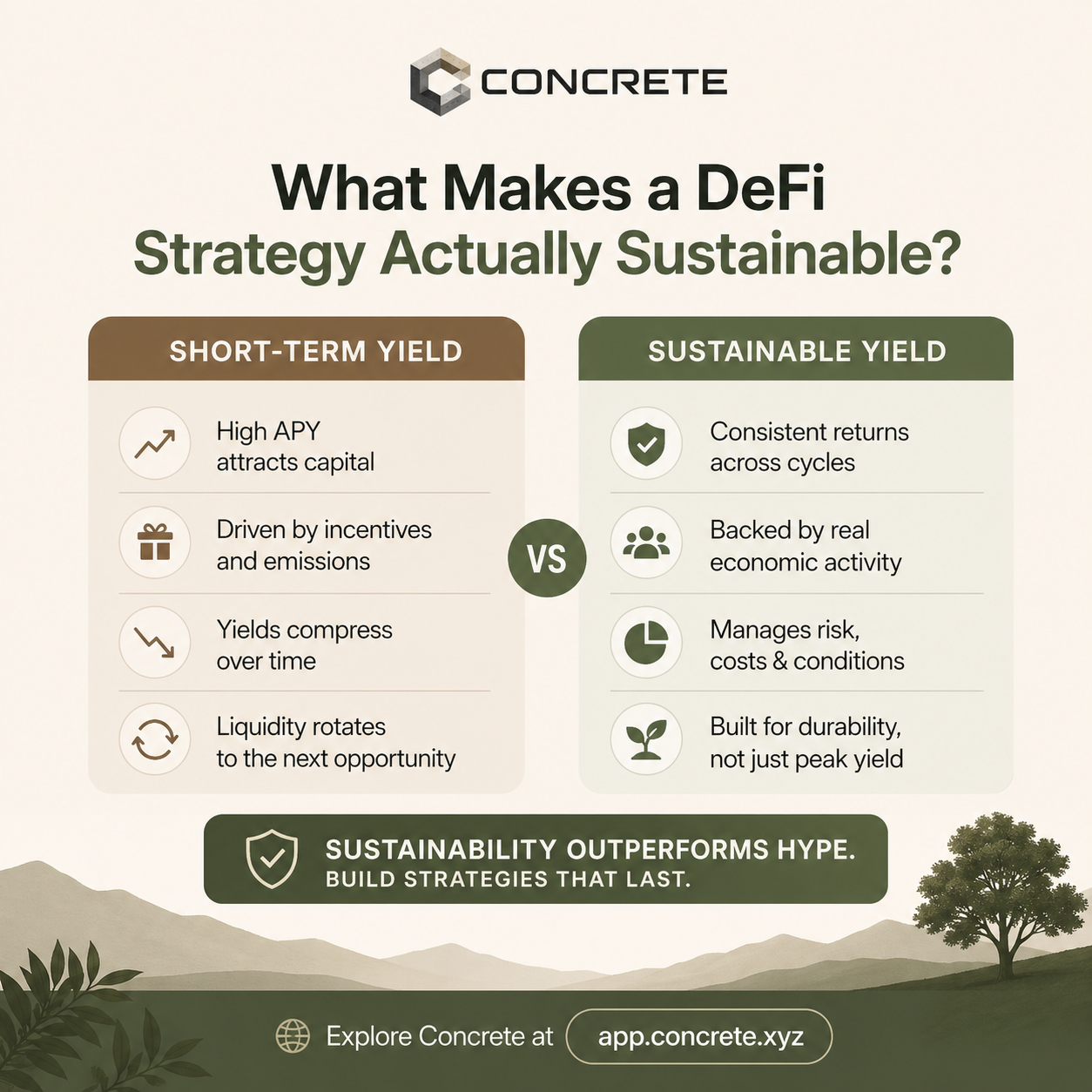
Yields compress. Incentives slow down. Liquidity rotates elsewhere. The strategy that looked unbeatable a month ago becomes irrelevant just as quickly as it arrived.
This has become one of the defining patterns of decentralized finance. The question is no longer where is the highest APY today? The better question is:
What actually lasts?
Because in mature financial markets, long-term winners are rarely the products with the loudest short-term returns. They are the systems that survive volatility, adapt across market cycles, and continue producing value over time.
That same shift is now happening in DeFi.
What Does Sustainable Yield Really Mean?
A sustainable yield strategy is not simply one with a high return. It is one that can continue generating returns through changing market conditions.
That means a strategy should be able to:
- Produce consistent returns over time
- Function without depending entirely on token incentives
- Remain viable in bull markets, bear markets, and sideways markets
- Deliver strong risk-adjusted yield, not just headline numbers
Sustainability is about durability. It asks whether a strategy still works when hype disappears.
Real Yield vs Temporary Yield
Not all yields are created equal.
Some returns come from real economic activity inside the market.
Examples include:
- Trading fees
- Lending demand
- Borrowing spreads
- Arbitrage opportunities
- Productive capital allocation
These forms of yield are linked to actual usage. As long as users trade, borrow, hedge, and move capital, these revenue streams can remain active.
Other yields come mainly from emissions or incentive programs. Protocols distribute tokens to attract liquidity, creating temporarily high returns.
This can be useful for bootstrapping growth, but it often fades quickly.
Once rewards decrease, many participants leave. Liquidity drops. Returns fall. What looked profitable was sometimes just subsidized.
That is why sustainable yield tends to come from activity, while temporary yield often comes from incentives.
Liquidity, Market Conditions, and Adaptability
Even strong strategies depend on environment.
A strategy may perform well when volatility is high but underperform when markets are calm. Another may rely on deep liquidity pools and become less efficient when volumes decline.
Sustainability often depends on factors such as:
- Liquidity depth
- Consistent user activity
- Volatility levels
- Borrow demand
- Cross-market inefficiencies
- Demand for the underlying strategy
Some DeFi strategies only work in specific windows.
Others adapt.
The most durable systems are flexible enough to allocate capital where conditions are strongest rather than relying on a single static source of return.
The Hidden Costs Many Investors Ignore
Many yields look attractive before costs are considered.
A strategy might advertise double-digit returns, but real performance can erode through:
- Execution fees
- Gas costs
- Slippage
- Rebalancing frequency
- Smart allocation errors
- Correlation shifts between assets
This is why net returns matter more than gross returns.
A sustainable strategy is one that accounts for friction, risk, and changing market structure, not just spreadsheet assumptions.
Better Strategy Design: From Opportunities to Systems
As DeFi matures, success is shifting away from chasing isolated opportunities and toward building systems for intelligent capital allocation.
That means:
- Diversifying across multiple yield sources
- Continuously monitoring markets
- Reallocating when conditions change
- Optimizing for net yield
- Managing downside risk
- Prioritizing long-term capital preservation
This is where managed DeFi becomes important.
Instead of manually rotating between protocols every week, users increasingly prefer infrastructure that can manage complexity on their behalf.
Why Concrete Vaults Matter
This is where Concrete vaults represent a meaningful evolution.
Rather than depending on one short-lived source of yield, vault structures aim to:
- Prioritize sustainable yield sources
- Allocate capital across multiple opportunities
- Adapt to market changes
- Reduce dependence on emissions-driven returns
- Improve efficiency in onchain capital deployment
That model matters not only for retail users, but also for growing interest in institutional DeFi, where consistency, transparency, and risk management are essential.
As capital becomes more sophisticated, infrastructure becomes more valuable than hype.
Concrete DeFi USDT: Sustainability in Practice
A useful example is Concrete DeFi USDT, which offers up to approximately 8.5% stable yield.
At first glance, that may look less exciting than a volatile farm promising dramatically higher APY. But over time, consistency often wins.
Why?
Because stable returns can:
- Compound more predictably
- Reduce downside exposure
- Attract long-term capital
- Improve portfolio planning
- Outperform unsustainable spikes that quickly collapse
This is one of the biggest lessons in finance: returns that last are often quieter than returns that trend online.
The Bigger Shift Ahead
DeFi is evolving.
It is moving away from short-term yield chasing and toward long-term capital strategy.
The next phase of growth will likely reward:
- Sustainable yield
- Reliable infrastructure
- Risk-aware systems
- Adaptive capital management
- Durable products that perform across cycles
The future of DeFi will not be defined by the highest APY on a random Tuesday.
It will be defined by the strategies that still work years from now.
Explore Concrete at app.concrete.xyz.