What Makes a DeFi Strategy Actually Sustainable?
--
DeFi is full of yield.
New protocols launch every week.
APYs spike.
Capital rushes in.
And then — almost predictably — yields compress, liquidity rotates, and the opportunity fades.
We’ve seen this cycle repeat across DeFi again and again:
- A new protocol offers high incentives
- Early capital captures outsized returns
- More users pile in
- Returns dilute
- Incentives dry up
- Capital exits
So the real question isn’t:
“What has the highest yield right now?”
It’s:
“What actually lasts?”
Defining Sustainability in DeFi
A sustainable DeFi strategy isn’t about short-term performance — it’s about durability.
At its core, sustainable yield should:
- Generate consistent returns over time
- Avoid heavy dependence on token incentives
- Remain viable across different market conditions
This is where risk-adjusted yield becomes more important than headline APY.
Because a strategy that earns 8% reliably is often stronger than one that spikes to 50% and collapses.
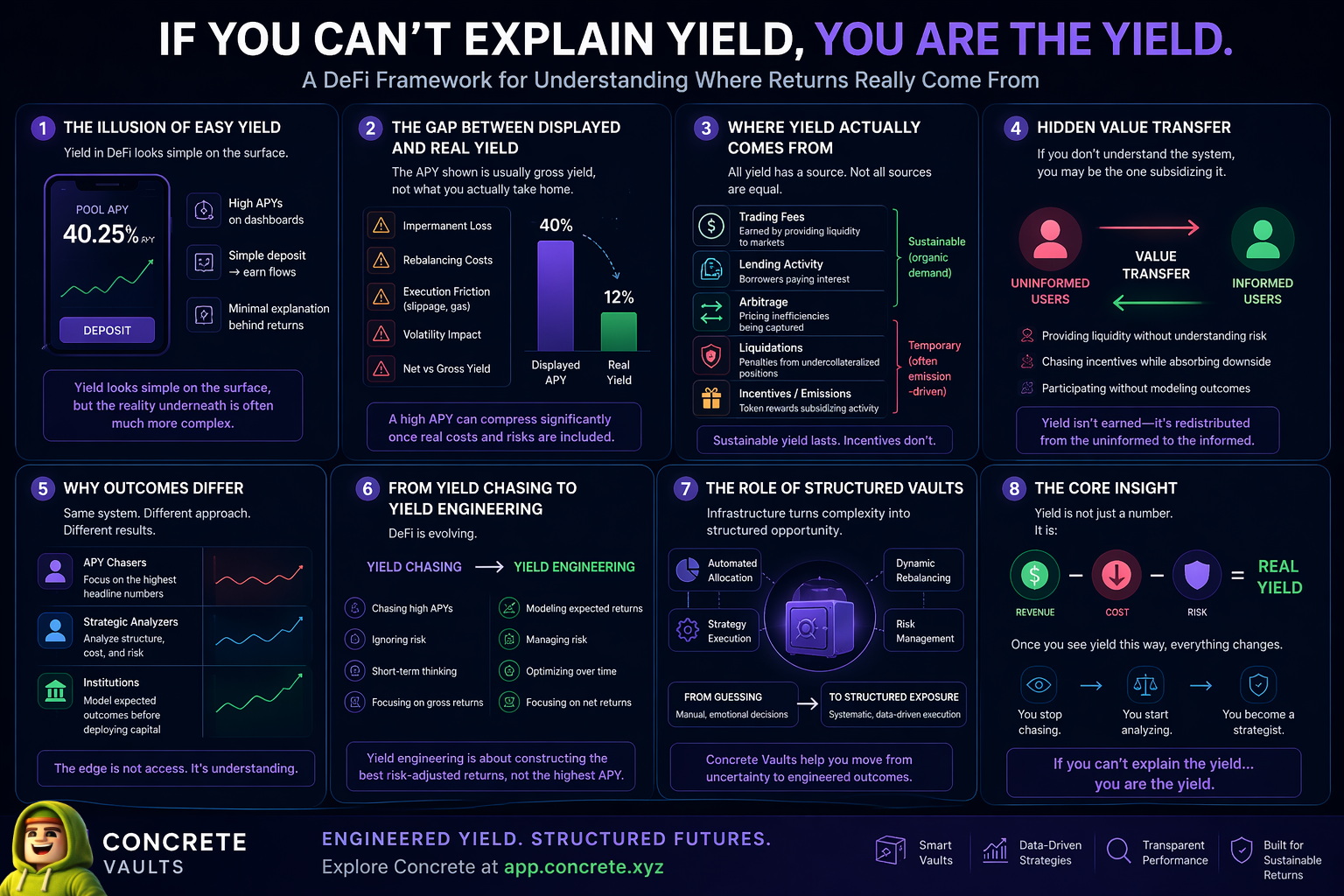
Real Yield vs Temporary Yield
Not all yield is created equal.
There are two primary sources:
1. Real Yield
Derived from actual economic activity:
- Trading fees
- Lending interest
- Arbitrage opportunities
This type of yield is tied to market demand, making it inherently more stable.
2. Incentive-Driven Yield
Derived from:
- Token emissions
- Liquidity mining rewards
This yield is often temporary.
Why?
Because emissions dilute over time. As more participants join, rewards shrink — and once incentives drop, liquidity disappears.
This is why many DeFi strategies fail:
They rely on subsidies, not sustainability.
The Role of Liquidity & Market Conditions
Sustainability is deeply tied to market structure.
Key factors include:
- Liquidity depth → shallow markets lead to instability
- User activity → no users = no real yield
- Volatility → some strategies thrive on it, others break
- Demand → without demand, returns vanish
Some strategies only work in bull markets.
Others only during high volatility.
But truly sustainable DeFi strategies adapt.
They aren’t dependent on one specific environment — they evolve with it.
Risk, Costs, and the Hidden Decay
Many strategies look great on paper — until reality kicks in.
Hidden factors that erode returns:
- Execution costs
- Slippage
- Rebalancing overhead
- Changing correlations
- Smart contract risks
Over time, these reduce net yield significantly.
This is why focusing only on APY is misleading.
What matters is:
👉 Net, risk-adjusted yield after costs
Designing Sustainable Strategies
Sustainable DeFi isn’t about chasing opportunities — it’s about building systems.
Strong strategies typically include:
- Diversification across multiple yield sources
- Continuous monitoring and adjustment
- Dynamic allocation based on market conditions
- Focus on net returns, not gross APY
This is where DeFi starts to resemble portfolio management, not speculation.
And where managed DeFi becomes essential.
The Role of DeFi Vaults
Instead of manually chasing yield, capital can be deployed through structured systems.
DeFi vaults aim to:
- Aggregate multiple strategies
- Optimize allocation dynamically
- Reduce reliance on incentives
- Focus on long-term sustainability
This is the shift from opportunity hunting → capital management.
Concrete Vaults and Sustainable Yield
This philosophy is central to Concrete vaults.
Rather than chasing peak returns, they are designed to:
- Prioritize sustainable yield sources
- Actively manage onchain capital
- Adapt to evolving market conditions
- Deliver risk-adjusted yield over time
This aligns closely with the direction of institutional DeFi, where consistency matters more than spikes.
A Real Example: Concrete DeFi USDT
Take Concrete DeFi USDT as a practical case.
- Offers up to ~8.5% stable yield
- Focuses on consistency rather than volatility
- Built for long-term capital allocation
At first glance, it may seem less exciting than high-APY farms.
But over time, stability often outperforms volatility.
Why?
Because consistent yield compounds — while unstable yield disappears.
And that’s what attracts serious capital.
The Bigger Shift in DeFi
DeFi is evolving.
We’re moving from:
- Short-term yield chasing
→ to long-term capital strategy
From:
- Incentive-driven ecosystems
→ to sustainable infrastructure
The future of DeFi will not be defined by:
❌ The highest APY
✔️ But by the strategies that endure across cycles
Because in the end:
Sustainability is the real alpha.
🚨 Explore Concrete at: https://app.concrete.xyz/earn 🚨