What Makes a DeFi Strategy Actually Sustainable ?
 Nguyenhint4 min read·Just now
--
DeFi is full of yield. New strategies launch every week. APYs spike. Capital flows in. But most of these strategies don’t last. Yields drop. Liquidity leaves. Opportunities disappear.
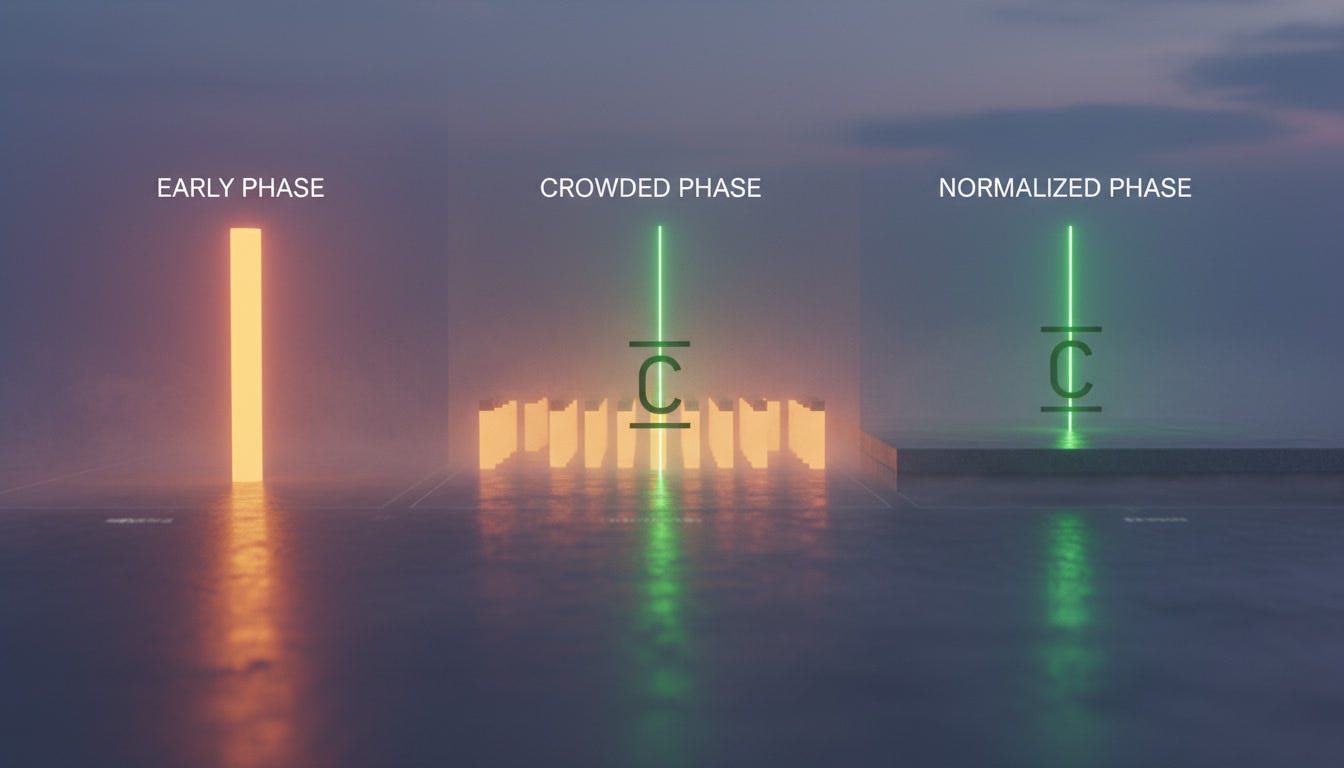
We’ve all watched the familiar cycle: a promising protocol or farm goes viral with eye-watering APYs, onchain capital pours in, and then often within weeks or months, yields compress sharply as competition intensifies or incentives taper off. Liquidity rotates to the next hot narrative, leaving behind empty pools and disappointed depositors. This pattern has repeated across bull and bear markets alike.
The real question isn’t “What has the highest yield?” It’s “What actually lasts?”
In mature financial systems, the best strategies might not be the ones that perform for a week, but the ones that survive across market cycles. So, what makes a DeFi strategy sustainable ?
Defining Sustainability in DeFi
A sustainable strategy generates consistent returns over time without collapsing when market conditions shift. It doesn’t depend entirely on temporary incentives. It remains viable across different regimes bull markets, bear markets, high volatility, and low liquidity periods.
Sustainability is about durability, not just raw performance. It means the underlying economics can support the yield long after the initial hype fades. True sustainable yield prioritizes risk-adjusted yield returns that account for volatility, drawdowns, and hidden costs over flashy headline APYs.
Real Yield vs. Temporary Yield
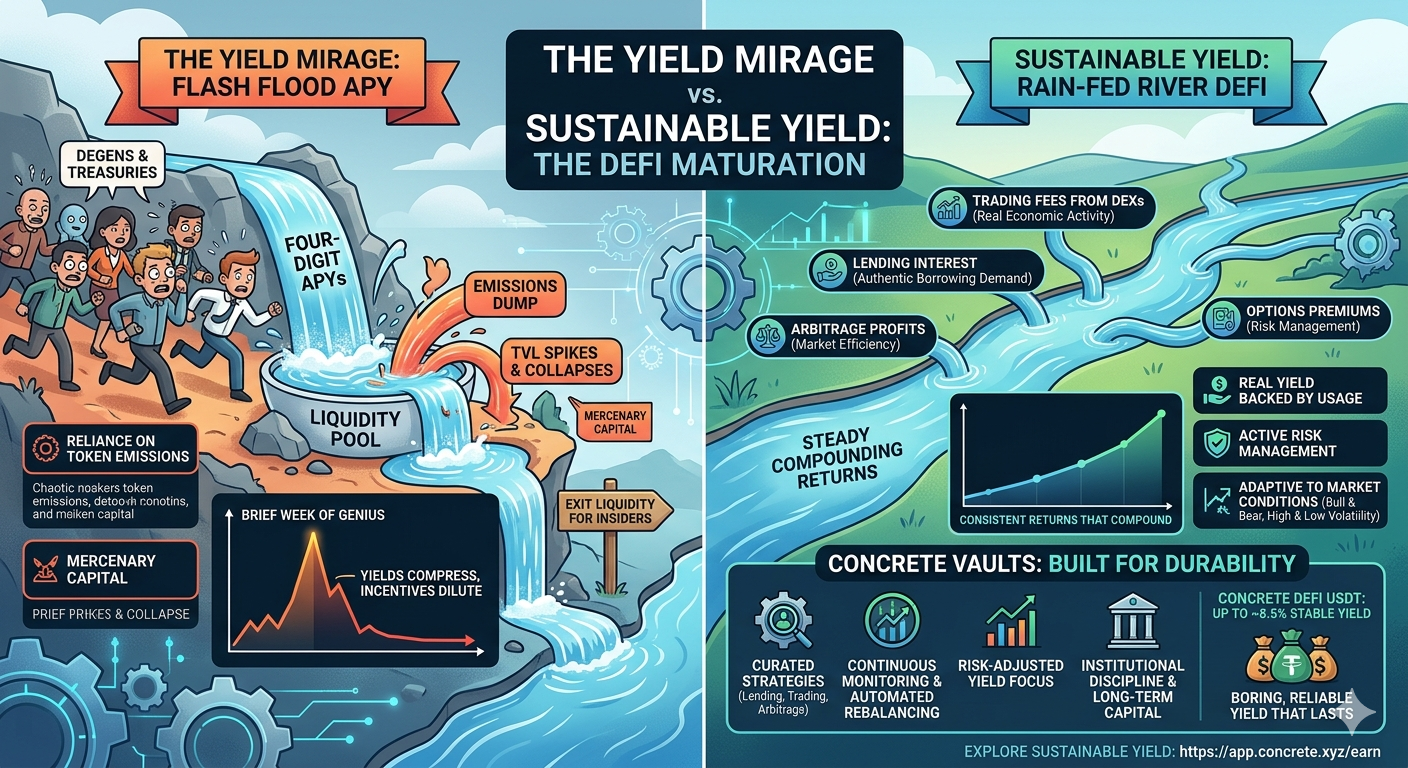
Not all yield is created equal. The key distinction lies between real yield generated from genuine economic activity and temporary yield driven by emissions or incentives.
- Real yield comes from actual protocol usage: lending interest, trading fees, arbitrage opportunities, or other productive onchain activity. When users borrow, trade, or use a service, fees flow naturally to liquidity providers or strategy participants. This yield tends to be more stable because it’s tied to real demand.
- Temporary yield, by contrast, relies heavily on token emissions, points programs, or short-term incentive campaigns. Protocols print tokens to attract liquidity, inflating APYs artificially. Once emissions slow or the token price corrects, yields collapse and liquidity flees.
Emissions-driven strategies often deliver explosive short-term gains but fade quickly. Real economic activity creates more persistent returns because it doesn’t require constant external subsidies. In the long run, strategies built on real yield prove far more resilient.
The Role of Liquidity and Market Conditions
Sustainability also hinges on liquidity depth, ongoing user activity, and adaptability to market volatility.
Some strategies thrive only in specific conditions such as low-volatility environments or when particular correlations hold. When volatility spikes or demand for the underlying asset dries up, these opportunities vanish. Others adapt: they diversify exposure, rebalance dynamically, or shift capital across protocols as conditions evolve.
Deep liquidity reduces slippage and improves execution. Strong user activity sustains fee generation. Strategies that ignore these factors may look profitable on paper but erode quickly in practice.
Risk and Cost Awareness
Even strong strategies can degrade once real-world frictions are factored in. Execution costs, frequent rebalancing, slippage on large positions, and changing asset correlations all eat into net returns.
A strategy boasting 50% APY might deliver far less after gas fees, impermanent loss, or liquidation risks. Sustainable approaches obsess over net returns rather than gross headline figures. They incorporate robust risk management position sizing, volatility targeting, and downside protection to preserve capital through cycles.
Building Better DeFi Strategies
Sustainable DeFi strategies emerge from thoughtful design rather than hype. Key elements include:
- Diversification across multiple yield sources
- Continuous monitoring and automated rebalancing
- Adaptation to shifting market dynamics
- A relentless focus on risk-adjusted yield and net performance
This is where DeFi begins to resemble professional asset management systems instead of isolated opportunities.
How Concrete Vaults Deliver Durability
Concrete vaults embody this philosophy. Rather than chasing peak yields, they prioritize sustainable yield sources, actively manage capital across strategies, and adapt to changing conditions while minimizing reliance on short-term incentives.
Concrete functions as institutional-grade onchain yield infrastructure. Its quantitative systems allocate, rebalance, and compound across vetted opportunities, emphasizing durability over speculation. By automating complex tasks and focusing on risk-adjusted yield, managed DeFi through Concrete helps capital persist across cycles.
Concrete DeFi USDT in Action
A clear example is the Concrete DeFi USDT vault. It targets up to ~8.5% stable yield through delta-neutral arbitrage and other low-volatility strategies on Ethereum. Recent realized yields have hovered around 7.5–8% annualized over 7- and 30-day periods, with significant TVL (over $60M).
While this may appear modest next to volatile high-APY farms, its consistency stands out. Stability compounds reliably over time and attracts long-term capital that avoids the boom-and-bust of incentive-driven plays. In uncertain markets, this kind of sustainable yield often outperforms flashy but fragile alternatives on a risk-adjusted basis. The vault reduces the burden of manual management while delivering predictable, managed DeFi exposure.
Explore Concrete at: https://app.concrete.xyz/earn
The Bigger Shift in DeFi
DeFi is maturing. The era of pure short-term yield chasing is giving way to long-term capital strategies where sustainability matters more than peak returns.
Infrastructure will outlast incentives. Protocols and products that deliver genuine economic value, robust risk management, and durable risk-adjusted yield will capture the next wave of onchain capital including from institutions seeking reliability.
The future of DeFi won’t be defined by the highest APY. It will be defined by the strategies and the vaults, that last.