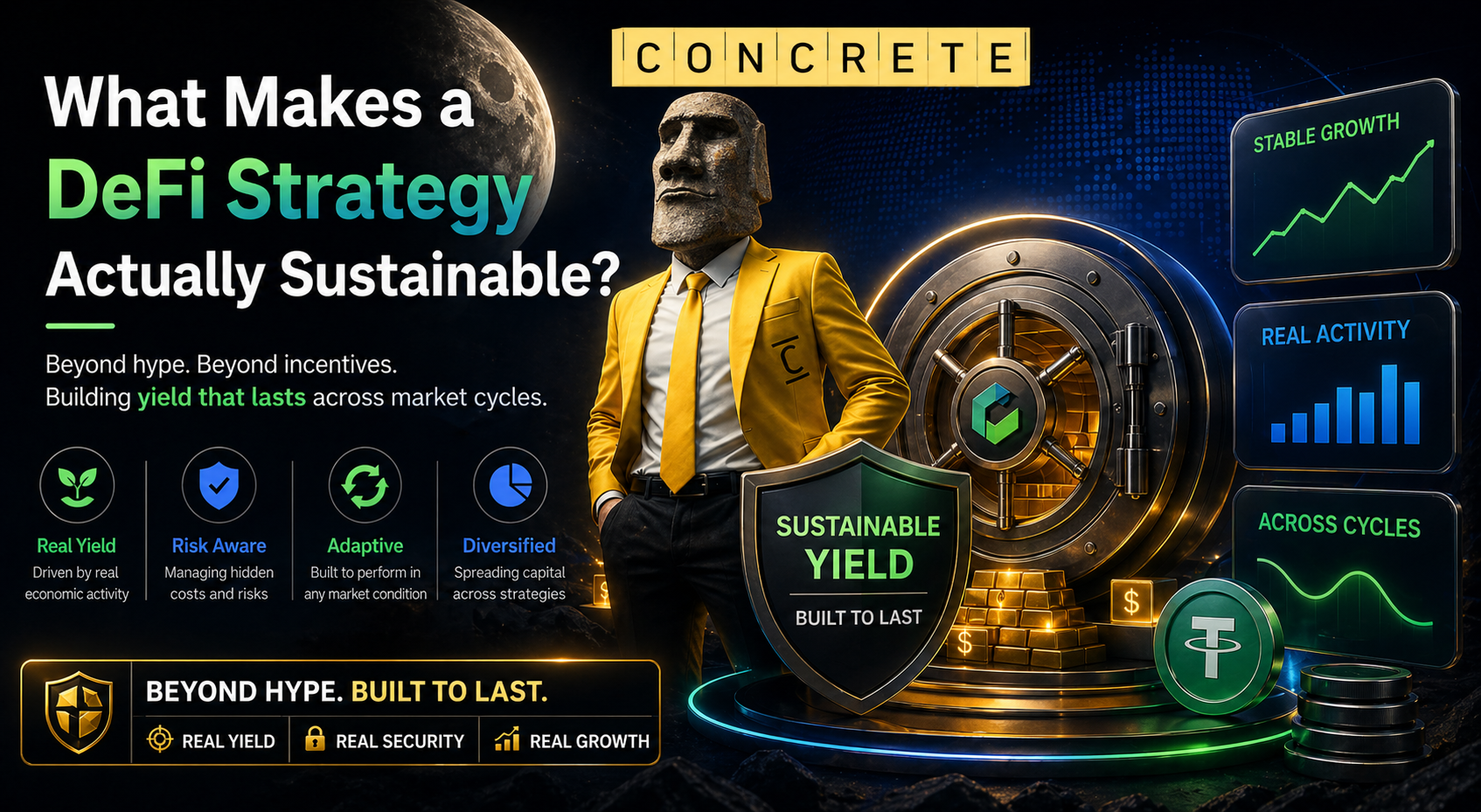
What Makes a DeFi Strategy Actually Sustainable?
--
Decentralized finance has never lacked opportunity. In fact, if anything, it has suffered from an overabundance of it. Every week, new protocols emerge with eye-catching promises — triple-digit APYs, innovative token mechanics, and narratives that pull in waves of onchain capital almost instantly. For a moment, everything works. Capital flows in, yields soar, and participants feel like they’ve discovered the next big edge.
Then the pattern repeats.
Yields compress. Liquidity thins out. Early participants exit. New opportunities emerge elsewhere. What once looked like a breakthrough becomes another short-lived experiment.
This cycle has defined DeFi since its earliest days. It’s not an exception — it’s the norm.
So the real question isn’t “What has the highest yield right now?” That question leads to short-term thinking and reactive capital allocation.
The more important question is: What actually lasts?
Because in any mature financial system, the most valuable strategies aren’t the ones that peak briefly — they’re the ones that endure across market cycles. Sustainability, not just performance, becomes the defining metric.
The Pattern: How DeFi Cycles Repeat
To understand sustainability, we first need to recognize the repeating structure of DeFi strategies.
A new protocol launches with aggressive incentives. Token emissions drive high yields, sometimes exceeding 100% APY. Early adopters rush in, attracted by the outsized returns. Liquidity pools deepen quickly, and activity spikes.
As more capital enters, the yield naturally declines. Emissions are spread across a larger base, and the initial inefficiencies disappear. At the same time, participants begin to anticipate the decline and position themselves to exit early.
Eventually, the incentives lose their effectiveness. Liquidity rotates elsewhere, chasing the next opportunity. The protocol is left with reduced activity and a much lower yield profile.
This pattern repeats across lending platforms, liquidity pools, yield farms, and even newer innovations. It’s not necessarily a flaw — it’s a reflection of how incentives and capital interact in open markets.
But it raises an important question:
Why do most DeFi strategies fade so quickly?
Defining Sustainability in DeFi
Sustainability in DeFi is often misunderstood. It’s not about avoiding risk entirely, nor is it about maintaining a fixed yield indefinitely.
Instead, a sustainable DeFi strategy has three defining characteristics:
1. Consistent Returns Over Time
The strategy produces stable, predictable outcomes across different market conditions, rather than extreme highs followed by sharp declines.
2. Independence from Incentives
It does not rely entirely on token emissions or short-term rewards to generate returns. Incentives can enhance a strategy, but they should not be its foundation.
3. Adaptability Across Market Cycles
The strategy remains viable in both bullish and bearish environments, adjusting to changes in liquidity, volatility, and user behavior.
In simple terms, sustainability is about durability. It’s the difference between a strategy that works briefly and one that continues to function even as the market evolves.
Real Yield vs Temporary Yield
One of the clearest ways to distinguish sustainable strategies from short-lived ones is by examining the source of yield.
Not all yield is created equal.
Temporary yield is typically driven by emissions and incentives. Protocols distribute tokens to attract liquidity, creating artificially high returns. While this can be effective in the short term, it is inherently unsustainable. As emissions decrease or token prices fall, the yield declines.
Real yield, on the other hand, comes from actual economic activity. This includes trading fees, lending interest, arbitrage opportunities, and other forms of value generation within the system.
The key difference lies in sustainability:
- Emissions-based yield tends to decline over time as incentives are reduced.
- Real yield is tied to ongoing demand and usage, making it more stable.
This doesn’t mean emissions are useless — they can bootstrap a network and attract early users. But a strategy that depends entirely on incentives is unlikely to endure.
Sustainable yield comes from economic activity, not just distribution mechanisms.
The Role of Liquidity and Market Conditions
Even strategies built on real yield are not immune to change. Sustainability depends heavily on the environment in which a strategy operates.
Several factors play a critical role:
Liquidity Depth
Deep liquidity reduces slippage and enables efficient execution. Shallow markets, by contrast, can erode returns quickly as trades impact prices.
User Activity
Strategies tied to trading or lending depend on consistent user engagement. Without activity, even well-designed systems can struggle to generate yield.
Market Volatility
Some strategies thrive in volatile environments, while others perform better in stable conditions. A sustainable approach must account for these dynamics.
Demand for the Strategy
If a strategy solves a real problem — such as providing liquidity or enabling borrowing — it is more likely to persist. If it exists purely for speculative gain, its lifespan may be limited.
The most resilient DeFi strategies are those that can adapt. They don’t rely on a single set of conditions but instead adjust as the market evolves.
The Hidden Costs of DeFi Strategies
One of the most overlooked aspects of sustainability is the impact of costs and risks that aren’t immediately visible.
A strategy might appear highly profitable on paper, but its real-world performance can be significantly lower once these factors are considered:
Execution Costs
Transaction fees can eat into returns, especially for strategies that require frequent adjustments.
Rebalancing
Maintaining optimal allocations often involves continuous rebalancing, which introduces both costs and complexity.
Slippage
In less liquid markets, large trades can move prices, reducing the effectiveness of a strategy.
Changing Correlations
Assets that appear uncorrelated in one market environment may move together in another, increasing risk.
These elements highlight an important point: headline APY is not the same as net return.
A sustainable strategy must account for these factors from the outset. Otherwise, its performance will degrade over time, even if the underlying idea remains sound.
Designing for Sustainability
If sustainability is the goal, then strategy design must evolve beyond simple yield chasing.
The most effective approaches tend to share several characteristics:
Diversification
Spreading capital across multiple strategies reduces reliance on any single source of yield.
Continuous Monitoring
Markets change rapidly. Strategies must be actively managed to remain effective.
Adaptability
Rather than being fixed, strategies should evolve in response to new conditions and opportunities.
Focus on Net Returns
What matters is not the highest possible yield, but the most reliable outcome after accounting for all costs and risks.
This is where DeFi begins to resemble more traditional financial systems — not in structure, but in philosophy. It becomes less about isolated opportunities and more about integrated systems of capital management.
The Role of Managed DeFi and Vaults
As the complexity of DeFi grows, the need for structured approaches becomes more apparent.
Managed DeFi solutions, particularly vaults, are designed to address this challenge. Instead of requiring individuals to constantly monitor and adjust their positions, vaults automate strategy execution and optimization.
The goal is not just to capture yield, but to do so in a way that is sustainable over time.
This involves:
- Allocating capital across multiple strategies
- Adjusting positions based on market conditions
- Reducing exposure to short-term incentives
- Prioritizing consistent, risk-adjusted yield
In this context, DeFi vaults represent a shift from manual participation to systematic capital management.
How Concrete Vaults Approach Sustainability
Concrete vaults are built with this philosophy in mind.
Rather than chasing the highest possible APY, they focus on identifying and maintaining sustainable yield sources. This means prioritizing strategies that generate real economic value and remain viable across different market conditions.
Key principles include:
Capital Allocation Across Strategies
Instead of relying on a single opportunity, capital is distributed to balance risk and return.
Adaptation to Market Changes
Strategies are continuously evaluated and adjusted as conditions evolve.
Reduced Reliance on Incentives
While incentives may be utilized when beneficial, they are not the primary driver of returns.
Focus on Durability
The goal is to create a system that performs consistently over time, rather than peaking briefly.
This approach reflects a broader shift in DeFi — from experimentation to infrastructure.
A Practical Example: Stable Yield with USDT
To understand the value of sustainability, it helps to look at a concrete example.
A product offering around ~8.5% stable yield on USDT may not generate the same excitement as a triple-digit APY farm. But over time, its consistency can lead to better outcomes.
Why?
Because stability compounds.
High-yield strategies often come with volatility, risk, and uncertainty. Returns can fluctuate dramatically, and timing becomes critical. By contrast, a stable yield provides predictability, making it easier to plan and manage capital.
For many participants — especially those thinking long-term — this reliability is more valuable than short-term spikes.
It also attracts a different kind of capital. Instead of opportunistic liquidity, it draws participants who are focused on risk-adjusted yield and long-term growth.
The Shift Toward Long-Term Thinking
DeFi is evolving.
In its early stages, the focus was on innovation and experimentation. High yields were a natural byproduct of this phase, as protocols competed for attention and liquidity.
But as the ecosystem matures, the emphasis is beginning to shift.
Participants are asking more sophisticated questions:
- How sustainable is this strategy?
- What are the underlying sources of yield?
- How does it perform across different market conditions?
- What are the true risks and costs?
This shift reflects the emergence of onchain capital as a long-term asset class, rather than a purely speculative arena.
Institutional DeFi is also playing a role, bringing expectations of stability, transparency, and risk management.
Why Sustainability Will Define the Future of DeFi
The next phase of DeFi will not be defined by the highest APY.
It will be defined by the strategies that endure.
Short-term opportunities will always exist. They are an essential part of an open financial system. But they will no longer be the primary focus for serious capital.
Instead, the emphasis will be on:
- Sustainable yield
- Risk-adjusted performance
- Systematic strategy design
- Long-term capital preservation
Infrastructure will outlast incentives. Systems will replace isolated opportunities. And the most successful participants will be those who prioritize durability over excitement.
Final Thoughts
DeFi has reached a point where the question is no longer “What can generate yield today?” but “What can continue to generate yield tomorrow?”
Sustainability is the answer.
It requires a deeper understanding of how strategies work, where yield comes from, and how markets evolve. It demands a shift from reactive behavior to deliberate design.
And it rewards those who think beyond the next cycle.
Explore Concrete at: https://app.concrete.xyz/earn