What Makes a DeFi Strategy Actually Sustainable?
 Ali Nurdin3 min read·Just now
--
DeFi doesn’t lack yield.
If anything, there’s too much of it.
Every week, new strategies appear with compelling APYs. Capital moves quickly, chasing whatever looks best in the moment. For a short window, returns look strong.
Then the pattern repeats.
Yields fall. Liquidity exits. Attention shifts elsewhere.
It raises a simple but important question:
What actually lasts in DeFi?
The Cycle Behind the Opportunity
Most DeFi strategies follow a predictable cycle.
It begins with high returns — often supported by incentives or early inefficiencies. Early participants benefit, and capital starts to flow in.
As participation increases:
- returns compress
- incentives get diluted
- competition increases
- liquidity rotates
What looked like a strong opportunity turns out to be temporary.
This cycle isn’t random. It’s built into how DeFi evolves.
Which is why sustainability matters.
Defining Sustainable Yield
When we talk about sustainable yield, we’re not talking about the highest number on a dashboard.
We’re talking about consistency.
A sustainable strategy is one that:
- generates returns over time, not just briefly
- doesn’t rely entirely on incentives to function
- continues to operate across different market conditions
It’s about durability.
Because over time, consistency tends to outperform short-lived spikes.
Real Yield vs Incentive-Driven Yield
One of the clearest ways to understand sustainability is to look at the source of yield.
Some returns come from real economic activity:
- trading fees
- lending demand
- arbitrage opportunities
These are tied to usage, which gives them a more stable foundation.
Other returns come from incentives:
- token emissions
- liquidity mining rewards
- short-term capital attraction mechanisms
These can create high APYs, but they’re often temporary.
When incentives fade, so does the yield.
That’s why risk-adjusted yield is more meaningful than raw APY.
It reflects both return and reliability.
The Role of Market Conditions
No strategy operates in a vacuum.
Performance depends on external factors:
- liquidity depth
- user activity
- volatility
- demand for the underlying strategy
Some strategies only perform well under specific conditions.
When those conditions change, performance drops.
More sustainable strategies are adaptable.
They adjust to different environments rather than depending on one favorable scenario.
The Cost Layer That Erodes Returns
Another reason strategies fail to last is cost.
On paper, returns can look strong.
But in reality, several factors reduce performance:
- execution costs
- rebalancing frequency
- slippage
- changing asset correlations
These aren’t always visible in headline APY.
But over time, they have a significant impact.
A strategy that ignores cost may look attractive initially — but struggle to maintain performance.
From Chasing Yield to Structuring It
Sustainable DeFi strategies are rarely built around a single opportunity.
They’re structured.
They often include:
- diversification across multiple approaches
- continuous monitoring and adjustment
- adapting to changing market conditions
- focusing on net returns instead of gross yield
At this stage, DeFi becomes less about finding the next opportunity — and more about managing onchain capital effectively.
The Role of Concrete Vaults
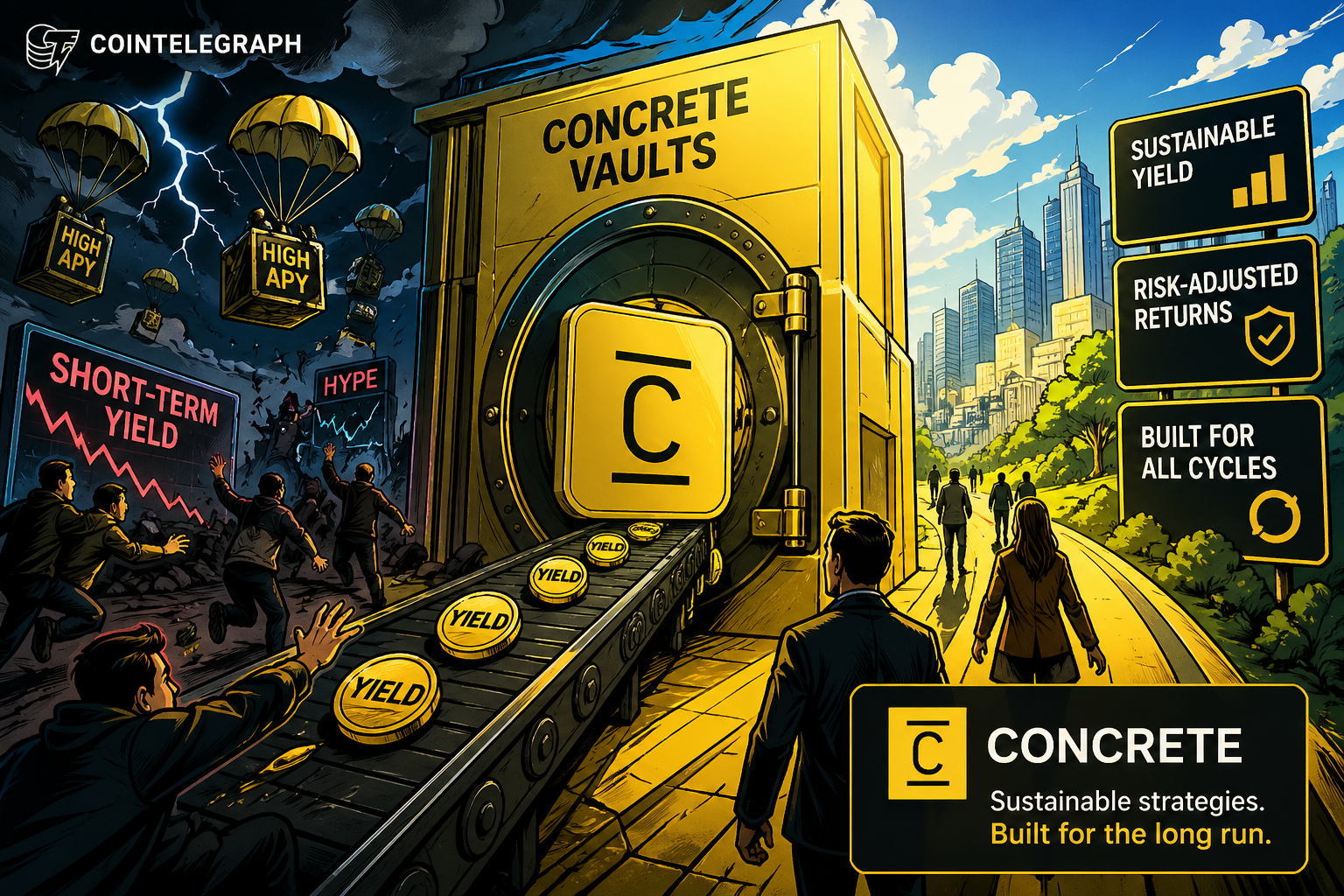
This is where Concrete vaults come in.
Instead of focusing on short-term opportunities, they are designed to prioritize sustainability.
Through a managed DeFi approach, Concrete vaults aim to:
- allocate capital across multiple strategies
- focus on more durable yield sources
- adapt as conditions change
- reduce reliance on temporary incentives
Users don’t need to constantly reposition capital.
Instead, they interact with structured DeFi vaults designed for capital efficiency and consistent risk-adjusted yield.
A Real Example: Concrete DeFi USDT
Consider Concrete DeFi USDT, offering up to around 8.5% stable yield.
Compared to higher APY strategies, it may seem less aggressive.
But over time, consistency matters.
A stable return that performs across different market conditions can outperform more volatile strategies that rely on short-term incentives.
This is especially relevant as DeFi evolves toward institutional DeFi, where predictability and reliability are key.
The Bigger Shift
DeFi is maturing.
The early phase was driven by experimentation and yield discovery.
The next phase is about sustainability.
- from short-term yield chasing
- to long-term strategy design
- from incentives
- to durable systems
In this shift, the most valuable strategies won’t be the ones with the highest peaks.
They’ll be the ones that continue to deliver — across cycles, across conditions, and over time.
Because in the end, what defines a strong strategy isn’t how high it goes.
It’s how long it can last.
Explore Concrete at: https://app.concrete.xyz/earn