What Makes a DeFi Strategy Actually Sustainable?
--
DeFi moves fast.
Every week, new strategies emerge with eye-catching APYs. Capital floods in, dashboards light up, and for a moment, it feels like easy money.
Then it fades.
Yields compress. Liquidity rotates. Attention shifts. The cycle repeats.
We’ve all seen this pattern:
- a new protocol launches with high incentives
- capital rushes in to capture yield
- rewards get diluted
- participants exit for the next opportunity
So the real question isn’t:
“What has the highest yield right now?”
It’s:
“What actually lasts?”
The Pattern Behind Short-Term Yield
Most DeFi strategies today are built for attraction, not retention.
High APYs are often designed to bootstrap liquidity quickly. Incentives pull users in, but they rarely create long-term economic value. Once emissions slow or stop, the strategy loses its core driver.
This creates a structural issue:
yield without durability.
And that’s why most strategies fade as quickly as they appear.
What Does Sustainable Actually Mean?
A sustainable DeFi strategy isn’t about peak performance. It’s about consistency.
At its core, sustainable yield should:
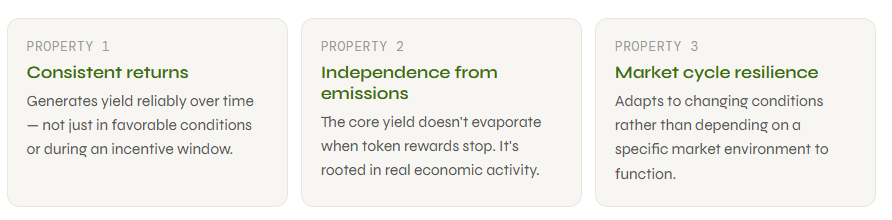
- generate reliable returns over time
- avoid total dependence on token incentives
- remain viable across different market conditions
This is where the idea of risk-adjusted yield becomes important.
Because a 50% APY that lasts two weeks is often worse than a steady 8% that compounds over years.
Durability beats spikes.
Real Yield vs Temporary Yield
Not all yield is created equal.
There’s a fundamental difference between:
Real Yield
- generated from actual economic activity
- trading fees, lending interest, arbitrage spreads
- tied to real demand and usage
Temporary Yield
- driven by token emissions or liquidity incentives
- dependent on continued capital inflow
- declines as incentives dry up
Emissions-based yield is powerful for growth, but fragile.
Real yield, on the other hand, is grounded in usage. And usage tends to persist longer than hype.
The Role of Liquidity and Market Conditions
Even strong strategies depend heavily on their environment.
Sustainability is shaped by:
liquidity depth → shallow markets break under pressure
user activity → no users, no fees, no yield
volatility → some strategies need movement, others need stability
demand → without it, returns collapse
Some strategies only work in bull markets.
Others survive sideways conditions.
Very few adapt across all cycles.
The ones that do are the ones worth paying attention to.
Risk and the Hidden Cost of Yield
A strategy can look great on paper and still fail in practice.
Why?
Because of overlooked factors like:
- execution costs
- rebalancing frequency
- slippage
- changing correlations between assets
These slowly eat into returns.
What starts as attractive yield often degrades into something much smaller once real-world conditions apply.
That’s why sustainable strategies focus on net returns, not headline APY.
From Opportunities to Systems
This is where DeFi is evolving.
The shift is subtle, but important:
From chasing individual opportunities
→ to building systems that manage them
Sustainable strategy design includes:
- diversification across multiple yield sources
- continuous monitoring and adjustment
- adapting to market changes
- focusing on long-term capital efficiency
This is what managed DeFi starts to look like.
Not just reacting to markets, but structuring around them.
Where Vaults Come In
This is the role of DeFi vaults.
Instead of requiring users to actively chase yield, vaults:
- allocate capital across strategies
- optimize for sustainable yield
- adjust positions as conditions change
- reduce reliance on short-term incentives
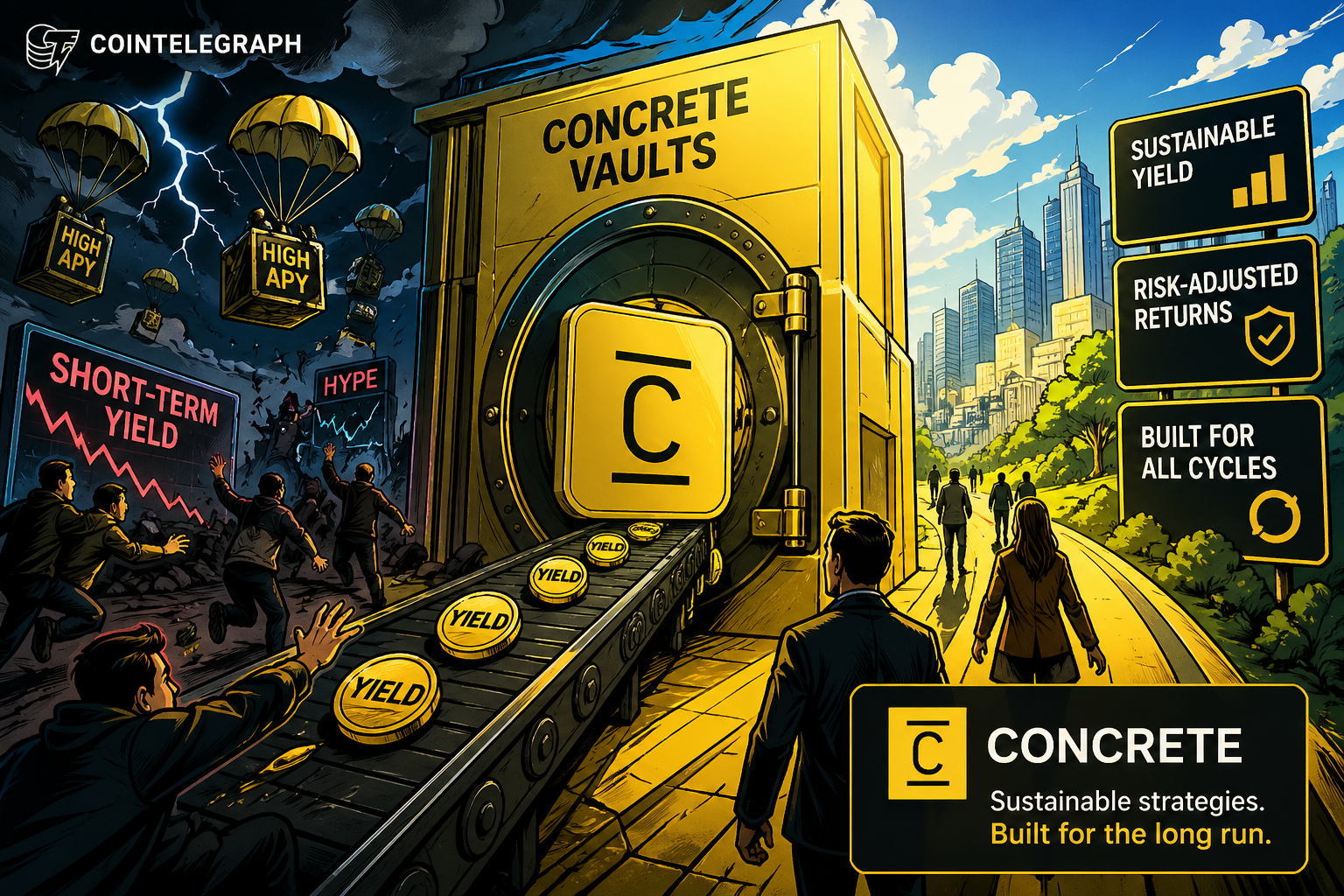
Concrete vaults are built with this mindset.
They prioritize durability over peak performance, aiming to create a more stable foundation for onchain capital.
A Practical Example: Stability Over Hype
Take Concrete DeFi USDT as an example.
It offers around ~8.5% stable yield.
At first glance, that might not seem exciting compared to triple-digit APYs elsewhere.
But zoom out.
A consistent, stable return
- compounds over time
- avoids volatility-driven losses
- attracts long-term capital
And over multiple market cycles, that consistency often outperforms short bursts of high yield.
Because sustainability isn’t about being the highest.
It’s about being reliable.
The Bigger Shift
DeFi is maturing.
The focus is slowly moving:
- from short-term yield chasing
- toward long-term capital strategies
In this next phase:
- sustainable yield will matter more than peak APY
- risk-adjusted yield will define better decisions
- infrastructure will outlast incentives
The strategies that survive across cycles will shape the future of DeFi.
Not the loudest ones.
The lasting ones.
Explore Concrete at: app.concrete.xyz/earn