Wealth Success: WealthK Trader Stories
 Wealth K Trading8 min read·Just now
--
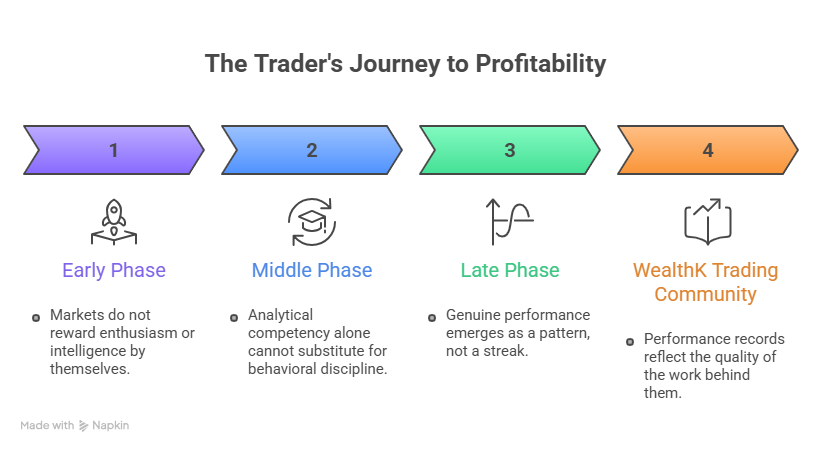
Every trader who reaches consistent profitability arrives there by a path that looks different in its surface details but shares the same underlying structure. The early phase involves overconfidence, underprepared strategies, and the painful discovery that markets do not reward enthusiasm or intelligence by themselves. The middle phase involves the difficult work of understanding what went wrong, rebuilding analytical frameworks, and developing the behavioral discipline that analytical competency alone cannot substitute. The late phase involves the gradual compounding of sound decisions across enough trades and enough market conditions for genuine performance to emerge as a pattern rather than a streak.
WealthK Trading has built its platform around traders at every stage of this progression. The stories that emerge from within the WealthK Trading community do not follow the promotional formula of overnight success or dramatic single-trade wealth creation. They follow the more honest and more instructive pattern of traders who developed genuine competency through structured effort and emerged from that development with performance records that reflect the quality of the work behind them.
What Trader Stories Actually Teach
The value of examining trader development journeys is not motivational. It is analytical. Experienced traders who reflect on their development with honesty provide a map of the cognitive and behavioral errors that markets consistently punish, the corrective processes that address those errors, and the performance characteristics that emerge when corrections are successfully implemented.
Research consistently shows that the errors separating unprofitable from profitable traders are not primarily analytical. Two traders using the same strategy and the same platform regularly produce dramatically different results over time. Barber and Odean’s landmark behavioral finance research demonstrated that the gap between intention and execution, driven by cognitive biases and emotional responses to market volatility, accounts for a significant portion of the underperformance that retail traders experience relative to the mechanical systems they claim to follow. The traders within the WealthK Trading community who have developed sustainable performance records did not primarily do so by finding better setups. They did so by developing better execution of the setups they already had.
The First Pattern: Overleverage and Its Consequences
One of the most consistent themes across trader development stories within the WealthK Trading community involves the early relationship with leverage. CFD trading provides access to leverage ratios that amplify both gains and losses proportionally, and the traders who enter the market without a developed framework for calibrating leverage to their actual skill level and account size encounter the consequences of that omission quickly.
The behavioral pattern that precedes leverage-related account damage is predictable. Early trades produce gains that feel like evidence of analytical skill but are more accurately described as evidence that the trader happened to take positions that aligned with short-term market direction during a favorable period. This confirmation of ability encourages position size increases that are not supported by the actual edge the trader has demonstrated over a statistically meaningful sample. When market conditions shift, the same leverage ratios that created outsized gains during the favorable period create outsized losses that disproportionately damage capital.
Traders who develop within the WealthK Trading framework report that the corrective process for leverage-related damage involves redefining position sizing from the perspective of acceptable capital risk per trade rather than from the perspective of available margin. The difference is significant. Sizing from available margin asks how large a position the account can support. Sizing from acceptable capital risk asks how large a position should be given that a fully executed stop loss represents a predetermined percentage of total capital, typically between one and two percent per trade. This reorientation from exposure maximization to capital preservation logic is the practical change that separates traders who compound through leverage from those who are periodically reset by it.
The Second Pattern: Strategy Drift and the Cost of Inconsistency
A second theme that emerges consistently from WealthK Trading community development stories involves the relationship between strategy and execution. Traders who have invested genuine effort in developing analytical frameworks and entry criteria regularly report a gap between the performance those frameworks produce in back-testing and the performance they produce in live trading. The gap is not primarily a product of strategy quality. It is a product of execution consistency.
Strategy drift takes several forms in live trading. Entering trades that partially but not fully satisfy entry criteria represents one form, typically driven by impatience or the fear of missing a move. Exiting winning trades before predetermined targets are reached represents another form, driven by the risk aversion that watching paper profits fluctuate during normal in-trade volatility creates. Holding losing trades past established stop levels represents the most consequential form, driven by the loss aversion that behavioral finance research has documented as one of the most powerful cognitive biases affecting financial decision-making.
Kahneman and Tversky’s foundational research established that losses feel psychologically approximately twice as painful as equivalent gains feel rewarding. This asymmetry creates systematic pressure toward holding losing trades in the hope of recovery rather than accepting the smaller defined loss that stop discipline requires. The traders within the WealthK Trading community who have developed past this pattern consistently report that the resolution came not from emotional change but from systematic change. Automating stop orders at position entry, maintaining trading journals that record deviations from plan criteria alongside their outcomes, and reviewing that journal data periodically to establish the P&L impact of specific behavioral patterns created the accountability infrastructure that emotional discipline attempts but inconsistently delivers.
The Third Pattern: Market Condition Awareness and Strategy Calibration
A third development pattern that WealthK Trading community traders describe involves the discovery that strategies delivering consistent performance in one market condition type produce inconsistent or negative performance when conditions shift. This is not a flaw in the strategy. It is a fundamental characteristic of trading strategies that all traders encounter eventually and that underprepared traders discover too late into a drawdown to respond constructively.
Trend-following strategies that generate strong performance during established directional moves in indices or currency pairs produce false signals and whipsaw losses during choppy, range-bound conditions whose price action lacks the directional conviction that trend-following entry criteria are calibrated to identify. Mean-reversion strategies that perform well during consolidation phases with identifiable boundaries produce sustained losses during trending conditions whose continued directional pressure overwhelms the reversion logic that range-bound behavior validated.
The traders who have developed market condition awareness within the WealthK Trading framework describe a process of explicitly classifying the current market environment before strategy deployment rather than applying strategies uniformly regardless of conditions. This classification uses the volatility characteristics, trend strength indicators, and price structure analysis that distinguish trending from ranging conditions at the current timeframe, then matches strategy selection to the identified condition type. It is a more demanding analytical process than single-strategy deployment, but it produces the performance consistency across full market cycles that condition-agnostic strategy application cannot.
The Fourth Pattern: The Role of Platform and Infrastructure
A dimension of trader development that receives less attention than analytical and psychological factors but appears consistently in WealthK Trading community stories involves the relationship between platform quality and trading outcome. Traders who have operated across multiple platforms describe a meaningful difference in performance attributable not to strategy quality but to execution infrastructure.
The sources of this infrastructure influence are specific. Execution speed during high-volatility market conditions determines whether entries and exits occur at intended prices or at the slippage-adjusted prices that slow execution during fast markets creates. The availability and reliability of conditional order types including stop-loss, take-profit, and trailing stop orders determines whether risk management rules are implemented automatically or depend on the manual intervention that attention limitations and emotional states compromise. The analytical tool quality available for pre-trade research and position monitoring determines whether the preparation that supports sound trading decisions is efficient or impaired by platform limitations.
WealthK Trading’s infrastructure investment addresses each of these dimensions with the execution quality, order management capability, and analytical depth that serious CFD trading demands. The traders within the WealthK community who identify platform improvements as a component of their development progress typically describe the specific ways that operational friction reduction allowed them to focus on analytical and behavioral quality rather than managing the platform limitations that inferior infrastructure creates.
What Consistent Performance Actually Looks Like
The traders within the WealthK Trading community who have developed genuinely consistent performance share characteristics that differ from the popular conception of trading success in instructive ways. Their win rates are not unusually high. Research consistently documents that experienced profitable traders regularly win fewer than half of their trades, with the profitability of those approaches built on the asymmetry between average win size and average loss size rather than on the frequency of wins. Traders who have reached consistency within the WealthK framework describe win rates between forty and sixty percent as typical, with the consistent profitability of those ranges built on position management discipline that cuts losses at defined levels and allows winning trades sufficient room to reach their analytical targets.
Their trading activity levels are not unusually high. The most consistent performers within the WealthK Trading community describe selective engagement with setups that fully satisfy their criteria rather than continuous market presence driven by the need to be active. Warren Buffett’s observation that investing is a no-called-strikes game applies directly to active CFD trading: the capacity to wait for high-quality setups without the impatience that forces participation in lower-quality ones is a behavioral characteristic that consistently profitable traders have developed and that the market rewards structurally.
Their development timelines are not unusually short. The traders who describe sustainable performance in the WealthK Trading community consistently report development periods of twelve to twenty-four months from serious analytical study and demo trading through the early live trading phase to genuine performance consistency. This timeline reflects the genuine complexity of developing the analytical, executional, and psychological competencies that CFD trading demands across diverse market conditions, not inadequate effort or talent deficiency.
Final Perspective
The trader stories that emerge from within the WealthK Trading community teach the same core lessons through different surface experiences. Analytical competency is necessary but not sufficient for trading success. The behavioral discipline to execute strategies with consistency across the full range of market conditions and emotional states that live trading creates is the competency that differentiates traders who develop genuine performance from those who possess analytical frameworks that their own behavior prevents from producing the results those frameworks contain.
WealthK Trading provides the market access, execution infrastructure, analytical tools, and educational frameworks that support this complete development. The traders within its community who have built sustainable performance records did not do so through shortcuts, exceptional natural talent, or favorable market conditions that their peers lacked. They did so through the systematic development of the complete trader competency that genuine performance requires, supported by the platform infrastructure and community context that WealthK Trading has built around that development process.