Vendor Reconciliation vs Bank Reconciliation: What Finance Teams Need to Check Differently
 Emily Carter5 min read·Just now
--
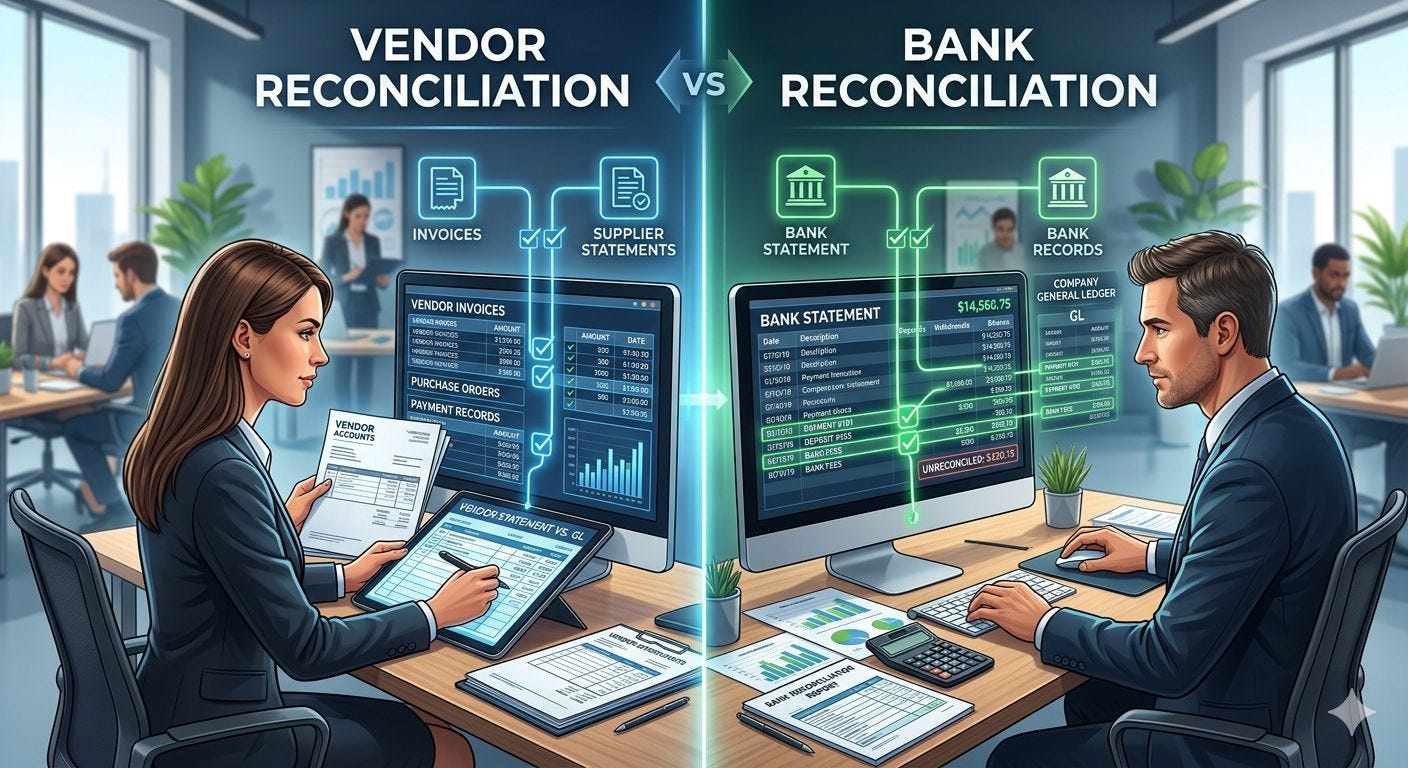
Finance teams often treat reconciliation as a single activity, yet different reconciliation types demand very different checks. When vendor and bank reconciliations are handled with the same approach, mismatches remain unresolved, close cycles stretch, and financial accuracy suffers. The issue is not effort but focus. Each reconciliation type operates on different data, timing, and risk areas. Without recognizing these differences, teams end up validating the wrong things while missing critical discrepancies.
This article explains how vendor reconciliation and bank reconciliation differ, what finance teams must check in each case, and how these checks impact financial accuracy, close timelines, and decision-making.
What Is Vendor Reconciliation?
Vendor reconciliation focuses on aligning payable records with vendor statements.
Definition of Vendor Reconciliation in Accounts Payable
It involves matching internal accounts payable data with vendor-provided statements.
Matching Vendor Statements with Internal Records
Invoices, payments, and adjustments are compared across systems.
Role of Vendor Reconciliation in Payables Accuracy
It ensures that liabilities are correctly recorded and payments are accurate.
To understand its specifics, refer to this detailed guide on vendor reconciliation.
What Is Bank Reconciliation?
Bank reconciliation focuses on aligning cash records with bank statements.
Definition of Bank Reconciliation in Cash Management
It compares internal cash records with bank transaction data.
Matching Bank Statements with Ledger Balances
Each transaction is verified against bank entries.
Role of Bank Reconciliation in Cash Accuracy
It ensures the reported cash position is correct.
For a clearer view of how this works in practice, this guide on bank reconciliation walks through the process in detail.
Why Vendor and Bank Reconciliation Are Often Confused
Both processes involve matching records, which leads to confusion.
Similar Objective of Matching Records
Both aim to identify mismatches between systems.
Overlap in Financial Close Processes
They are often performed during the same reporting cycle.
Differences Hidden Within Workflow Details
Despite similar goals, the underlying checks differ significantly.
This distinction becomes clearer when comparing their core purpose.
Core Difference Between Vendor and Bank Reconciliation
The difference lies in what is being validated.
Third-Party Statement vs Financial Institution Record
Vendor reconciliation uses supplier statements, while bank reconciliation uses bank data.
Liability Tracking vs Cash Balance Validation
Vendor reconciliation focuses on payables, bank reconciliation focuses on cash.
Frequency and Timing of Reconciliation Activities
Vendor checks depend on invoice cycles, while bank checks follow transaction timelines.
Understanding this difference helps define what to verify in each process.
What Finance Teams Must Check in Vendor Reconciliation
Vendor reconciliation requires detailed invoice-level validation.
Invoice-Level Matching Across Records
Each invoice must match vendor records.
Credit Notes, Discounts, and Adjustments
All adjustments must be reflected accurately.
Open Payables and Outstanding Balances
Unpaid invoices must align with vendor statements.
This level of detail is not required in bank reconciliation.
What Finance Teams Must Check in Bank Reconciliation
Bank reconciliation focuses on transaction-level validation.
Deposits, Withdrawals, and Transaction Entries
Each transaction must match bank records.
Bank Fees, Charges, and Interest Adjustments
Charges and interest must be accounted for.
Timing Differences and Uncleared Transactions
Pending transactions must be tracked carefully.
These checks highlight the difference in data sources.
Data Sources Used in Vendor vs Bank Reconciliation
Each process relies on distinct inputs.
Vendor Statements, Invoices, and AP Ledgers
Vendor reconciliation uses payable-related data.
Bank Statements, Cash Ledgers, and Payment Records
Bank reconciliation uses transaction-level data.
Integration with ERP and Accounting Systems
Both processes rely on system integration but with different data flows.
This impacts how matching is performed.
Matching Complexity in Vendor vs Bank Reconciliation
The complexity varies significantly.
Line-Item Matching Across Multiple Invoices
Vendor reconciliation often requires detailed matching.
Transaction-Level Matching in Bank Statements
Bank reconciliation focuses on individual transactions.
Handling Partial Matches and Aggregated Entries
Both processes require handling incomplete matches differently.
Timing also plays a critical role.
Timing Differences That Impact Each Reconciliation Type
Timing gaps create mismatches.
Delayed Invoice Posting and Vendor Updates
Vendor records may not be updated immediately.
Payment Processing Delays in Banking Systems
Transactions may appear later in bank statements.
Cut-Off Timing During Month-End Close
Timing differences affect reporting accuracy.
These issues are especially visible during month-end reconciliation cycles.
Common Errors in Vendor Reconciliation
Vendor reconciliation errors often stem from documentation issues.
Missing or Duplicate Invoices
Invoices may be incorrectly recorded.
Incorrect Invoice Amounts or Tax Values
Amounts may not match vendor records.
Unrecorded Vendor Adjustments
Adjustments may be missed entirely.
Bank reconciliation errors differ in nature.
Common Errors in Bank Reconciliation
Bank reconciliation errors are transaction-focused.
Missing Transactions in Ledger Records
Transactions may not be recorded internally.
Incorrect Bank Charges or Fees
Charges may be misreported.
Duplicate or Reversed Entries
Transactions may be recorded incorrectly.
These errors lead to different types of impact.
Impact of Vendor Reconciliation Errors on Finance
Vendor errors affect liabilities and relationships.
Overstated or Understated Payables
Financial records become inaccurate.
Delays in Vendor Payments and Relationships
Vendor trust may be affected.
Risk of Duplicate Payments
Incorrect payments may occur.
Bank reconciliation errors impact cash visibility.
Impact of Bank Reconciliation Errors on Finance
Bank errors affect cash accuracy.
Incorrect Cash Position Reporting
Cash balances may be misstated.
Misalignment in Financial Statements
Reports may not reflect reality.
Risk of Fraud or Unauthorized Transactions
Unusual transactions may go unnoticed.
Both processes play a role in financial close.
Role of Vendor Reconciliation in Financial Close
Vendor reconciliation ensures payable accuracy.
Ensuring Accuracy of Accounts Payable Balances
Balances must match vendor records.
Aligning Vendor Records Before Reporting
Records must be verified before close.
Reducing Last-Minute Adjustments
Early checks prevent late corrections.
Bank reconciliation complements this process.
Role of Bank Reconciliation in Financial Close
Bank reconciliation ensures cash accuracy.
Validating Cash Balances Before Close
Balances must align with bank records.
Ensuring Ledger and Bank Alignment
All transactions must match.
Supporting Accurate Financial Reporting
Reports depend on correct cash data.
Despite similarities, process differences remain.
What Finance Teams Should Check Differently
Clear separation of focus improves accuracy.
Vendor Reconciliation Focus on Invoice-Level Accuracy
Teams must verify detailed payable records.
Bank Reconciliation Focus on Cash-Level Accuracy
Teams must validate transaction-level data.
Separate Workflows for Distinct Objectives
Each reconciliation type requires its own approach.
Conclusion
Vendor reconciliation and bank reconciliation serve different purposes, even though both involve matching records. Vendor reconciliation focuses on invoice-level accuracy and payable balances, while bank reconciliation validates transaction-level cash data. Treating them as identical processes leads to missed discrepancies, delayed close cycles, and inaccurate reporting.
Finance teams that align their checks with the purpose of each reconciliation type improve accuracy, reduce rework, and strengthen financial control. Clear separation of workflows, combined with consistent validation practices, ensures both payables and cash positions remain reliable across reporting cycles.