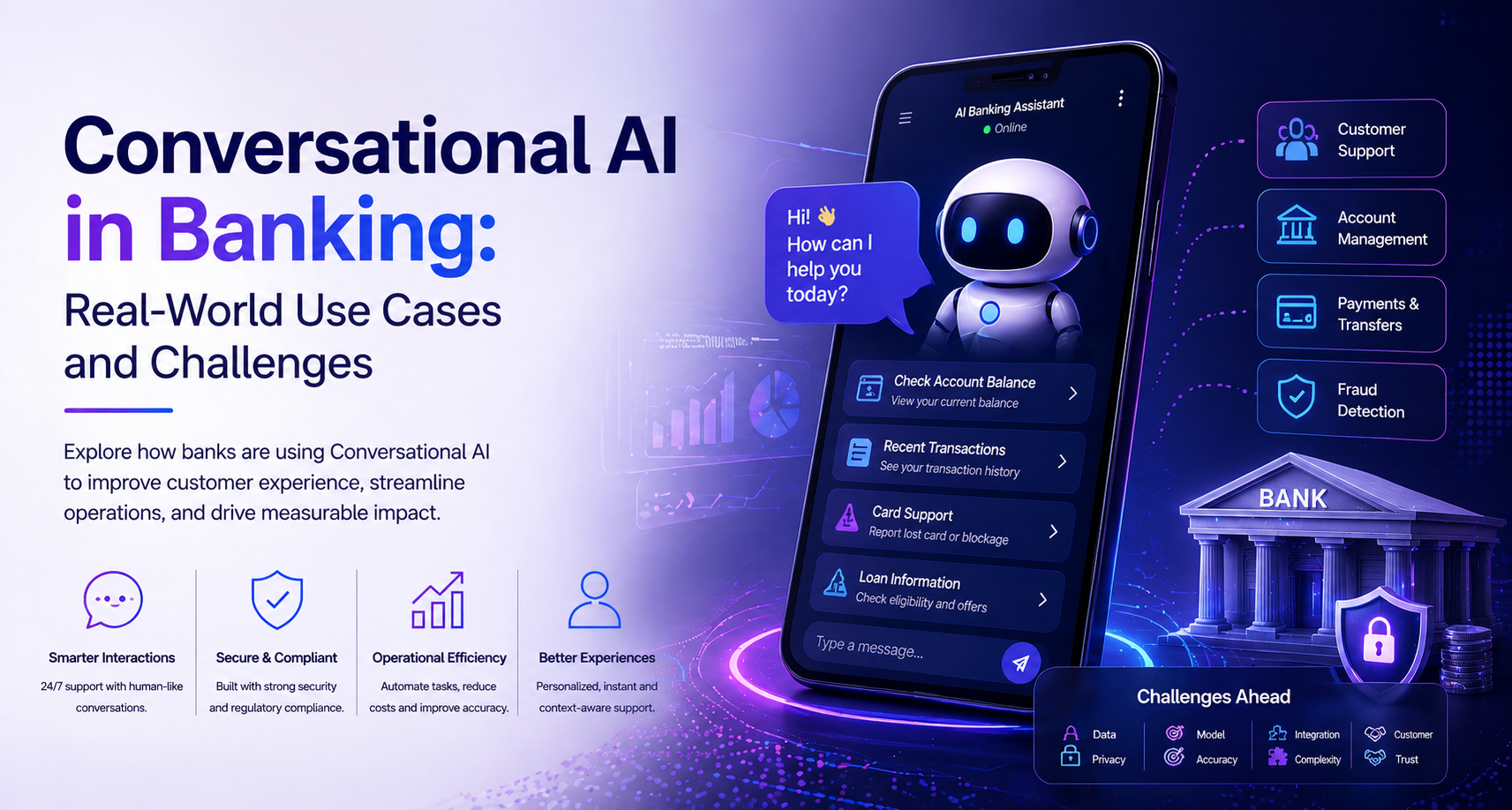
Conversational AI in Banking: Real-World Use Cases and Challenges
 Daksh Rautela8 min read·Just now
--
The banking industry is undergoing one of the biggest digital transformations in its history. Customer expectations have changed dramatically over the last few years, and traditional banking models are no longer enough to meet modern demands. Today’s customers expect instant responses, personalized experiences, seamless digital interactions, and 24/7 access to financial services. At the same time, banks are under pressure to reduce operational costs, improve efficiency, strengthen security, and stay competitive in a rapidly evolving financial ecosystem.
This is where Conversational AI is creating a major impact.
Conversational AI is transforming how banks interact with customers by enabling intelligent, human-like conversations across digital channels. Unlike traditional chatbots that rely on predefined scripts, modern conversational AI systems use technologies such as Natural Language Processing (NLP), Machine Learning (ML), and Large Language Models (LLMs) to understand context, process intent, and provide more accurate and personalized responses.
In 2026, conversational AI is no longer limited to answering basic customer queries. Banks are now using AI-driven conversational systems for customer onboarding, loan assistance, fraud alerts, financial advisory, payment support, internal operations, and even autonomous banking workflows.
However, despite its advantages, implementing conversational AI in banking is not without challenges. Financial institutions must address concerns related to security, compliance, privacy, integration complexity, trust, and accuracy.
This article explores conversational AI in banking in detail, including how it works, its real-world use cases, benefits, implementation challenges, and the future of AI-powered banking experiences.
Understanding Conversational AI in Banking
Conversational AI refers to intelligent systems capable of interacting with users through natural language conversations. These systems can operate across multiple channels such as:
- Mobile banking apps
- Websites
- Messaging platforms
- Voice assistants
- Customer support systems
Unlike traditional rule-based chatbots, conversational AI systems understand intent and context. They can process user queries dynamically, learn from interactions, and improve over time.
In banking, conversational AI combines multiple technologies including:
- Natural Language Processing (NLP)
- Machine Learning
- Speech Recognition
- Sentiment Analysis
- AI Reasoning Systems
- Large Language Models
This allows banks to create highly personalized and efficient customer experiences while automating repetitive tasks and reducing manual workloads.
Why Conversational AI is Growing in Banking
The banking sector is particularly well-suited for conversational AI adoption because customer interactions are frequent, repetitive, and often data-driven. Banks manage millions of customer requests daily, ranging from balance inquiries to loan applications and fraud-related concerns.
Several factors are driving the adoption of conversational AI in banking.
One of the biggest drivers is customer expectation. Modern customers want instant service without waiting in call center queues or visiting branches. Conversational AI enables banks to provide immediate support at any time.
Operational efficiency is another major factor. AI-powered systems can automate routine interactions, allowing human employees to focus on higher-value tasks. This reduces operational costs while improving service quality.
Banks are also increasingly focused on personalization. Conversational AI systems can analyze customer behavior, transaction history, and preferences to provide more relevant recommendations and financial guidance.
The rise of digital banking and mobile-first experiences has further accelerated the need for intelligent conversational interfaces.
How Conversational AI Works in Banking
Conversational AI systems in banking operate through multiple interconnected layers.
The first layer is user interaction, where customers communicate through text or voice. The system then processes the input using Natural Language Processing to understand intent, context, and meaning.
The AI system may then interact with:
- Core banking systems
- CRM platforms
- Fraud detection systems
- Payment gateways
- Customer databases
Once the required information is retrieved, the AI generates a response and performs the requested action if authorized.
Advanced conversational AI systems can also:
- Maintain conversation context
- Understand sentiment
- Escalate complex cases to human agents
- Trigger workflows automatically
This creates a more natural and efficient customer experience.
Real-World Use Cases of Conversational AI in Banking
Conversational AI is already transforming multiple areas within the banking industry.
Customer Support Automation
One of the most common applications of conversational AI in banking is customer support. Banks receive large volumes of repetitive queries related to account balances, transaction history, card status, branch information, and password resets.
Conversational AI systems can handle these interactions instantly without human intervention. Customers receive faster responses, while banks reduce call center workload and operational costs.
Modern AI systems can also:
- Understand customer intent more accurately
- Handle multilingual conversations
- Transfer complex issues to human agents when necessary
This improves both efficiency and customer satisfaction.
AI-Powered Virtual Banking Assistants
Banks are increasingly deploying AI-powered virtual assistants within mobile banking applications. These assistants act as personalized financial support systems that help users manage their banking activities more effectively.
Virtual banking assistants can:
- Provide account summaries
- Analyze spending behavior
- Send payment reminders
- Recommend savings strategies
- Assist with financial planning
Some advanced systems even provide proactive insights, such as notifying users about unusual spending patterns or suggesting investment opportunities.
This creates a more engaging and intelligent banking experience.
Loan and Credit Assistance
Applying for loans is often a time-consuming process involving multiple steps and documentation requirements. Conversational AI simplifies this process significantly.
AI systems can:
- Guide users through loan applications
- Collect required information
- Verify eligibility
- Explain interest rates and repayment options
- Update customers on application status
By automating these interactions, banks reduce processing time while improving user experience.
Conversational AI also helps customers better understand financial products, which improves transparency and trust.
Fraud Detection and Security Alerts
Fraud prevention is a major priority for financial institutions. Conversational AI plays an important role in identifying suspicious activities and communicating with customers in real time.
For example, if an unusual transaction occurs, the AI system can instantly contact the customer to verify whether the transaction is legitimate.
AI-driven fraud systems can:
- Detect suspicious patterns
- Trigger security workflows
- Block unauthorized transactions
- Assist users with account recovery
This helps reduce fraud-related losses while improving customer confidence.
Payment and Transaction Assistance
Conversational AI is making digital payments more seamless and intuitive.
Customers can:
- Transfer money using voice or text commands
- Schedule recurring payments
- Check transaction history
- Track payment status
This simplifies banking interactions and improves convenience, especially within mobile banking environments.
Customer Onboarding and KYC Automation
Banks often struggle with lengthy onboarding and KYC (Know Your Customer) processes. Conversational AI helps streamline these workflows by guiding users through verification steps and collecting required documents automatically.
AI systems can:
- Explain onboarding requirements
- Validate submitted information
- Assist with identity verification
- Reduce onboarding time significantly
This improves operational efficiency while creating a smoother customer experience.
Internal Banking Operations
Conversational AI is not limited to customer-facing interactions. Banks are also using AI internally to improve employee productivity and operational workflows.
Internal AI assistants can help employees:
- Access policy information
- Retrieve customer data
- Generate reports
- Automate repetitive administrative tasks
This reduces manual effort and improves efficiency across departments.
Benefits of Conversational AI in Banking
Conversational AI provides several important advantages for banks and financial institutions.
One of the biggest benefits is improved customer experience. Customers receive faster, more personalized support without long wait times.
Another major advantage is operational efficiency. AI systems automate repetitive interactions, reducing the burden on customer support teams and lowering operational costs.
Banks also benefit from:
- 24/7 service availability
- Improved scalability
- Faster response times
- Better fraud prevention
- Personalized financial experiences
Conversational AI also supports digital transformation initiatives by making banking more accessible and efficient.
Challenges of Implementing Conversational AI in Banking
Despite its advantages, implementing conversational AI in banking comes with several challenges.
Data Privacy and Security
Banks handle highly sensitive financial information. Conversational AI systems must comply with strict security and privacy regulations.
Any vulnerability in the system can lead to:
- Data breaches
- Financial fraud
- Regulatory penalties
- Loss of customer trust
This makes security one of the most critical considerations.
Regulatory Compliance
The banking industry operates under strict compliance requirements related to:
- Data protection
- Financial reporting
- Customer verification
- Fraud prevention
AI systems must align with these regulations while maintaining transparency and accountability.
Accuracy and Hallucination Risks
AI systems can sometimes generate incorrect or misleading responses, especially when handling complex financial queries.
In banking, inaccurate information can create serious financial and legal consequences. This makes validation and monitoring essential.
Integration Complexity
Banks often rely on legacy systems and fragmented infrastructure. Integrating conversational AI into these environments can be technically challenging.
AI systems must connect securely with:
- Core banking platforms
- Payment systems
- Customer databases
- Fraud monitoring systems
This requires careful architecture planning.
Building Customer Trust
Many customers still prefer human interactions for sensitive financial matters. Banks need to ensure that AI systems feel reliable, transparent, and trustworthy.
Maintaining a balance between automation and human support is critical.
Also Read: Conversational AI & Multi-agent AI for 24/7 banking assistance
Best Practices for Conversational AI in Banking
To implement conversational AI successfully, banks should follow several best practices.
First, they should start with clearly defined use cases rather than trying to automate every process at once. Focusing on high-impact workflows improves adoption and results.
Banks should also prioritize security and compliance from the beginning. AI systems must include strong authentication, encryption, and governance frameworks.
Continuous monitoring and improvement are equally important. AI systems should be evaluated regularly to improve accuracy and reduce errors.
Another best practice is maintaining human-in-the-loop systems for sensitive or complex interactions. This ensures that customers can escalate issues to human agents when necessary.
Finally, personalization should be balanced with privacy. Customers value tailored experiences, but they also expect responsible handling of their data.
Future of Conversational AI in Banking
The future of conversational AI in banking is moving toward more intelligent, proactive, and autonomous systems.
Future banking AI systems will likely:
- Provide proactive financial guidance
- Manage complex workflows autonomously
- Support multimodal interactions
- Integrate deeply with digital ecosystems
- Enable AI-driven financial advisory services
The rise of Agentic AI will further expand capabilities by allowing conversational systems to execute tasks, coordinate workflows, and make decisions with greater autonomy.
As AI technology evolves, conversational interfaces may become the primary way customers interact with banks.
Role of AI Development Companies
Building enterprise-grade conversational AI systems requires expertise in AI architecture, banking integrations, compliance, and security. This is why many financial institutions partner with AI-focused development companies like Technoyuga to accelerate implementation and reduce operational risk.
Experienced AI partners help banks:
- Design scalable AI architectures
- Integrate AI with banking systems
- Ensure compliance and security
- Optimize conversational workflows
- Improve long-term scalability
This allows financial institutions to move from experimentation to real-world AI adoption more effectively.
Best Read: Conversational AI in Fraud Management: Can your Bots keep your Customers safe?
Conclusion
Conversational AI is transforming the banking industry by enabling faster, smarter, and more personalized customer interactions. From customer support and fraud detection to loan assistance and financial advisory services, AI-driven conversational systems are becoming an essential part of modern banking operations.
However, successful implementation requires more than simply deploying chatbots. Banks must address security, compliance, integration complexity, and customer trust while designing systems that deliver measurable value.
As AI technology continues evolving, conversational AI will move beyond reactive support systems toward intelligent financial assistants capable of managing workflows and driving operational efficiency autonomously.
The future of banking will not be defined only by digital platforms.
It will be defined by intelligent conversations powered by AI.