Unlocking Financial Data: Building a RAG Pipeline with LangChain and Gemini
--
A deep dive into Retrieval-Augmented Generation for Financial Organizations — how it works, why it matters, and what it takes to go to production.
In the highly regulated world of finance, organizations are drowning in unstructured data. Compliance guidelines, risk policies, audit reports, and legal contracts span thousands of pages of dense text. Finding a specific regulatory requirement or verifying a compliance policy can take hours of manual reading.
Enter Retrieval-Augmented Generation (RAG). RAG is a powerful AI architecture that allows organizations to “chat” with their own private documents, returning highly precise answers backed by citations.
In this article, we’ll explore how RAG works using a recent Proof-of-Concept (PoC) built with LangChain, ChromaDB, and Google’s Gemini, discuss how financial institutions can leverage this technology, and highlight the critical missing pieces needed to take a PoC to a production-ready enterprise solution.
How Does RAG Actually Work? (The PoC Architecture)
At its core, RAG solves the primary problem with Large Language Models (LLMs): hallucinations. Instead of relying on the LLM’s internal memory (which can be outdated or inaccurate), RAG forces the LLM to read specific, relevant documents before answering a question.
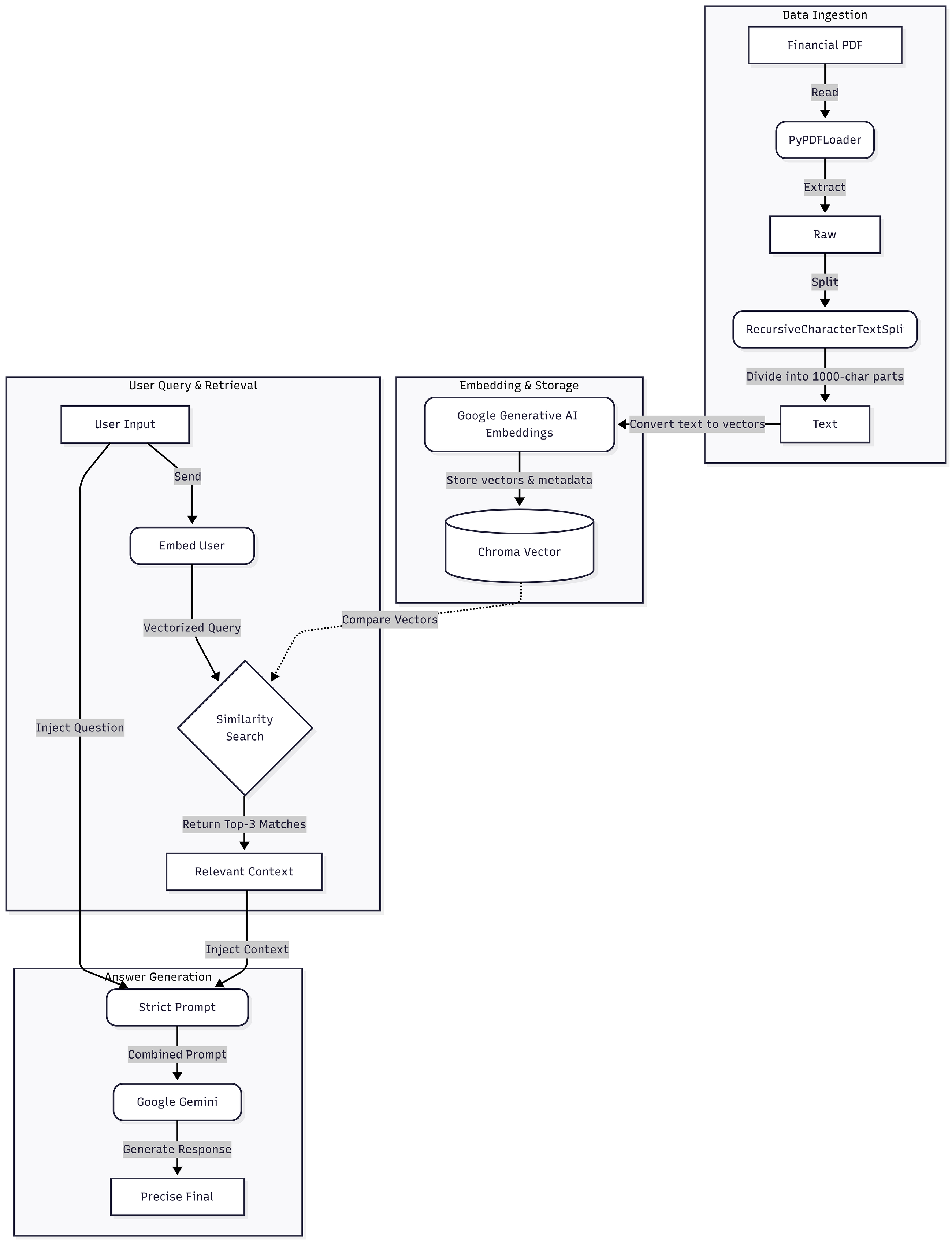
Here is the step-by-step breakdown of how our RAG pipeline processes a financial compliance document:
1. Data Ingestion & Chunking
Financial documents are usually large PDFs. Our pipeline uses LangChain’s PyPDFLoader to extract the raw text. However, you can't feed a 500-page PDF directly into an LLM all at once due to context window limits and processing costs.
- The Solution: We use a
RecursiveCharacterTextSplitterto break the document into smaller "chunks" (e.g., 1000 characters). We also include a 200-character overlap between chunks to ensure a sentence or concept isn't cut cleanly in half, preserving the context.
2. Embeddings & Vector Storage
How do we know which chunk of text contains the answer to the user’s question? We use math.
- Embeddings: Each text chunk is passed to an embedding model (in our case,
gemini-embedding-001). This model converts the text into a dense vector (a long array of numbers) representing the semantic meaning of the text. - Vector Database: These vectors are then stored in a specialized database designed to handle high-dimensional arrays. Our PoC uses
ChromaDB, a fast, local vector store.
3. User Query & Retrieval
When a compliance officer asks, “What are the new KYC requirements for high-risk entities?”, the system:
- Converts the user’s question into a vector using the same embedding model.
- Performs a “similarity search” in the Vector Database to find the chunks of text whose vectors are mathematically closest to the question’s vector.
- Retrieves the top-K matches (e.g., the top 3 most relevant paragraphs).
4. Answer Generation (The LLM)
Finally, we construct a “Strict Enterprise Prompt”. We feed the retrieved context paragraphs and the user’s question into the LLM (gemini-flash-latest).
Crucially, we instruct the LLM:
“Use ONLY the following retrieved context to answer the user’s question. If the answer is not contained in the context, say ‘I do not have enough information…’ Do not hallucinate.”
The LLM synthesizes the extracted paragraphs and generates a precise, natural-language answer.
How Financial Organizations Can Use RAG
The ability to accurately synthesize large volumes of unstructured text unlocks massive value for financial institutions:
- Automated Compliance & Regulatory Q&A: Regulatory frameworks (like Basel III, MiFID II, or internal KYC/AML policies) are vast. A RAG system acts as a specialized assistant for compliance officers, allowing them to instantly query policies and get answers mapped directly back to the source text.
- Advisor “Copilots”: Wealth managers and financial advisors can use RAG to query complex financial products, historical market research, or internal fund prospectuses while on a call with a client, enabling faster, more accurate advice.
- Audit & Due Diligence: During M&A activities or internal audits, analysts have to comb through hundreds of contracts and financial statements. RAG can surface anomalous clauses, identify risk factors, and summarize obligations in minutes.
- Customer Support: Chatbots powered by RAG can access the bank’s up-to-date public policies and FAQs, providing retail customers with accurate answers regarding account fees, loan terms, and application processes without needing human intervention.
The Missing Pieces for Enterprise Production Enablement
While our PoC successfully demonstrates the power of RAG, moving from a script on a laptop to an enterprise-grade financial application requires bridging several critical gaps. This PoC does not cover the following necessary production elements:
1. Data Security & Access Control (The Governance)
In finance, not everyone is allowed to see every document. The PoC searches all documents globally. A production system requires Role-Based Access Control (RBAC) applied at the vector-database level. When a user queries the system, the retriever must filter the search to only include vectors representing documents the specific user has permission to read.
2. Advanced Document Parsing (Tables, Images, & OCR)
Financial PDFs are notoriously complex. They contain multi-column layouts, charts, and dense tables (like balance sheets). Standard text extractors (like PyPDFLoader) often scramble tabular data. Production pipelines require advanced parsing (like Unstructured.io, LlamaParse, or dedicated OCR engines) to accurately extract and format tabular data before chunking.
3. Scalable Infrastructure
Our PoC uses a local SQLite-backed instance of ChromaDB. An enterprise deployment handling millions of documents requires a scalable, cloud-native vector database (such as Pinecone, Milvus, Weaviate, or pgvector on PostgreSQL). Furthermore, the ingestion pipeline needs to be orchestrated (using tools like Airflow or Dagster) to handle updates, deletions, and incremental syncing of new documents.
4. Evaluation and Observability
How do you know the LLM isn’t hallucinating? You cannot deploy a financial AI without rigorous evaluation. Production systems utilize frameworks like RAGAS or TruLens to quantitatively measure “Context Relevance” (did we retrieve the right paragraphs?) and “Faithfulness” (is the answer fully supported by the context?). Additionally, robust LLM observability (like LangSmith or Phoenix) is required to trace latency, token costs, and user feedback loops.
5. Advanced RAG Techniques
Standard similarity search struggles with complex questions. Production systems implement advanced retrieval strategies such as:
- Hybrid Search: Combining vector search with traditional keyword search (BM25) to catch specific names or ID numbers.
- Query Expansion & Routing: Using a smaller LLM to re-write the user’s question for better retrieval or routing the query to different specialized databases.
- Re-ranking: Retrieving a large number of chunks (e.g., 20) and using a specialized cross-encoder model to re-rank them, ensuring the most relevant ones are passed to the final LLM.
Conclusion
Retrieval-Augmented Generation is a paradigm shift for financial organizations, offering a way to turn thousands of pages of dormant policies into interactive, high-value knowledge bases. Building a PoC with modern tools like LangChain and Gemini is easier than ever. However, the true engineering challenge lies in the “last mile” — ensuring security, mastering complex document parsing, and guaranteeing the relentless accuracy required by the financial sector.
Github sample code for RAG — https://github.com/imbansalvishal/fintech-rag-poc
Have you started experimenting with RAG in your organization? What are your biggest hurdles with unstructured data? Let’s discuss in the comments!