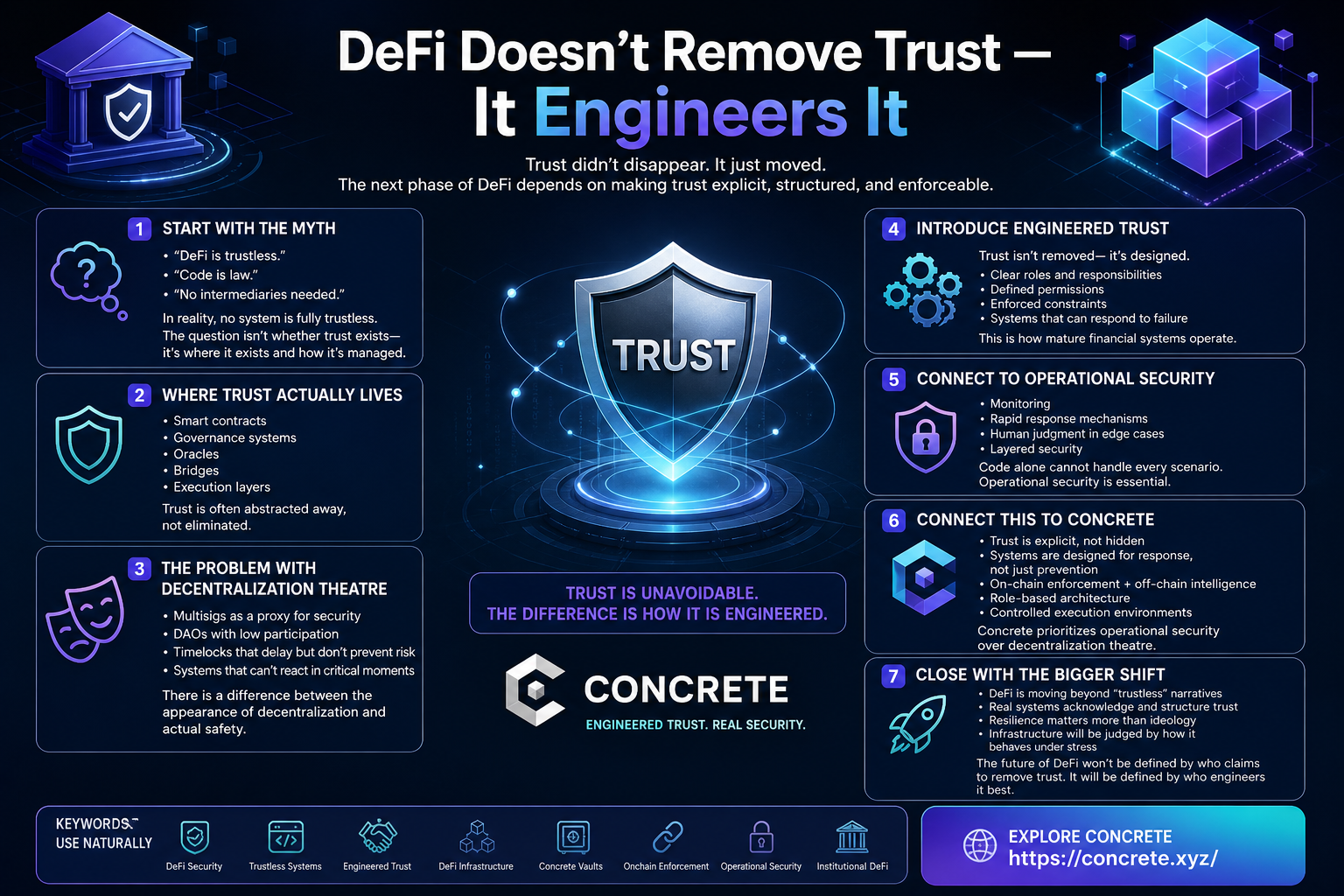
Trust Is the Hidden State in Every DeFi System
 sofiya2 min read·Just now
--
Builders removed banks and assumed they removed trust. Users deposited into contracts and believed execution replaced judgment.
Execution replaced some decisions. It did not remove dependence.
Every DeFi system carries a hidden state: who holds power when things break.
The Early Model
Builders wrote contracts that executed fixed rules. Users interacted with those rules without asking permission.
That design removed a layer of friction.
It did not remove the need for coordination, updates, or external inputs.
As protocols expanded, they introduced moving parts that code alone could not fully govern.
Where Power Actually Sits
Power concentrates at specific control points.
Developers define architecture and often retain upgrade paths or emergency controls.
Governance voters adjust parameters. Low turnout shifts control toward a small group.
Oracle providers determine the data that drives execution. Protocols inherit that dependency.
Bridge systems custody assets across environments. They become critical risk hubs.
Validators and sequencers control transaction flow. Ordering decisions affect outcomes.
These points define how the system behaves under stress.
Users rarely evaluate them before entering positions.
The Mismatch Between Perception and Reality
Interfaces present simplicity.
They show balances, yields, and positions. They do not show who can pause contracts or change logic.
Teams benefit from that abstraction. It reduces friction and increases adoption.
That abstraction also hides risk.
When failures occur, users discover the system they trusted differs from the system they imagined.
Turning Trust Into a Design Variable
Resilient systems treat trust as something to specify.
Builders assign roles with defined authority. They limit actions through enforceable constraints.
They assume failure will happen and design containment.
Engineered trust creates predictable behavior.
Users understand exposure. Systems operate within clear boundaries.
The Need for Active Security
Code provides baseline guarantees. It does not handle dynamic conditions alone.
Protocols need monitoring to detect abnormal states. Teams need structured mechanisms to respond.
Humans act during edge cases. Their actions must follow strict permissions.
Layered security distributes responsibility across components.
Operational security ensures systems remain functional when assumptions fail.
Concrete Structures Trust Explicitly
Concrete builds infrastructure where trust is visible and enforced.
Concrete vaults apply onchain enforcement to define permissions and execution rules. Controlled environments limit how actions can occur.
Offchain intelligence introduces context while respecting those constraints. Systems respond without introducing hidden control.
Concrete prioritizes operational security that performs during volatility and failure.
This approach aligns with institutional DeFi requirements for clarity and control.
Concrete at https://concrete.xyz/