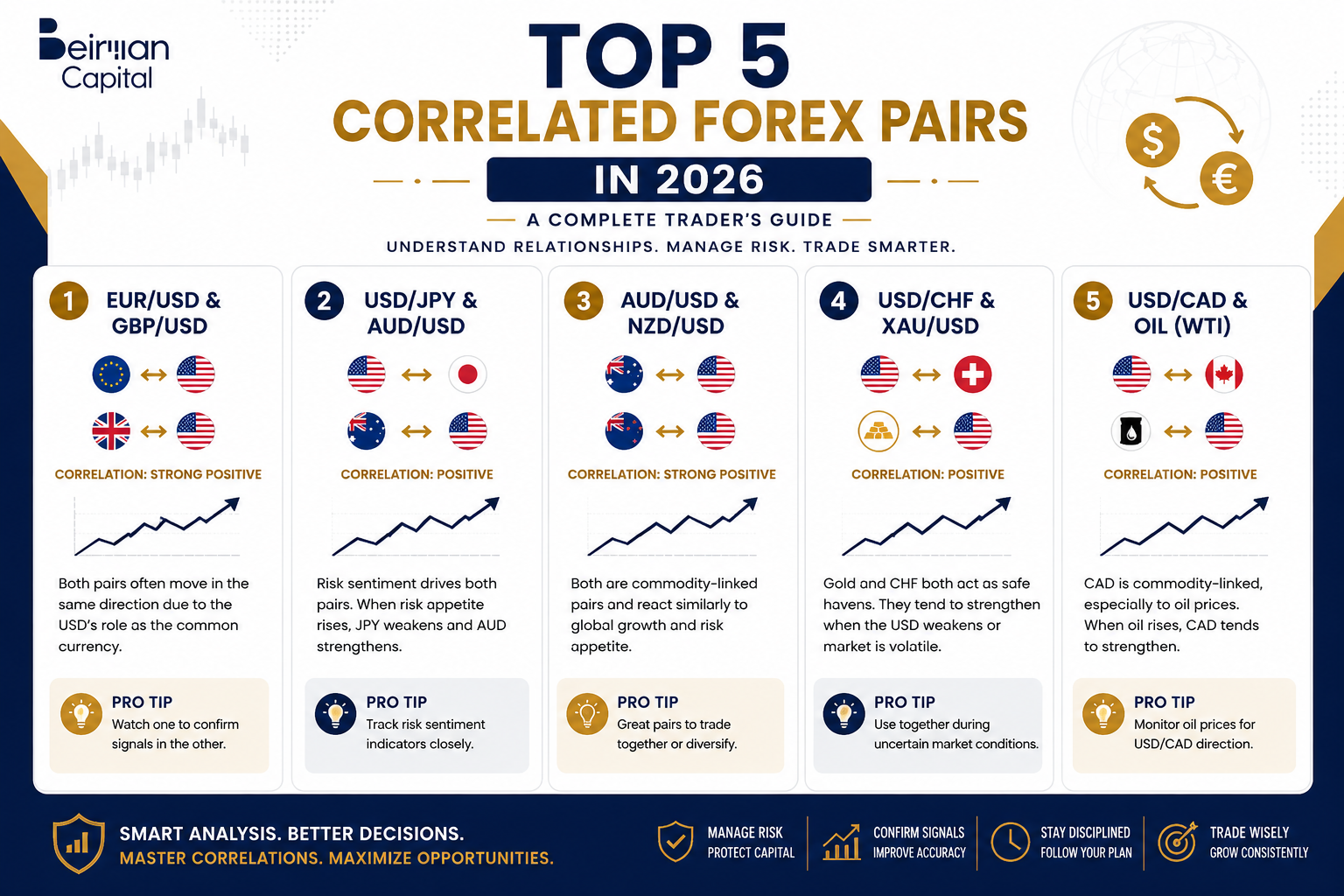
Top 5 Correlated Forex Pairs in 2026: A Complete Trader’s Guide
 Beirmancapital6 min read·1 hour ago
--
Introduction
In the fast-evolving forex market of 2026, understanding currency pair correlations is no longer optional — it’s essential. With global central banks navigating post-inflation policies, the BRICS currency expansion, and ongoing geopolitical shifts, forex pairs are moving in tighter sync than ever before.
Whether you’re a beginner or a seasoned trader, knowing which forex pairs are correlated can help you:
- Avoid double exposure to the same risk
- Hedge positions effectively
- Identify high-probability trade setups
- Diversify your trading portfolio
In this guide, we’ll break down the Top 5 most correlated forex pairs in 2026, backed by current market data, and show you exactly how to trade them profitably.
What is Forex Correlation? (Quick Refresher)
Forex correlation measures how two currency pairs move in relation to each other. It’s expressed on a scale from -1 to +1:
Pro Tip: Correlations above +0.7 or below -0.7 are considered strong and tradable.
Top 5 Correlated Forex Pairs in 2026
1 EUR/USD and GBP/USD — Positive Correlation (+0.88)
Correlation Type: Strong Positive
2026 Correlation Coefficient: +0.88
The EUR/USD and GBP/USD remain the most positively correlated forex pair in 2026. Both pairs share the U.S. Dollar as the quote currency, meaning USD strength or weakness affects both simultaneously.
Why They’re Correlated in 2026:
- Both Eurozone and UK economies are tightly linked through trade
- Post-Brexit alignment on monetary policy with the ECB and BoE
- Shared exposure to U.S. Federal Reserve rate decisions
- Similar reactions to risk-on/risk-off market sentiment
Trading Strategy:
- Avoid going long on both simultaneously (doubles your USD risk)
- Use one as a confirmation signal for the other
- Watch for divergences as early reversal signals
2 EUR/USD and USD/CHF — Negative Correlation (-0.94)
Correlation Type: Strong Negative
2026 Correlation Coefficient: -0.94
This is the strongest negatively correlated pair in 2026. When EUR/USD rises, USD/CHF almost always falls — and vice versa.
Why They’re Correlated in 2026:
- The Swiss Franc (CHF) is heavily tied to the Euro due to Switzerland’s trade ties
- Both pairs have USD on opposite sides
- The Swiss National Bank’s continued peg-like behavior with the Euro
- Safe-haven flows benefit CHF when EUR weakens
Trading Strategy:
- Use as a hedging pair — long EUR/USD + long USD/CHF cancels USD exposure
- Confirm trend strength using inverse movement
- Ideal for arbitrage strategies
3 AUD/USD and NZD/USD — Positive Correlation (+0.91)
Correlation Type: Strong Positive
2026 Correlation Coefficient: +0.91
The Aussie and Kiwi dollars continue to move in lockstep in 2026, driven by their close geographical, economic, and trade relationships.
Why They’re Correlated in 2026:
- Both economies depend heavily on commodity exports (especially to China)
- Similar interest rate trajectories from RBA and RBNZ
- Shared exposure to Asia-Pacific growth and Chinese demand
- Both are classified as “risk-on” currencies
Trading Strategy:
- Trade the AUD/NZD cross when correlation weakens
- Use China’s economic data (PMI, GDP) as a leading indicator
- Avoid simultaneous long/short positions on both
4 USD/CAD and Crude Oil (Inverse Correlation: -0.85)
Correlation Type: Strong Negative (with WTI Crude Oil)
2026 Correlation Coefficient: -0.85
While not a traditional forex pair-to-pair correlation, USD/CAD vs. Crude Oil remains one of the most powerful relationships in 2026.
Why They’re Correlated in 2026:
- Canada is the 4th largest oil exporter globally
- Rising oil prices = stronger CAD = lower USD/CAD
- 2026’s energy transition policies still leave oil as a major CAD driver
- Increased North American oil production amplifies this link
Trading Strategy:
- Monitor WTI and Brent crude prices before entering USD/CAD trades
- Use OPEC+ announcements as trade catalysts
- Combine with USD index (DXY) for confirmation
Gold (XAU/USD) and AUD/USD — Positive Correlation (+0.82)
Correlation Type: Strong Positive
2026 Correlation Coefficient: +0.82
Australia is the world’s second-largest gold producer, making AUD/USD highly sensitive to gold price movements — a relationship that has strengthened in 2026 amid record gold prices.
Why They’re Correlated in 2026:
- Gold prices hit new all-time highs in 2026 ($2,800+/oz)
- AUD benefits directly from gold export revenues
- Both are inversely correlated to the USD
- Central bank gold buying (especially from BRICS+) boosts AUD
Trading Strategy:
- Use gold as a leading indicator for AUD/USD
- Watch U.S. real yields — falling yields lift both gold and AUD
- Combine with risk sentiment (VIX) for high-probability setups
2026 Forex Correlation Matrix (Quick Reference Table)
How to Use Forex Correlations in Your 2026 Trading Strategy
1. Diversification
Avoid trading multiple positively correlated pairs simultaneously — it multiplies your risk instead of diversifying it.
2. Hedging
Use negatively correlated pairs to hedge open positions and reduce drawdowns during volatile sessions.
3. Confirmation Trading
If EUR/USD breaks resistance, check GBP/USD for confirmation. Aligned moves = stronger trade signals.
4. Divergence Trading
When historically correlated pairs diverge, it often signals an upcoming reversal or breakout opportunity.
5. Risk Management
Never risk more than 1–2% per trade, especially when trading multiple correlated pairs.
Important: Correlations Change Over Time
Forex correlations are not static. In 2026, several factors are reshaping traditional correlations:
- BRICS+ currency expansion affecting USD dominance
- CBDC (Central Bank Digital Currency) adoption
- Energy transition impacting commodity currencies
- Diverging central bank policies post-2025 rate cuts
- AI-driven algorithmic trading tightening intraday correlations
Always check correlation coefficients weekly using tools like:
- Myfxbook Correlation Tool
- OANDA Currency Correlation
- Investing.com Forex Heatmap
- TradingView Correlation Indicator
Common Mistakes to Avoid When Trading Correlated Pairs
Doubling down on the same risk (long EUR/USD + long GBP/USD)
Ignoring fundamental shifts that break historical correlations
Using outdated correlation data (always use 2026 real-time data)
Over-hedging and reducing profit potential to zero
Forgetting commodity-currency relationships (gold, oil)
Final Thoughts: Mastering Forex Correlations in 2026
Understanding correlated forex pairs is one of the most underrated skills in modern trading. In 2026’s interconnected global economy, correlations are tighter and faster-moving than ever before.
By mastering the top 5 correlated forex pairs outlined above — EUR/USD–GBP/USD, EUR/USD–USD/CHF, AUD/USD–NZD/USD, USD/CAD–Oil, and AUD/USD–Gold — you can:
Make smarter trading decisions
Reduce unnecessary risk exposure
Identify hedging opportunities
Improve overall portfolio performance
Remember: Correlations are tools, not guarantees. Always combine them with technical analysis, fundamentals, and proper risk management.
Ready to Trade Smarter in 2026?
At Beirman Capital, we provide traders with cutting-edge tools, real-time correlation data, and expert market insights to help you trade with confidence.
Open Your Live Trading Account Today and Start Leveraging Forex Correlations Like a Pro!
Beirman Capital Portal | Account
Edit description
client.beirmancapital.com
Frequently Asked Questions (FAQ)
Q1: What is the most correlated forex pair in 2026?
A: EUR/USD and USD/CHF have the strongest negative correlation (-0.94), while AUD/USD and NZD/USD lead positive correlations (+0.91).
Q2: Can correlated forex pairs be used for hedging?
A: Yes. Negatively correlated pairs like EUR/USD and USD/CHF are commonly used to hedge USD exposure.
Q3: How often do forex correlations change?
A: Correlations can shift daily based on news, central bank policies, and macroeconomic events. Check them weekly for accuracy.
Q4: Are commodity correlations reliable in 2026?
A: Yes, especially USD/CAD with oil and AUD/USD with gold — both remain highly reliable in 2026’s market environment.
Q5: What tools can I use to track forex correlations in 2026?
A: Use Myfxbook, OANDA, Investing.com, and TradingView’s correlation indicators for real-time data.
Suggested Tags:#ForexTrading #CurrencyCorrelation #ForexPairs2026 #TradingStrategy #BeirmanCapital #ForexEducation #RiskManagement #TechnicalAnalysis
Home
Beirman Capital offers leverage & security for Forex, Stocks, Crypto & Currency Trading. Join best brokers and maximize…
beirmancapital.com
Blogs
Beirman Capital has multiple blogs on forex, commodities, stocks, indices, and others. Get well-versed in the trading…
beirmancapital.com
📩 Join Investor’s Handbook Digest — get the best investing, markets, and wealth-building insights each week.