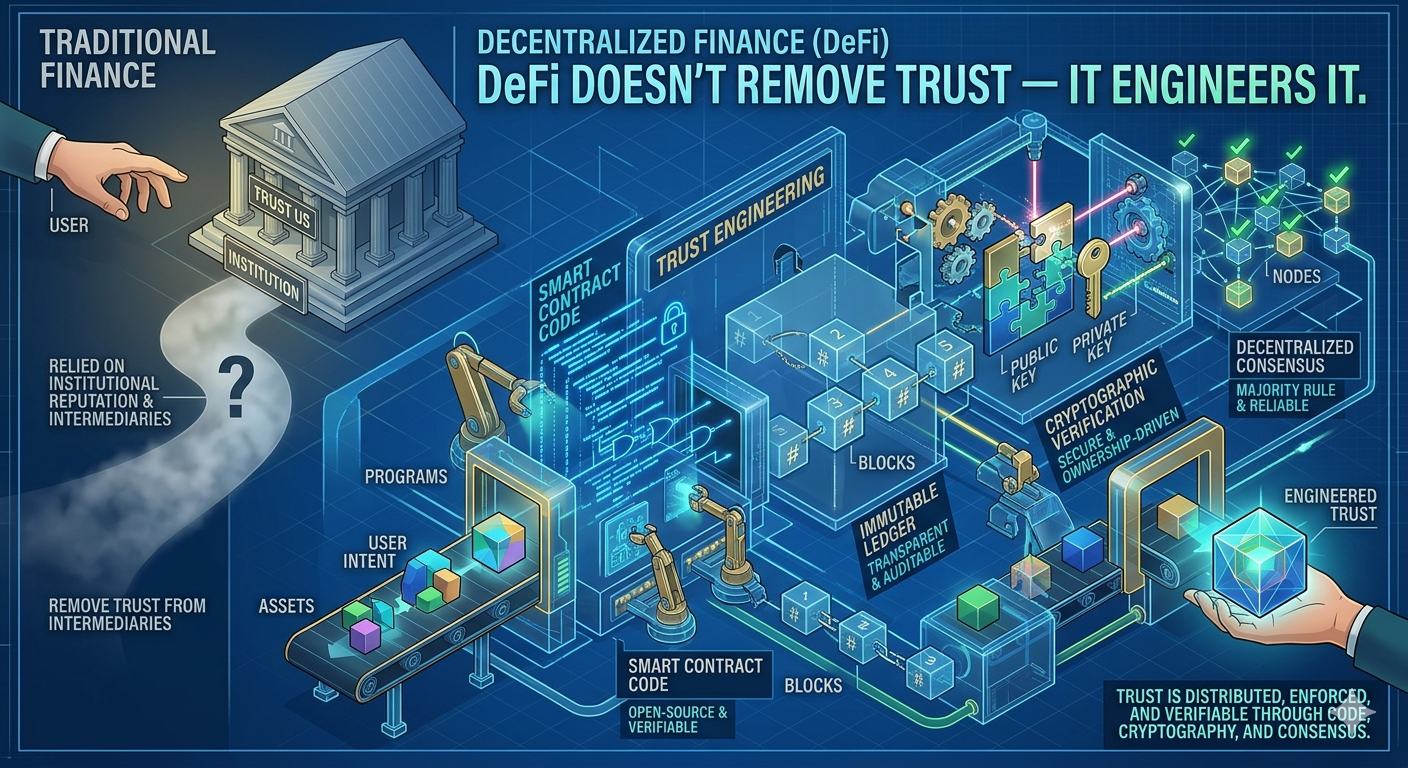
DeFi Doesn’t Remove Trust — It Engineers It
 Godric Eth4 min read·Just now
--
DeFi launched with a powerful, almost romantic promise: “Don’t trust people. Trust code.” No more shady bankers, no intermediaries skimming fees, no single point of failure. Just pure, immutable smart contracts running the show. “Code is law,” we said. “Trustless systems” became the rallying cry.
For a while, that narrative held up pretty well. Early protocols proved you could move value across the globe without asking anyone’s permission. But as DeFi matured and scaled to billions in TVL, the cracks started showing. Trust didn’t vanish — it simply relocated. And pretending otherwise has become one of the industry’s riskiest blind spots.
The Myth Meets Reality
We still love saying DeFi is trustless. In theory, you deposit into a protocol, the code executes exactly as written, and you get your yield or your loan or your swap. No KYC, no counterparty risk in the traditional sense.
In practice? Every major DeFi interaction sits on a stack of assumptions. You trust that the smart contract was written correctly and won’t have a hidden bug. You trust the governance process won’t rug or dilute you. You trust oracles are feeding accurate prices. You trust bridges won’t get drained. You trust the underlying execution layer (L1 or L2) won’t have consensus failures or sequencer issues.
Trust isn’t gone. It’s abstracted, fragmented, and often hidden behind marketing copy about decentralization.
Where Trust Actually Lives in DeFi
Look under the hood of almost any protocol and you’ll find layers of human and systemic trust:
- Smart contracts: Even audited code carries assumptions about external dependencies and economic incentives. Bugs still happen.
- Governance: Token-weighted voting often means low turnout and whales calling the shots. “Decentralized” decisions can be surprisingly centralized in practice.
- Oracles: Price feeds are critical, yet many still rely on limited sources or have latency/ manipulation risks.
- Bridges and execution layers: These are massive choke points. Billions have been lost here, not because of “decentralization,” but because of concentrated risk.
- Multisigs and timelocks: Common “security” measures that often just delay problems rather than solve them.
The result? A lot of decentralization theatre — systems that look open and permissionless on the surface but lack real resilience when things go wrong. DAOs with 3% voter participation. Pause buttons that no one can effectively use in a crisis. Protocols that freeze in place during black swans because there’s no structured way for informed intervention.
The Cost of Hiding Trust
When trust is implicit or denied, failures hit harder. Users get rug-pulled by “decentralized” teams with admin keys. Funds get stuck because governance is too slow. Teams scramble in private group chats because the on-chain design left no graceful way to respond.
Mature financial systems don’t pretend trust doesn’t exist. They engineer it with clear roles, checks and balances, monitoring, and escalation paths. DeFi needs to do the same if it wants to move beyond speculation into real infrastructure.
Engineered Trust: The Better Way
This is where the conversation needs to shift. Trust isn’t the enemy — it’s inevitable. The winning systems will be those that make trust explicit, structured, and enforceable.
Engineered trust means:
- Clear roles and responsibilities instead of vague “community governance.”
- Defined permissions with least-privilege principles.
- Enforced constraints and separation of duties.
- Systems built for response and recovery, not just prevention.
Real operational security — monitoring, rapid but controlled response mechanisms, human judgment for genuine edge cases, layered defenses — becomes table stakes. Code handles the repeatable stuff. People (or well-designed processes) handle the judgment calls that pure code can’t.
How Concrete Approaches This
This philosophy is exactly what drew me to Concrete (check them out at https://concrete.xyz/). They’re building institutional-grade on-chain yield infrastructure with over $1B in assets on platform and billions processed.
Concrete doesn’t hide behind “trustless” slogans. Their approach makes trust explicit:
- Role-based architecture that separates concerns — Vault Manager, Allocator, Strategy Manager, etc. — so no single point of control exists for high-impact actions.
- On-chain enforcement paired with off-chain intelligence for better decision-making without sacrificing transparency.
- Concrete vaults designed for automated yet controllable execution — quantitative systems handle allocation and rebalancing, while structured roles enable proper oversight and rapid response when needed.
- A focus on operational security and DeFi security that prioritizes resilience over pure decentralization theatre.
They deliver competitive, risk-adjusted yields through these ERC-4626 vaults while giving institutions and serious users the controls and visibility they actually need. It’s infrastructure built for stress, not just bull markets.
The Bigger Shift Ahead
DeFi is growing up. The next phase won’t be won by who shouts “trustless” the loudest. It will be won by teams that engineer trust most effectively — who acknowledge where it lives, design for it deliberately, and build systems that perform when markets get ugly.
Resilience matters more than ideology. Institutional DeFi needs reliable DeFi infrastructure that sophisticated players can actually trust with meaningful capital. Onchain enforcement and operational security aren’t compromises — they’re upgrades.
The future belongs to protocols that treat trust as a feature to design, not a bug to deny. Concrete is one example of that mindset in action. As an industry, we should demand more of it.
What do you think? Where have you seen trust hidden in DeFi projects you’ve used? Drop your thoughts below — I’d love to hear where else this “engineered trust” lens applies.
Explore Concrete at https://concrete.xyz/