THE WRONG BUYER ROOM
 VICTOR RAPHAEL3 min read·Just now
--
He Spent Eight Months Pitching AI Funds. The Company That Paid $41 Million Was a Logistics Firm.
Every meeting felt right until it didn’t.
He had built an AI infrastructure layer for supply chain optimization. The technology was real. The product worked. He had paying customers and two years of retention data. He started his acquisition process the obvious way — he went to the AI-native funds, the specialist Web3 investors, the technical buyers who would understand what he had built.
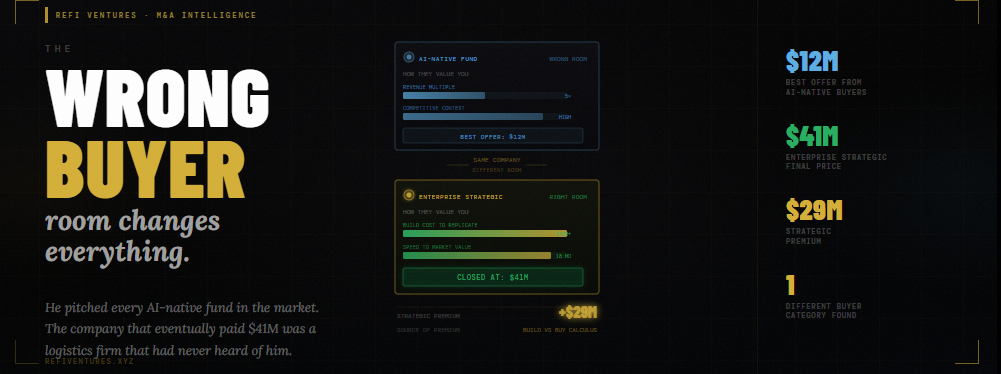
The best offer after eight months was $12 million.
He almost took it. Then an advisor asked him one question: who would have to spend $60 million and eighteen months to build what you have if they decided not to buy it?
The answer was not an AI fund. It was every mid-size logistics, retail, and manufacturing company in the world that had just been told by their board that they needed an AI capability in the next two years and had no idea how to build one. He had built exactly what they needed and could not make themselves. He just had not told any of them it existed.
Four months later, a logistics company with $2.4 billion in annual revenue paid $41 million to acquire his AI infrastructure layer. They did not negotiate on price the way the AI funds had. They negotiated on integration timeline. The price conversation was brief because the build-versus-buy calculus was not close. Their engineering team had estimated $60 million and twenty-two months to replicate the capability internally. Paying $41 million for something that worked today was not a premium. It was a discount.
This dynamic — enterprise strategic buyers paying two to four times what financial buyers pay for the same AI and Web3 asset — is the least discussed pricing phenomenon in this market. It exists because financial buyers and strategic buyers are solving completely different problems.
A financial buyer is optimizing for return on invested capital. They are building a model, applying a revenue multiple, stress-testing the assumptions, and arriving at a number that satisfies their fund return requirements. Their ceiling is mathematical. When every AI infrastructure company in their portfolio is valued at six times revenue, yours will be too. Your exceptionalism does not change their model.
A strategic buyer is solving an existential business problem. They have a board mandate, a competitive threat, or a customer requirement that demands a capability they do not have. The price they will pay is not anchored to your revenue multiple. It is anchored to their internal cost of solving the problem another way. If building it costs $60 million and three years, they will pay $40 million to own it today. The premium they pay over financial buyer valuations is not irrational. It is the mathematical expression of a deadline they cannot miss.
AI and Web3 founders systematically undervalue themselves by pitching only to the buyers who understand what they built rather than the buyers who desperately need what they built. The buyers who understand it are the ones with the lowest ceiling. The buyers who need it are the ones with no ceiling at all except the alternative cost.
Finding strategic buyers requires different research than finding financial buyers. The question is not which funds are investing in your category. The question is which industries have a capability gap that your product closes, which companies in those industries are under board pressure to close it, and which of those companies have the balance sheet and the urgency to move in your timeframe.
That research is not glamorous. It does not involve pitching at Web3 conferences or getting warm introductions from investors. It involves reading earnings call transcripts to find CEOs who have publicly committed to AI integration roadmaps they cannot deliver organically. It involves identifying the companies in adjacent industries where your technology creates an unfair advantage. It involves thinking about your product not as what it is but as what it replaces for someone who cannot build it.
The $29 million difference between his AI fund offer and his logistics company offer was not a negotiation outcome.
It was a room selection outcome.
You are in the right room when your buyer cannot afford to walk away.
Find the buyers who cannot afford to say no at refiventures.xyz