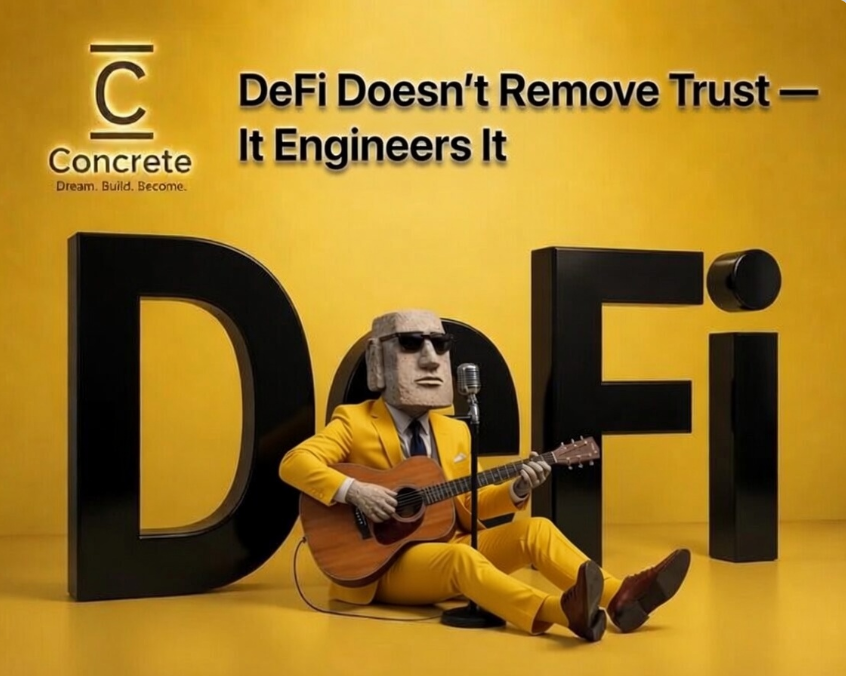
The “Trustless” Myth Is Costing DeFi Billions
 Kcezstl4 min read·Just now
--
Start With the Failure
Every few months, another billion-dollar protocol collapses.
Not because the code was obviously buggy. Not because the team was malicious. But because hidden trust assumptions failed at the worst possible moment.
The industry calls these “bridge exploits,” “oracle attacks,” or “governance captures.”
But really? They’re trust failures dressed up as technical problems.
The “trustless” myth has a hidden cost: it blinds us to where risk actually lives.
1. Why “Don’t Trust, Verify” Falls Short
The mantra is beautiful in theory.
In practice, verification is impossible for most users. You cannot audit every contract. You cannot monitor every oracle. You cannot vote in every DAO proposal.
So what actually happens?
Users trust by default.
They trust that:
- The audit caught everything
- The founder can’t rug
- The bridge won’t get hacked tomorrow
- The governance multisig won’t collude
“Don’t trust, verify” becomes “Trust that someone else verified.”
That’s not trustlessness. That’s delegated trust without accountability.
2. The Hidden Trust Layers No One Talks About
Let’s map where trust actually concentrates in DeFi today:
Smart Contract Author Trust
You trust that the developer didn’t accidentally (or intentionally) leave a backdoor. Even after multiple audits, re-entrancy and logic flaws continue to surface years later.
Governance Trust
You trust that whale voters won’t collude, that proposal discussions are honest, and that timelocks actually provide safety — not just delay.
Oracle Trust
You trust that Chainlink nodes are honest, that the aggregator wasn’t compromised, and that the price feed won’t stall during volatility.
Bridge Trust
You trust that validators on both sides will behave, that relayers won’t censor, and that the multi-sig won’t be compromised. History says: this trust is often misplaced.
Execution Layer Trust
You trust that the sequencer won’t front-run you, that the validator won’t reorder your transaction, and that MEV won’t liquidate you unnecessarily.
Each of these is a trust dependency. Each has failed — catastrophically — in real DeFi history.
3. The Cost of Pretending
Pretending trust doesn’t exist has real consequences:
- Bridges lost over $2.5B in two years. Why? Because users trusted “bridge security” without understanding validator sets, finality guarantees, or withdrawal delays.
- Oracles caused hundreds of millions in bad debt and liquidations. Why? Because protocols assumed price feeds were invincible — until they weren’t.
- Governance attacks drained treasuries and redirected protocol funds. Why? Because low-turnout DAOs gave whales veto power by default.
The “trustless” narrative doesn’t eliminate risk. It hides it.
And hidden risk is the most dangerous kind.
4. A Better Model: Engineered Trust
What if we stopped pretending?
Engineered trust is the alternative. It doesn’t eliminate trust — it structures it so that:
- Trust boundaries are explicit — You know exactly where trust is placed, with whom, and under what conditions.
- Permissions are constrained — No single key, multisig, or DAO has unlimited power.
- Failures are survivable — When trust breaks (not if), the system can respond, pause, or unwind safely.
- Accountability exists — If something goes wrong, there is a clear path to understand why and who was responsible.
This is how every resilient system works. Airplanes, power grids, military networks, central banks — all rely on engineered trust, not trustlessness.
DeFi infrastructure is no different.
5. Concrete’s Approach to Trust Engineering
Concrete was built from this realization.
Instead of pretending trust is gone, Concrete designs it explicitly:
- Role-based security — Clear separation between operators, governors, and users. Each role has defined permissions and constraints.
- On-chain enforcement — Trust rules are not policies. They are code-enforced limits.
- Operational response — Systems are built for monitoring, alerting, and rapid intervention when edge cases appear.
- Institutional-ready — Concrete vaults provide the structure that funds, DAOs, and protocols actually need to sleep at night.
Engineered trust isn’t a compromise. It’s an upgrade.
6. What the Next Phase of DeFi Looks Like
The protocols that survive the next five years won’t be the ones with the most “trustless” marketing.
They will be the ones that:
- Acknowledge trust dependencies openly
- Engineer constraints around those dependencies
- Build operational security for when things fail
- Stop pretending decentralization theatre equals safety
The market is already moving here. Institutional DeFi security requirements are becoming stricter. Audits are no longer enough. Real-time monitoring, response mechanisms, and explicit trust models are becoming table stakes.
DeFi infrastructure is growing up.
Close: From Myth to Engineering
The “trustless” myth was a necessary phase. It helped builders escape the mindset of traditional intermediaries.
But that phase is ending.
The next phase of DeFi infrastructure belongs to those who understand that trust doesn’t disappear — it gets engineered.
And the best engineering happens when you stop pretending and start building for reality.
Concrete is building that reality. Explore it here:
https://concrete.xyz/