The Lie of “Trustless” DeFi
--
Builders sold DeFi as trustless. Users believed code could replace judgment.
Then systems grew up.
Protocols stacked dependencies on top of each other. Each layer introduced decisions, permissions, and failure points. Trust never left. It spread across the stack.
The Promise That Broke
Early DeFi worked in tight loops.
A swap executed. A loan settled. A contract followed fixed rules.
That simplicity created confidence. People saw deterministic outcomes and assumed the entire system behaved that way.
Complex systems do not behave like that.
They depend on inputs, upgrades, coordination, and timing. Code executes logic, but people define that logic and maintain the system around it.
Where Trust Concentrates
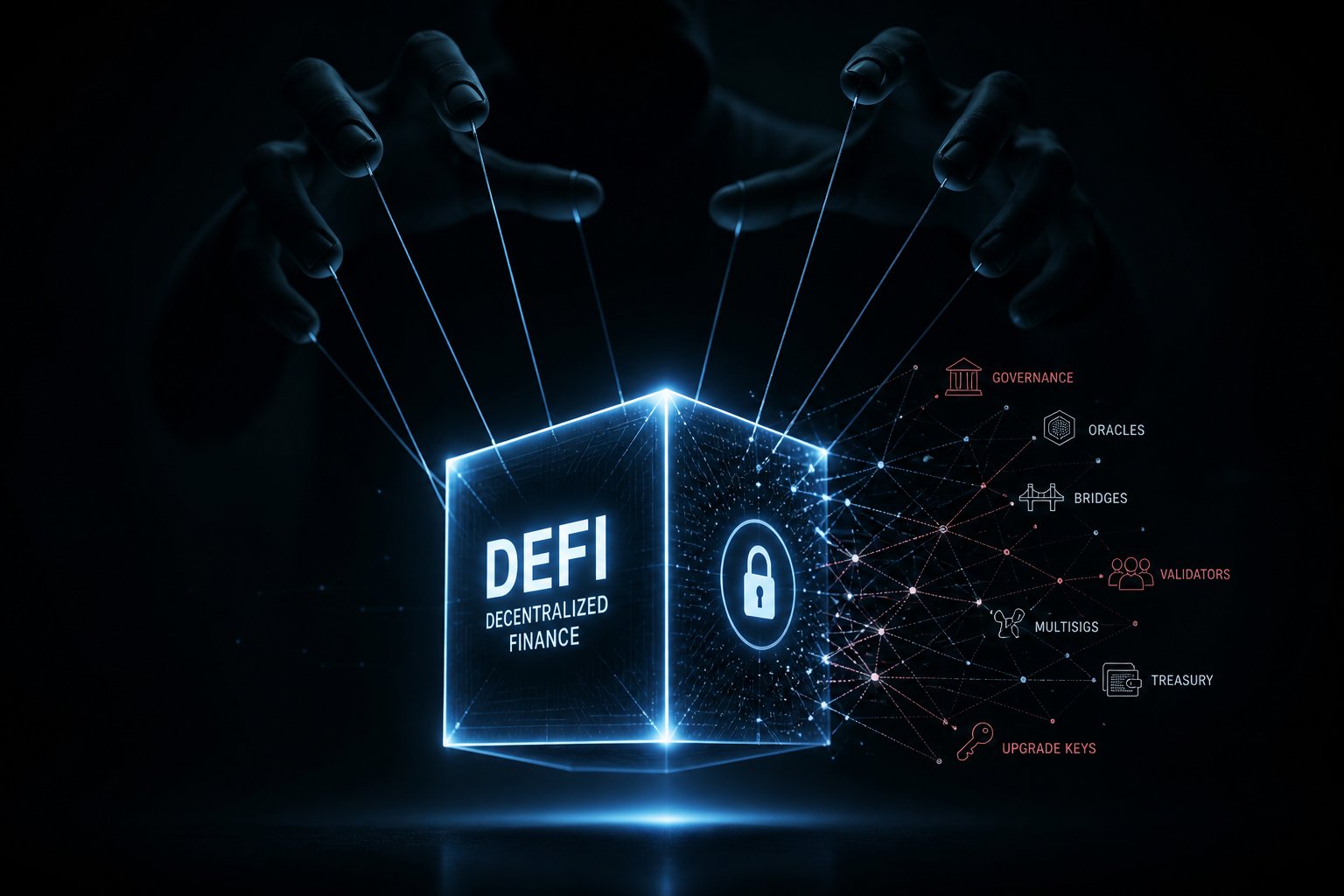
Every serious protocol carries invisible weight.
Developers control how contracts evolve. Upgrade keys, patches, and emergency functions sit somewhere.
Governance voters decide risk parameters and treasury flows. Low turnout concentrates that power.
Oracles inject external data. Protocols cannot verify reality without them.
Bridges hold pooled liquidity across chains. Attackers target that concentration.
Execution infrastructure orders transactions. That ordering affects outcomes and value extraction.
Users interact with frontends that abstract all of this away.
The interface looks simple. The trust map is not.
Why Decentralization Theatre Persists
Teams know what users respond to.
They show token voting. They show multisigs. They show timelocks.
These signals create comfort.
A multisig still centralizes authority. A DAO without participation centralizes outcomes. A timelock delays action without guaranteeing safety.
These structures pass surface checks. They fail when systems need fast, coordinated responses.
Trust as a Designed Constraint
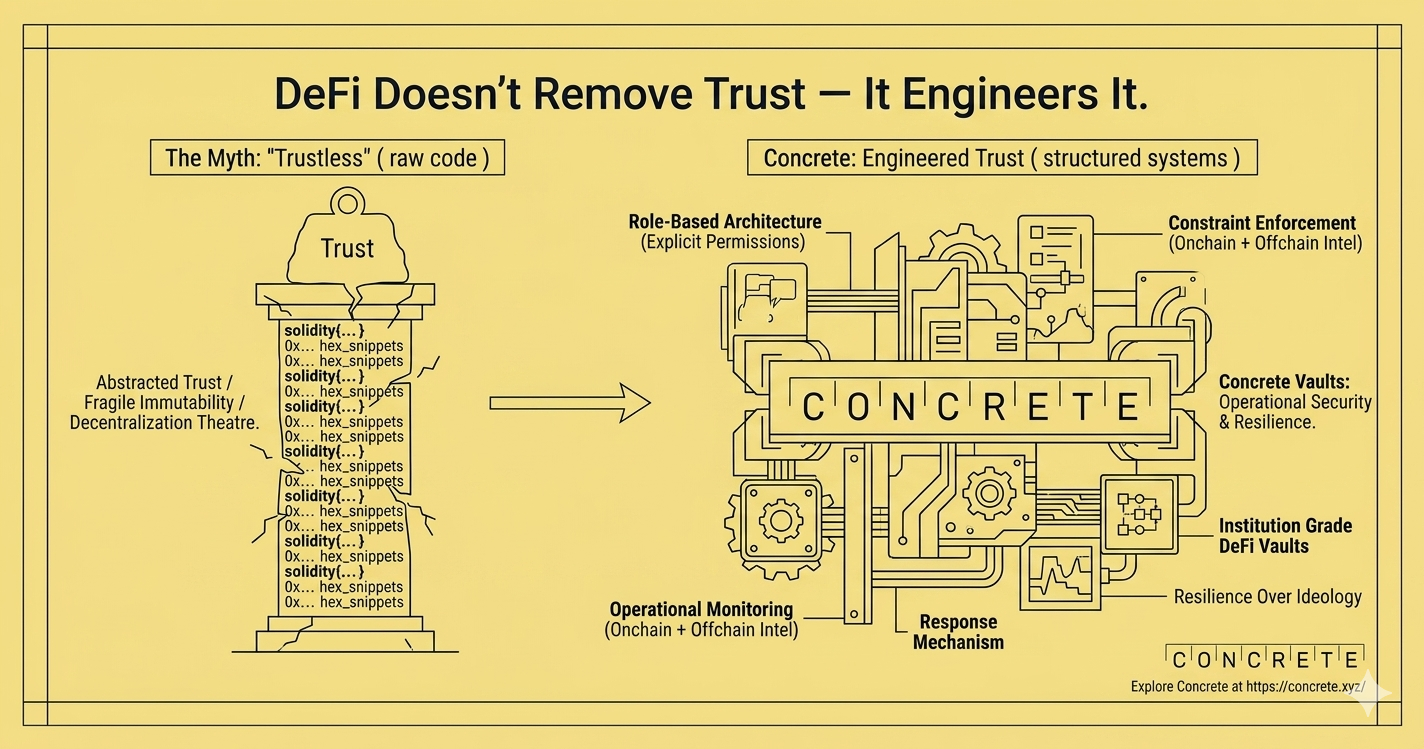
Builders who ship resilient systems treat trust as a constraint to manage.
They define authority upfront. They limit actions through enforced rules. They create systems that can respond without breaking guarantees.
Engineered trust reduces uncertainty.
Users can see who controls what. Systems can operate within known boundaries. Failures stay contained instead of cascading.
This approach looks less like ideology and more like engineering.
Security That Lives Beyond Code
Smart contracts handle execution. They do not handle context.
Markets shift. Attackers adapt. Dependencies fail without warning.
Protocols need monitoring to detect abnormal states. Teams need defined response paths. Humans need to act within controlled permissions.
Layered security creates resilience. No single component carries the entire burden.
Operational security turns static protocols into living systems.
Concrete Builds for Real Conditions
Concrete designs DeFi infrastructure around explicit trust.
Concrete vaults enforce permissions onchain while operating within controlled environments. Builders define roles and boundaries at the system level.
Offchain intelligence adds awareness without introducing unchecked control. Systems respond to changing conditions while staying within enforced limits.
Concrete focuses on operational security instead of surface-level decentralization.
This design matches how institutional DeFi evaluates infrastructure.