--
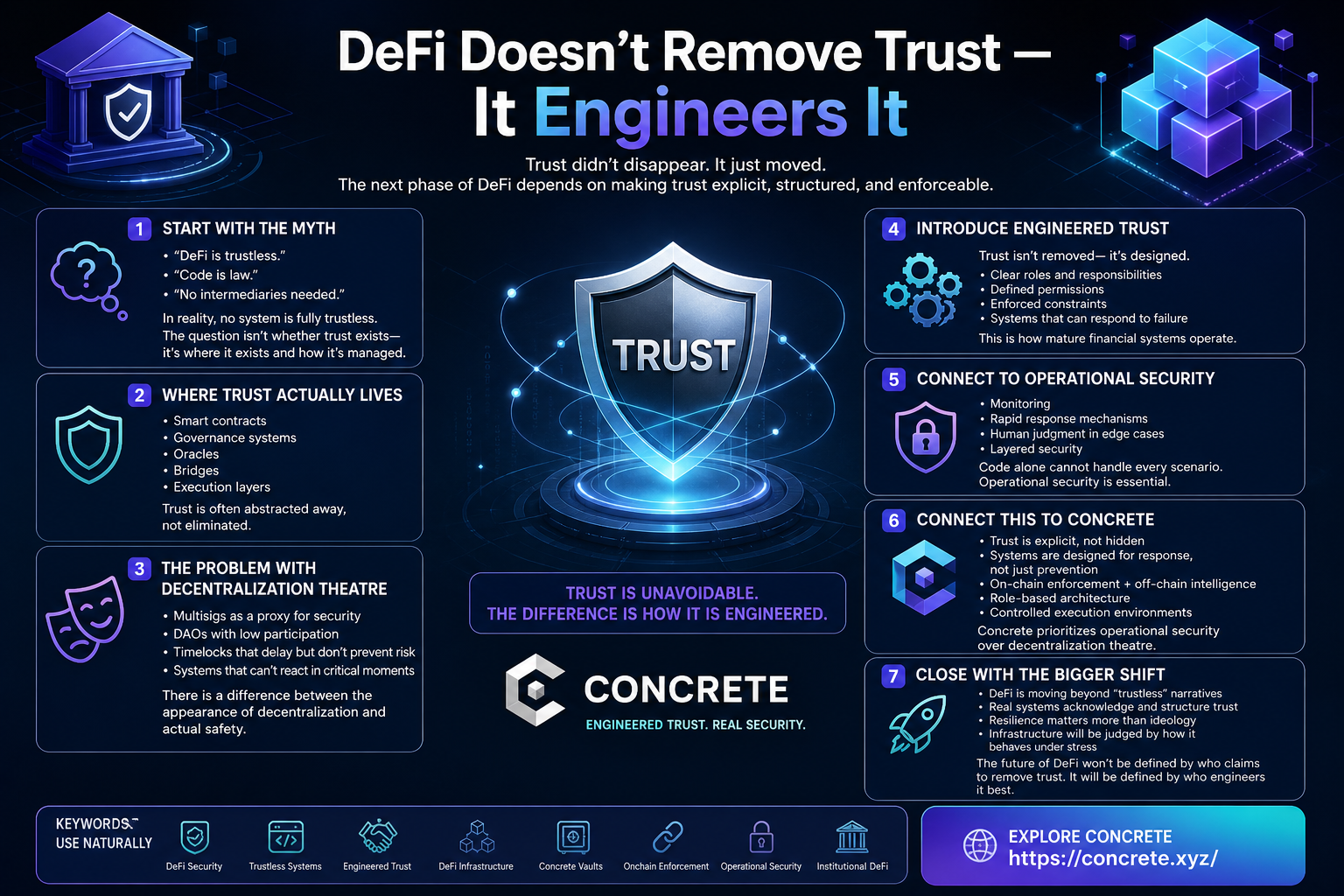
DeFi Doesn’t Remove Trust — It Engineers It
A Systems-Level Perspective on Security, Control, and the Future of Financial Infrastructure
gmcrete @everyone! Submit your article and earn 400 bags!
---
## Introduction: From Ideology to Infrastructure
DeFi didn’t just introduce new financial tools—it introduced a new philosophy:
- “Don’t trust people. Trust code.”
- “Code is law.”
- “No intermediaries needed.”
This wasn’t incremental innovation. It was a direct challenge to centuries of financial architecture built on institutions, regulation, and human oversight.
And for a moment, it felt like it worked.
Protocols executed automatically. Liquidity moved without permission. Markets formed without centralized operators.
But as DeFi scaled—from experimental protocols to billions in value locked—an uncomfortable truth surfaced:
> **Trust never disappeared. It was restructured, fragmented, and often hidden.**
Today, the conversation is no longer about eliminating trust.
It’s about **engineering it correctly**.
---
## 1️⃣ The Myth: “Trustless Systems”
The term *trustless* became the defining narrative of DeFi.
It implied:
- Zero reliance on human actors
- Purely deterministic execution
- Complete removal of intermediaries
But this framing is incomplete.
Because every system—technical or otherwise—operates on assumptions.
And assumptions are trust.
---
### The Real Question
Instead of asking:
> “Is this system trustless?”
We should be asking:
> “Where does trust exist, and how is it enforced?”
Because hidden trust is not eliminated risk.
It is **unaccounted-for risk**.
---
## 2️⃣ Mapping Trust in DeFi Systems
DeFi is not a single layer—it’s a stack.
And each layer introduces its own trust dependencies.
---
### 🔹 Smart Contracts: Deterministic, But Not Infallible
Smart contracts enforce rules automatically.
But users trust:
- That the code is correct
- That edge cases are handled
- That upgrades won’t introduce risk
In reality:
- Bugs exist
- Audits are probabilistic, not guarantees
- Complexity increases attack surfaces
**Code doesn’t remove trust—it compresses it into logic.**
---
### 🔹 Governance: Decentralized in Theory, Concentrated in Practice
Governance systems promise collective decision-making.
But actual dynamics often include:
- Low voter turnout
- Token concentration
- Governance capture
This leads to:
> A system that is **structurally decentralized, but behaviorally centralized**.
---
### 🔹 Oracles: External Truth, Internal Risk
Oracles connect blockchains to real-world data.
They introduce trust in:
- Data providers
- Aggregation logic
- Latency and timing
A single oracle failure can cascade across protocols.
**Oracles are silent dependencies with systemic impact.**
---
### 🔹 Bridges: Interoperability Meets Fragility
Bridges allow assets to move across chains.
But they rely on:
- Validators or relayers
- Cryptographic proofs or multisigs
- Complex verification systems
They are:
> High-value targets with concentrated trust assumptions.
---
### 🔹 Execution Layers: The Hidden Influence
Users assume fair execution.
But in reality:
- MEV extraction alters outcomes
- Transaction ordering is manipulable
- Sequencers may centralize control
Even execution introduces **implicit trust in actors and incentives**.
---
## 3️⃣ Decentralization Theatre: When Optics Replace Security
A critical issue in DeFi today is not centralization—
It’s **performative decentralization**.
---
### Common Illusions
#### Multisigs as “Security”
They distribute keys—but not necessarily trust.
#### DAOs Without Participation
Governance exists—but engagement does not.
#### Timelocks as Protection
They delay actions—but don’t prevent them.
#### Immutable Systems Without Flexibility
They cannot adapt when things go wrong.
---
### The Core Problem
There is a gap between:
- **What systems claim to be**
- **How systems actually behave under stress**
And in financial systems, stress is inevitable.
---
## 4️⃣ Engineered Trust: Designing for Reality
If trust is unavoidable, then the objective becomes:
> **Make trust explicit, structured, and enforceable.**
This is **engineered trust**.
---
### What Engineered Trust Looks Like
- **Explicit Roles**
Every actor’s authority is clearly defined
- **Granular Permissions**
Actions are scoped and controlled
- **Constraint-Based Design**
Systems prevent unsafe states
- **Reactive Capabilities**
Systems can respond—not just execute
---
### Why This Matters
Traditional finance evolved around:
- Risk management
- Operational controls
- Accountability frameworks
DeFi must integrate similar discipline—without sacrificing transparency.
---
## 5️⃣ Operational Security: The Layer DeFi Can’t Ignore
Smart contracts operate in static environments.
Markets do not.
---
### The Missing Dimension
DeFi systems face:
- Adversarial actors
- Volatile conditions
- Unknown failure modes
This requires **operational security**, not just code security.
---
### Core Components
#### Monitoring
Continuous detection of anomalies across systems.
#### Rapid Response
Ability to intervene before damage escalates.
#### Human Judgment
Edge cases require context-aware decisions.
#### Layered Defense
Security across multiple vectors—not a single mechanism.
---
### Key Insight
> **Security is not a feature. It is an ongoing process.**
---
## 6️⃣ Concrete: Engineering Trust at the Infrastructure Layer
Concrete represents a shift toward **institutional-grade DeFi infrastructure**.
It does not attempt to hide trust.
It **defines, structures, and enforces it**.
---
### 🔹 Explicit Trust Architecture
Concrete exposes:
- Who can act
- What they can do
- Under which constraints
This eliminates ambiguity.
---
### 🔹 Systems Designed for Response
Instead of assuming perfect conditions, Concrete assumes:
- Failures will happen
- Attacks will occur
And builds systems that:
- Detect
- React
- Recover
---
### 🔹 Onchain Enforcement + Offchain Intelligence
Concrete integrates:
- **Onchain enforcement** → immutable guarantees
- **Offchain intelligence** → adaptive decision-making
This hybrid model reflects real-world system design.
---
### 🔹 Role-Based Control Systems
Permissions are:
- Granular
- Auditable
- Context-aware
This reduces systemic risk and improves accountability.
---
### 🔹 Controlled Execution Environments
Execution is:
- Bounded
- Verified
- Condition-based
Not left open to undefined behavior.
---
### Concrete Vaults: A New Standard
Concrete vaults combine:
- DeFi security primitives
- Operational oversight
- Institutional-grade controls
They enable:
- Predictable performance
- Managed risk exposure
- Scalable infrastructure
---
### Strategic Positioning
Concrete prioritizes:
- **Operational security over decentralization theatre**
- **Resilience over ideology**
- **Execution over narrative**
---
## 7️⃣ The Bigger Shift: From Trustless to Trust-Aware Systems
The DeFi industry is evolving.
The next phase will not be defined by removing trust—
But by **understanding and engineering it properly**.
---
### What Changes Next
- Systems will expose trust assumptions
- Infrastructure will prioritize stress performance
- Security will become dynamic and adaptive
- Institutional adoption will accelerate
---
### The New Benchmark
Protocols will no longer be evaluated by:
- How decentralized they appear
But by:
- How they behave under failure conditions
---
## Conclusion: The Future Belongs to Engineered Systems
DeFi began as an ideological movement.
It is becoming an engineering discipline.
And in engineering, clarity matters more than belief.
---
### Final Thought
> Trust is not the enemy of DeFi.
> Unstructured trust is.
The systems that win will not claim to remove trust.
They will:
- Define it
- Control it
- Enforce it
- Operate it
---
🚨 **Explore Concrete at https://concrete.xyz/** 🚨
---