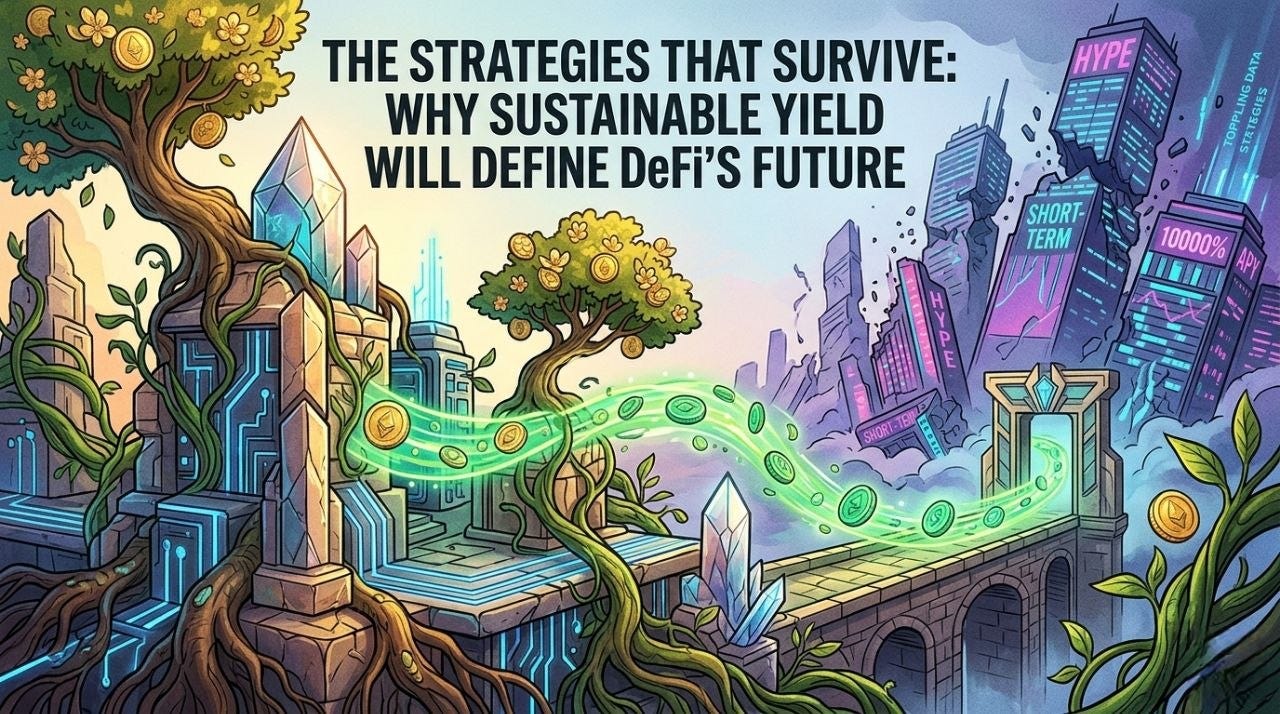
The Strategies That Survive: Why Sustainable Yield Will Define DeFi’s Future
--
The pattern is almost predictable now. A new protocol launches.
The APY is eye-catching — sometimes absurd. Crypto Twitter lights up.
Capital rushes in. For a brief moment, it feels like you’ve found it — the opportunity. Then, just as quickly: Yields compress. Liquidity fades. Attention moves on. And the cycle resets.
The Loop We Keep Repeating
If you’ve spent any time in DeFi, you’ve seen this play out over and over:
- New strategies launch with high APY
- Early capital captures outsized returns
- More users pile in
- Returns decline as liquidity increases
- Incentives dry up
- Capital rotates elsewhere
It’s not a bug. It’s the system working exactly as designed. Which raises a more important question: Why do most DeFi strategies fade so quickly?
And more importantly… What actually lasts?
What Does “Sustainable” Really Mean?
In DeFi, “high yield” is easy to find. Sustainable yield? Much harder. A strategy is sustainable if it can:
- Generate consistent returns over time
- Operate without relying entirely on incentives
- Remain viable across different market conditions
This is not about chasing peaks. It’s about durability. Because the best strategies aren’t the ones that win for a week… They’re the ones that are still standing a year later.
Real Yield vs Temporary Yield
At the heart of sustainability is a simple distinction: Where does the yield actually come from? There are two broad categories:
1. Yield from Real Economic Activity
- Trading fees
- Lending interest
- Arbitrage flows
This type of yield is driven by actual usage. As long as markets exist, this activity continues. It may fluctuate — but it doesn’t disappear overnight.
2. Yield from Emissions & Incentives
- Token rewards
- Liquidity mining programs
- Short-term subsidies
This yield is designed to attract capital. But it comes with an expiration date. As emissions decrease or token prices fall… So does the yield.
Not all yield is created equal. Sustainable yield is earned. Temporary yield is distributed. And over time, the difference becomes obvious.
The Role of Liquidity and Market Conditions
Even strategies built on real yield aren’t automatically sustainable. They depend on the environment around them. Key factors include:
- Liquidity Depth
Thin liquidity can amplify risk and reduce efficiency. - User Activity
No traders → no fees. No borrowers → no interest. - Market Volatility
Some strategies thrive on movement. Others break under it. - Demand for the Strategy
If no one needs the service, the yield disappears.
Some strategies only work in bull markets. Others only during volatility spikes. But sustainable strategies? They adapt.
The Hidden Erosion: Risk and Costs
One of the biggest mistakes in DeFi is focusing only on visible yield.
Because what you don’t see can hurt you.
Over time, strategies are impacted by:
- Execution costs
- Slippage
- Rebalancing frequency
- Changing asset correlations
A strategy that looks strong on paper can slowly degrade in reality. This is where risk-adjusted yield matters more than raw APY. Because:
A stable 8% that you can actually keep
often beats a volatile 30% that you can’t.
Designing for Durability
Sustainable DeFi strategies don’t happen by accident. They are engineered. The strongest approaches tend to include:
- Diversification across multiple strategies
- Continuous monitoring and adjustment
- Adaptation to changing market conditions
- Focus on net returns, not headline APY
This is where DeFi starts to evolve. From isolated opportunities… Into interconnected systems. From manual decisions… Into managed DeFi.
From Chaos to Structure: The Role of Vaults
As complexity increases, infrastructure becomes essential. This is where DeFi vaults come in — particularly systems designed for long-term capital. Concrete vaults aim to do exactly that. Instead of chasing short-term spikes, they are built to:
- Prioritize sustainable yield sources
- Allocate capital across multiple strategies
- Adapt dynamically to market conditions
- Reduce reliance on short-term incentives
The goal isn’t to maximize peak returns. It’s to create durable, repeatable outcomes.
A Real Example: Stability Over Hype
Consider Concrete DeFi USDT. It offers up to ~8.5% stable yield. At first glance, it might not seem impressive compared to triple-digit APYs elsewhere. But that’s the point. Because over time:
- Stability compounds
- Volatility erodes
- Consistency attracts serious capital
For onchain capital — especially institutional DeFi participants — predictability matters more than spikes. And this is where sustainable yield quietly outperforms.
The Shift That’s Already Happening
DeFi is maturing. Slowly, but unmistakably. We’re moving from:
- Yield chasing → Strategy design
- Short-term gains → Long-term positioning
- Isolated bets → managed DeFi systems
The next phase of DeFi won’t be defined by who finds the highest APY. It will be defined by who builds strategies that last.
The Takeaway
Sustainable yield doesn’t scream for attention. It doesn’t spike overnight. It doesn’t rely on hype. But it does something far more important: It endures.
Because in the end:
- Capital doesn’t stay where returns are highest
- It stays where returns are reliable
And as DeFi evolves, the winners won’t be the fastest movers… They’ll be the most resilient builders. If you want to explore what sustainable, structured yield looks like in practice:
Explore Concrete at: https://app.concrete.xyz/earn