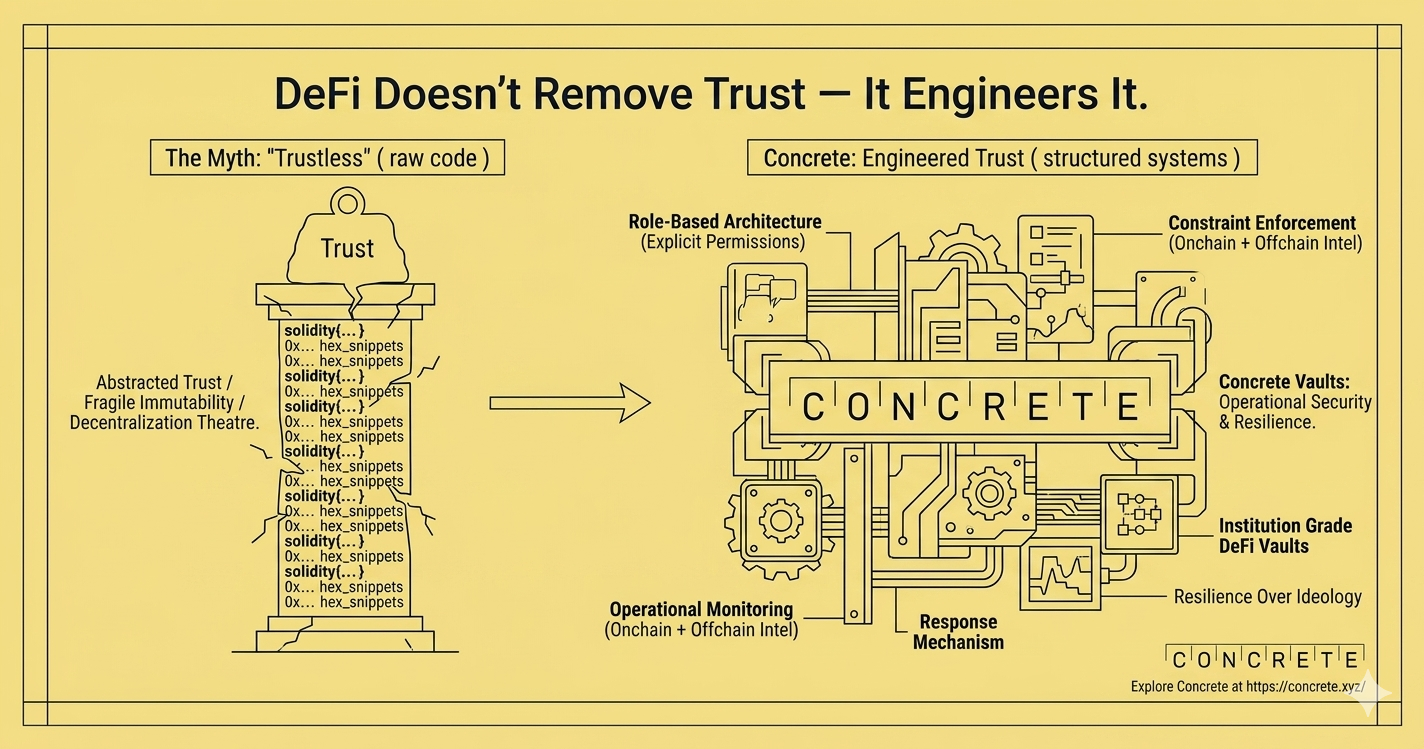
The Story We Told Ourselves
--
DeFi never eliminated trust. Builders shifted it into code and called it solved.
“Code is law” gave early users confidence. Smart contracts replaced brokers. Protocols replaced institutions. People believed the system could run without human judgment.
Then reality showed up.
Every exploit, oracle failure, and bridge hack exposed the same truth: trust never left the system. It hid in places most users never checked.
Early DeFi culture pushed a clean narrative.
No intermediaries. No permissions. No trust.
Builders wrote contracts. Users deposited funds. Everything executed as written.
That model worked in simple conditions. It broke under complexity.
Markets do not stay stable. Attackers adapt. Dependencies fail.
Code executes instructions. It does not interpret intent.
Where Trust Actually Sits
Every DeFi system depends on decisions someone makes.
Developers deploy smart contracts and choose upgrade paths. Users trust those decisions even if they never read the code.
Governance participants vote on parameter changes. Low turnout turns “decentralized governance” into a small committee.
Oracles feed external data on-chain. If data gets manipulated, protocols follow it blindly.
Bridges move assets across chains. Attackers target them because they concentrate risk.
Execution infrastructure processes transactions. Validators and sequencers influence ordering and inclusion.
Each layer introduces trust. Most protocols abstract it away instead of exposing it.
The Illusion of Safety
Teams often optimize for optics.
They add multisigs and call it security. A handful of signers still control upgrades.
They launch DAOs and call it decentralization. A few wallets dominate voting power.
They add timelocks and call it protection. Delays do not stop bad decisions.
These patterns create decentralization theatre. They signal safety without delivering it.
When systems face pressure, hidden trust surfaces fast.
Designing Trust Instead of Ignoring It
Serious systems treat trust as a design problem.
They define who has authority. They restrict what each role can do. They enforce rules at the system level.
Engineered trust creates boundaries.
It limits damage when something fails. It gives systems a way to react without breaking core guarantees.
This approach looks less ideological and more practical. It reflects how real financial systems survive.
Operational Security Is the Missing Layer
Static code cannot handle dynamic risk.
Protocols need monitoring to detect anomalies. Teams need tools to respond before losses compound.
Humans still play a role. They step in during edge cases where code has no context.
Layered security matters. One failure should not cascade into total loss.
DeFi security improves when systems assume failure will happen and prepare for it.
Concrete’s Approach
Concrete builds around explicit trust instead of hiding it.
Concrete vaults combine onchain enforcement with controlled execution. The system defines roles, permissions, and limits up front.
Builders design environments where actions follow strict rules. Offchain intelligence adds context when conditions change.
This structure focuses on operational security.
Concrete treats infrastructure as something that must perform under stress, not something that only looks decentralized in calm markets.
Explore Concrete at https://concrete.xyz/