The Rise of Privacy-Preserving Blockchains: How ZK-SNARKs and Zero-Knowledge Proofs Are Changing the Game
Cryptography & Blockchain Infrastructure
 Ritika Prajapati5 min read·Just now
--
Key Insights
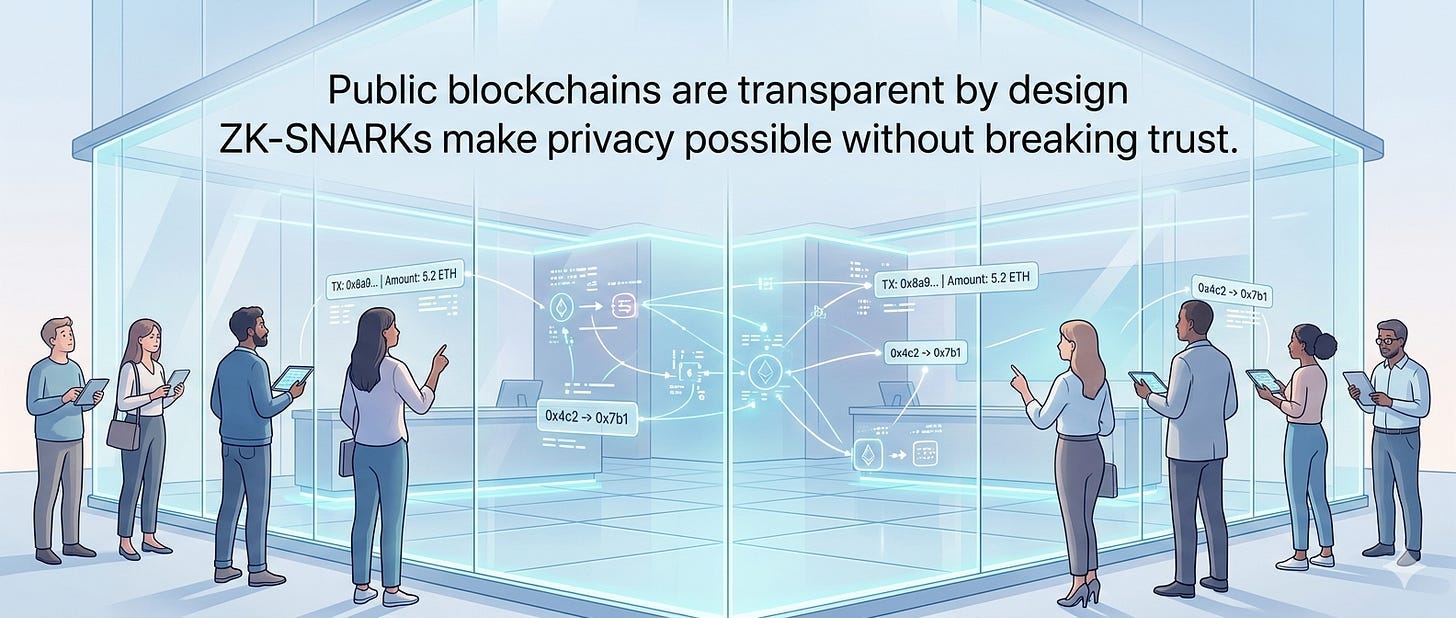
Blockchains are transparent by design ZK-SNARKs fix the privacy problem without breaking trust.
Proof generation is now as fast as 55ms; 2025 hardware optimizations cut latency by 97.8%.
The ZK project ecosystem carries an $11.7B market cap with over $3.5B in daily volume infrastructure, not hype.
Trusted setup “toxic waste” remains the single most underappreciated systemic risk.
Quantum computing will eventually break elliptic curve cryptography; post-quantum hybrids are coming but not here yet.
Privacy gains can be partially undone by metadata leaks chain of custody still leaves traces.
The Bank That Knew Too Much
Imagine a bank that posts every transaction in its lobby salaries, debt payments, medical bills visible to anyone who walks in. That’s essentially how a standard public blockchain works. Wallet addresses are pseudonymous, not anonymous. With enough data and basic on-chain forensics, your identity and financial behavior can be inferred.
For cypherpunks, this was always an uncomfortable tradeoff. For regulated banks, healthcare networks, and enterprise supply chains, it was a deal-breaker. Enter zero-knowledge proofs specifically, ZK-SNARKs and suddenly, the rules change.
It sounds paradoxical: prove you know something without revealing it. But it isn’t magic. It’s mathematics reshaping how we think about trust, privacy, and scalability in the digital economy.
“You can prove your bank balance is above $10,000 without telling anyone the actual number. That is not a trick. That is a proof.”
Why Transparency Became a Liability
Blockchain’s original promise was radical openness: every node verifies every transaction. For cryptocurrency between pseudonymous wallets, that was fine. But as adoption expands into regulated industries, transparency becomes a liability.
Hospitals logging patient consent, banks settling interbank transfers, multinationals verifying supplier certifications these are sensitive use cases. Public exposure isn’t just undesirable; it can violate GDPR, HIPAA, and other global data laws.
Private blockchains are one solution but they recreate centralization under a new label. Zero-knowledge proofs offer a smarter approach: keep the data private, keep verification public. Confirm validity without revealing the underlying details.
How ZK-SNARKs Actually Work
ZK-SNARK stands for Zero-Knowledge Succinct Non-Interactive Argument of Knowledge. Dense name, elegant concept.
Mechanics: a prover convinces a verifier that a statement is true e.g., “I have enough funds for this transaction” without disclosing the actual data. Proofs are small, fast to check, and non-interactive. The prover cannot fake it without owning the private information.
Workflow:
Witness computation: Prover assembles private inputs (transaction details, balances) into a witness. Data never leaves the prover.
Circuit definition: Statement encoded as an arithmetic circuit (e.g., “sender funds ≥ transfer amount”).
Proof generation: Using public parameters from a trusted setup, a compact proof is generated.
Verification: Verifier checks the proof against public inputs. Verification is cheap (~300,000 gas on Ethereum), regardless of computation complexity.
The key: proof generation is expensive; verification is cheap. This asymmetry makes ZK-SNARKs practical at scale.
Where This Technology Is Deployed
Privacy coins: Zcash pioneered shielded transactions. Valid transactions occur without revealing sender, receiver, or amount. Digital cash on a public blockchain.
Ethereum Layer 2 scaling: ZK-rollups (zkSync Era, Polygon zkEVM, Starknet) batch thousands of transactions off-chain, post a single proof on Ethereum, boosting throughput to 2,000+ TPS and lowering gas costs — scaling and privacy solved simultaneously.
Identity and compliance: ZK proofs confirm age, passport validity, or KYC compliance without exposing documents. For financial institutions, this is compliance and privacy in one architecture.
Mina Protocol: Using recursive ZK-SNARKs, Mina maintains a blockchain just 22KB in size. A full node fits on a phone a radical departure from conventional designs.
zkML: Early but promising. zkML proves AI predictions were generated by a verified model without revealing weights or inputs potential in fraud detection, medical AI, and verifiable autonomous systems.
Key Metrics
Proof generation: 55ms (vs 3.8s for zk-STARKs)
Verification cost (Ethereum): ~300K gas
2025 latency reduction: 97.8% proving time cut (~60s)
ZK market cap: $11.7B
24h trading volume: $3.5B
Rollup TPS ceiling: 2,000+
A 97.8% reduction in proving latency transforms lab experiments into production-ready infrastructure. Hardware acceleration (GPU/FPGA) drives this improvement.
Risks
Critical: Trusted setup compromise. Leaked “toxic waste” enables fake proofs — catastrophic.
High: Quantum vulnerability. Elliptic curve cryptography is breakable with future quantum computers. Post-quantum ZK research exists but is early.
High: Implementation bugs. Circuit complexity can silently enable false proofs.
Medium: Proving cost scaling. Large computations spike generation costs.
Medium: Bandwidth strain. Compact proofs still consume resources in constrained networks.
Bull vs Bear Case
Bull: ZK-rollups dominate Ethereum, regulatory-compliant private DeFi unlocks institutional capital, zkML powers private AI, hardware acceleration reduces costs, post-quantum ZK hybrids arrive.
Bear: Trusted setup exploited, enterprise adoption stalls, regulators mandate transparency, quantum hardware outpaces research, metadata undermines privacy, developer complexity limits adoption.
Scenario Analysis
Bull (Mainstream): Hardware acceleration matures, proving latency <1s, zkEVM hits critical mass, major banks deploy ZK interbank settlements, ZK identity becomes EU standard, ZK market cap >$50B.
Base (Gradual Buildout): zk-rollups consolidate, enterprise pilots scale slowly, zkML remains research-stage, proving costs drop 60–70%, ZK ecosystem cap doubles.
Bear (Technical Debt): Circuit vulnerability triggers audits, adoption stalls, privacy regulations tighten, ZK market cap reverses, enterprises revert to permissioned chains.
What Most People Miss
Non-quantum resistance is a first-order risk, not a footnote.
Privacy on-chain does not guarantee anonymity; metadata leaks persist.
ZK-STARKs avoid trusted setup, offering transparency for high-stakes use cases.
Circuit design is specialized; zkVMs compiling Rust/Solidity expand the talent pool — the most underappreciated positive development.
Key Variables
Hardware acceleration velocity — Real-time viability hinges on GPU/FPGA proving costs.
Regulatory stance — EU/US clarity sets adoption pace.
Post-quantum R&D timeline — Lattice-based ZK systems vs quantum hardware.
zkVM developer adoption — Tooling reduces entry barriers.
L3 rollup architecture — Application-specific chains could create liquidity fragmentation.
Trusted setup evolution — Universal or trustless setups mitigate systemic risk.
Strategic Impact
TradFi: Interbank settlement without competitive exposure triggers adoption.
DeFi: Privacy-preserving DeFi unlocks institutional capital.
Healthcare: HIPAA-compliant blockchain for verified health credentials.
Supply Chain: Prove compliance without exposing proprietary relationships.
AI / zkML: Verifiable inference without revealing models creates new commercial dynamics.
Conclusion
Zero-knowledge proofs aren’t new the math is from the 1980s. What’s new is practicality: faster hardware, efficient proofs, maturing developer ecosystems, and regulatory pressure making privacy mandatory.
The infrastructure being built zkSync, Polygon zkEVM, Mina, Starknet bridges cryptographic ideals and compliance requirements. The risks are real: trusted setup, quantum vulnerability, scarce talent. But adoption is inevitable.
The $11.7B ZK market cap is early-stage pricing. If even a fraction of enterprise use cases scale, it will look like a rounding error.
What strikes me most isn’t the cryptography though it’s beautiful but the practical gap between capability and understanding in financial services. Institutions that close that gap first will gain a structural advantage. This is one of those rare technologies that rewards early mastery.