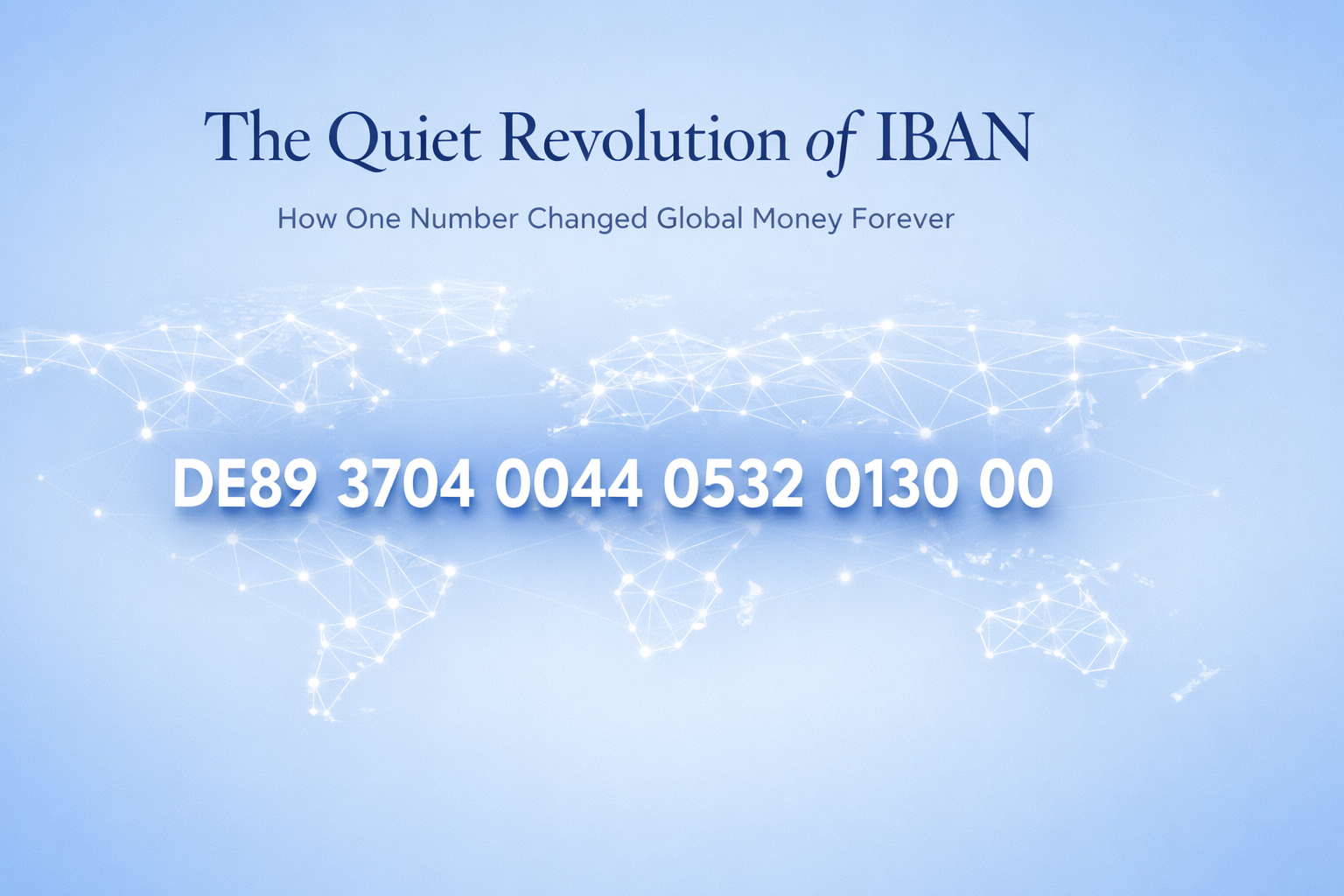
The Quiet Revolution of IBAN: How One Number Changed the Way the World Moves Money
Why a string of letters and digits became one of the most important inventions in modern banking
 Fin Saumya6 min read·Just now
--
I still remember the first time I sent money across borders. It was 2018. I was sitting in an apartment in Delhi trying to send 500 euros to a friend studying in Germany. The process took three days cost me 800 rupees in fees and left me anxious the entire time. The bank asked for details the recipients bank rejected the transfer once because of a formatting error and I had no idea where my money was.
That experience stayed with me. What I did not know then was that a quiet technical solution already existed that could have made that transfer faster cheaper and less stressful. It is called IBAN. It has quietly transformed how millions of people and businesses move money around the world.
The Human Cost of Payments
For most of us sending money should be as simple as sending a message.. For decades cross-border payments remained frustratingly complex. Different countries had banking rules account formats varied wildly and errors were common. A single misplaced digit could send your earned money into banking limbo for days or even weeks.
This was not an inconvenience. For workers supporting families back home small business owners trading internationally or families paying for education abroad these complications carried real emotional and financial weight. Every delay meant another month of uncertainty. Every extra fee meant money reaching the people who needed it most.
IBAN emerged as an answer to this chaos.
What IBAN Actually Is and Why It Matters
The International Bank Account Number or IBAN is essentially a format for identifying bank accounts across national borders. Developed by the International Organization for Standardization it creates a language that banks worldwide can understand.
An IBAN consists of up to 34 characters. It includes a country code, two check digits and a long string that identifies both the bank and the specific account. What looks like characters to most people is actually a carefully structured code designed to minimize errors.
For example a German IBAN starts with “DE” followed by numbers while one from the United Kingdom begins with “GB.” These codes are not arbitrary. The built-in check digits help detect mistakes before a transfer even begins, dramatically reducing the chance of money going to the place.
What makes IBAN powerful is its simplicity in a world. Of providing multiple pieces of information like bank name, branch code, account number, SWIFT code and address you often just need this one string. It reduces friction in a system that was previously weighed down by layers of complexity.
How IBAN Changed Lives Behind the Scenes
Consider Maria, a nurse from the Philippines working in Dubai. Every month she sends money to her parents and younger siblings. Before IBAN became widely adopted in regions she would spend hours at the bank filling out forms and worrying about whether the money would arrive safely. Now with IBAN transfers available through many channels she can complete the process faster and with greater confidence that her family will receive the full amount they need.
Take Ahmed, a small importer in Morocco who buys goods from suppliers in Spain and Italy. The standardization brought by IBAN has cut down on rejected payments. Reduced the administrative burden on his small team. What used to be a source of stress has become a manageable part of running his business.
These are not stories of overnight transformation. They are victories. The kind where life becomes just a bit easier where families feel more secure and where small businesses can focus on growth instead of banking bureaucracy.
The Technical Beauty of a Designed System
One of the most impressive aspects of IBAN is its built-in validation system. Those two check digits are not there for decoration. They serve as a checksum that can catch most common typing errors. This small feature has prevented countless failed transfers and saved millions of hours of investigation and correction.
Different regions have adopted IBAN at speeds. It is mandatory across the European Union. Has been widely implemented in many Middle Eastern and North African countries. Other regions are gradually moving toward standardization recognizing that in a connected global economy fragmented banking systems create unnecessary barriers.
The Challenges That Still Remain
Despite its benefits IBAN is not a perfect or universal solution yet. Not every country has fully adopted it. In some places banks still require both IBAN and traditional account details. Many people outside of Europe have never heard of IBAN even when they frequently send or receive payments.
There is also the human learning curve. For someone who has never used IBAN before the long string of characters can look intimidating. Fear of making a mistake often leads people to avoid it or pay parties higher fees just for peace of mind.
Moreover while IBAN reduces errors it does not solve every problem in -border payments. Exchange rates, intermediary bank fees and compliance requirements still create friction. The system is powerful. Operates within a larger more complex financial ecosystem.
Building Trust in an Invisible System
What fascinates me most about IBAN is how it represents a kind of innovation. This was not a consumer app or a revolutionary new technology that promised to change everything overnight. It was a standardized approach to solving a real problem that millions of people experienced every day.
It reminds us that some of the meaningful advances are not the ones that grab headlines. They are the ones that quietly remove obstacles we did not even realize were holding us back. They create space for connection and economic opportunity to flow more freely.
In our globalized world, where families span continents and businesses operate across time zones systems like IBAN matter deeply. They represent a commitment to making the infrastructure of life work better for everyone not just those with resources or technical expertise.
What the Future Holds for Standardized Payments
As digital payments continue to evolve IBAN and similar standardization efforts are becoming more relevant. Open banking initiatives, real-time payment systems and blockchain-based solutions are building upon the foundation that IBAN helped establish.
We are moving toward a world where sending money internationally feels as seamless as sending it to someone in the city. Younger generations, who expect instant and transparent services are driving demand for better systems. At the time regulators and banks are recognizing that standardization improves security reduces costs and increases financial inclusion.
Yet this future will not arrive automatically. It requires collaboration between countries, banks and technology providers. It also requires education so that people understand these tools and feel confident using them.
Finding Simplicity in a Complex Financial World
In the end IBAN represents something human. It is an acknowledgment that behind every transaction are real people with real needs, hopes and responsibilities. A parent sending money for school fees. A freelancer receiving payment for work. A business keeping its supply chain alive.
By reducing complexity systems like IBAN allow us to focus on what truly matters: the relationships and opportunities that money helps facilitate.
The time you need to make an international transfer take a moment to appreciate the infrastructure working quietly in the background. That long string of characters is not just banking code. It is a bridge, between people, cultures and economies. It is proof that thoughtful design can make the world feel a little smaller and more connected.
In a world that often feels divided that is no small achievement.