The Perennial and the Annual: What DeFi Can Learn from Nature About Lasting Returns
 zakk6 min read·Just now
--
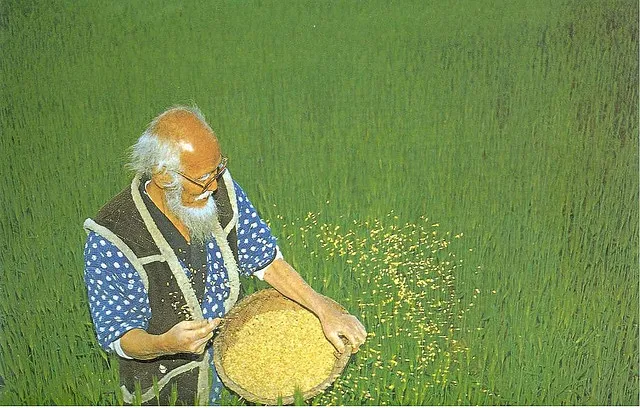
When the Japanese botanist Masanobu Fukuoka stopped tilling his fields in the 1950s, his neighbors thought he had lost his mind. Every farmer in his prefecture plowed, fertilized, replanted, and repeated the same exhausting annual cycle. Fukuoka did none of it. Instead, he planted perennials — crops with deep root systems that returned year after year without intervention. His yields, measured over decades, were indistinguishable from those of his neighbors who worked ten times as hard. He had discovered something that agricultural scientists would later spend careers confirming: in complex natural systems, durability outperforms intensity. The crop that survives every season compounds its value over time. The crop that peaks in one season must be replanted at the cost of the last. — Shikoku, Japan, 1950s
DeFi has been farming annuals.
New protocols launch with high APY — a bloom that attracts capital the way pollen attracts insects. Liquidity floods in. Yields compress as the pool fills. The incentive budget runs thin. Capital rotates to the next bright flower. The field is left fallow, and the cycle repeats somewhere new.
The question Fukuoka’s method asks of DeFi is simple: what grows back? What survives the winter? What generates yield not because conditions are perfect, but because the root system is deep enough to outlast the seasons that aren’t?
The Cycle We’ve All Watched Repeat
It starts with a launch. A new protocol, a new strategy, a new chain deployment — and a number that makes the existing dashboards look boring. Capital moves fast in DeFi because barriers to entry are low. Within days, a strategy that offered 80% APY might be offering 20% as new deposits dilute the pool. Within weeks, the emissions driving that yield begin their programmed decay. Within months, the liquidity has moved on to the next high number, leaving behind a shell of a strategy and the late arrivals who didn’t rotate in time.
This isn’t a flaw in DeFi’s design — it’s a natural consequence of permissionless markets where capital can move instantly and costlessly. But it creates a structural problem: the strategies that attract the most capital are often the least durable, and the capital that chases them is often the first to leave when conditions shift.
Fukuoka’s neighbors measured success by the peak harvest of any single season. He measured it by the cumulative output of a field that never stopped producing. DeFi is still learning to measure the second way.
What “Sustainable” Actually Means
Sustainability in DeFi is not about finding strategies that avoid risk entirely. No agricultural system is immune to drought, and no financial system is immune to volatility. Sustainability is about building yield strategies whose fundamental mechanics don’t depend on conditions that are temporary.
A sustainable strategy generates consistent returns not because the market is favorable, but because its underlying logic holds across a range of market conditions. It doesn’t require a bull market to work. It doesn’t require a fresh batch of emissions to remain viable. Its yield comes from genuine economic activity that continues to happen regardless of sentiment.
Real Yield vs Temporary Yield
This is the distinction that separates perennial from annual strategies in DeFi. Not all yield is generated the same way — and the difference between yield that persists and yield that fades almost always traces back to its economic origin.
Neither category is inherently bad. Emissions-based incentives played a crucial role in bootstrapping DeFi’s liquidity to the depth it has today. But a strategy built primarily on emissions is a strategy with a known expiration date — and capital that doesn’t account for that date tends to discover it at the worst possible moment.
Perennial crops develop deep roots because they must survive winters that annuals never face. Real yield sources are the deep roots of DeFi strategy design. They keep producing when the surface conditions aren’t favorable.
How Liquidity and Market Conditions Shape Durability
Even a fundamentally sound strategy can become unsustainable if it depends on conditions that fluctuate. Fukuoka understood this — even perennial crops need the right soil composition. In DeFi, that soil is made of liquidity depth, user activity, and market structure.
What Looks Strong on Paper, But Decays in Practice
There is a class of strategy failure in DeFi that is less visible than a protocol exploit or an emissions collapse, but equally damaging over time: the slow erosion of returns by costs and frictions that don’t appear in the headline APY.
A strategy can look excellent in a spreadsheet and quietly underperform in practice because the model didn’t account for what execution actually costs in the real world.
These costs are not exceptional. They are routine. A sustainable strategy accounts for them in its design, not as an afterthought. The gap between gross yield and net yield is where many DeFi strategies quietly fail to deliver on their promise.
What Sustainable Strategy Design Actually Looks Like
Fukuoka didn’t plant perennials and walk away. He designed a system — choosing plants with complementary root depths, positioning them to protect each other from wind, selecting varieties suited to his specific soil chemistry. The lack of intervention was itself the product of careful design, not negligence.
Sustainable DeFi strategy design follows the same principle. The goal is not to find the highest-yielding opportunity and hold it. It is to build a system that generates consistent risk-adjusted yield across changing conditions — where the design does the work that would otherwise require constant manual intervention.
Infrastructure Built for Durability, Not Just Peak Performance
This is the principle that shapes how Concrete vaults approach onchain capital deployment. The goal is not to find the strategy with the highest APY on any given day. It is to maintain managed DeFi infrastructure that performs reliably across the days that follow — including the ones where conditions are difficult.
Concrete vaults pursue this through the same layered design logic that sustainable agriculture uses: the Allocator continuously repositions capital toward the most viable opportunities; the Strategy Manager enforces a defined universe of eligible yield sources that prioritize real economic activity over temporary incentives; the Hook Manager enforces risk parameters that prevent the optimization layer from reaching beyond defined boundaries in pursuit of higher short-term yield.
Together, these mechanisms reduce the reliance on short-term incentives that makes most DeFi strategies fragile — replacing it with systematic capital management that adapts to changing conditions without requiring the user to anticipate them.
The future of DeFi will not be defined by who finds the highest yield. It will be defined by who builds strategies robust enough to keep generating it when conditions change.
Fukuoka’s farm was not productive because he found the perfect season. It was productive because he built a system that didn’t need one. The roots went deep enough that what grew above ground was almost incidental — a natural consequence of structure rather than a bet on circumstance.
DeFi is moving, gradually and inevitably, toward the same standard. The protocols that will define institutional DeFi in five years are not the ones advertising the highest APY today. They are the ones whose yield mechanics will still make sense when incentive budgets are exhausted, when token prices have cycled through a bear market, and when the capital that chased peak returns has long since moved on.
Sustainable yield often looks less exciting than peak yield. The 8.5% that is still 8.5% next year is a different kind of achievement than the 80% that was 6% before summer ended. One of them is a flower. The other is a root.
Plant the root.
Explore Concrete vaults and sustainable onchain capital deployment at app.concrete.xyz