The Payment Challenges in Alternative Health Products
--
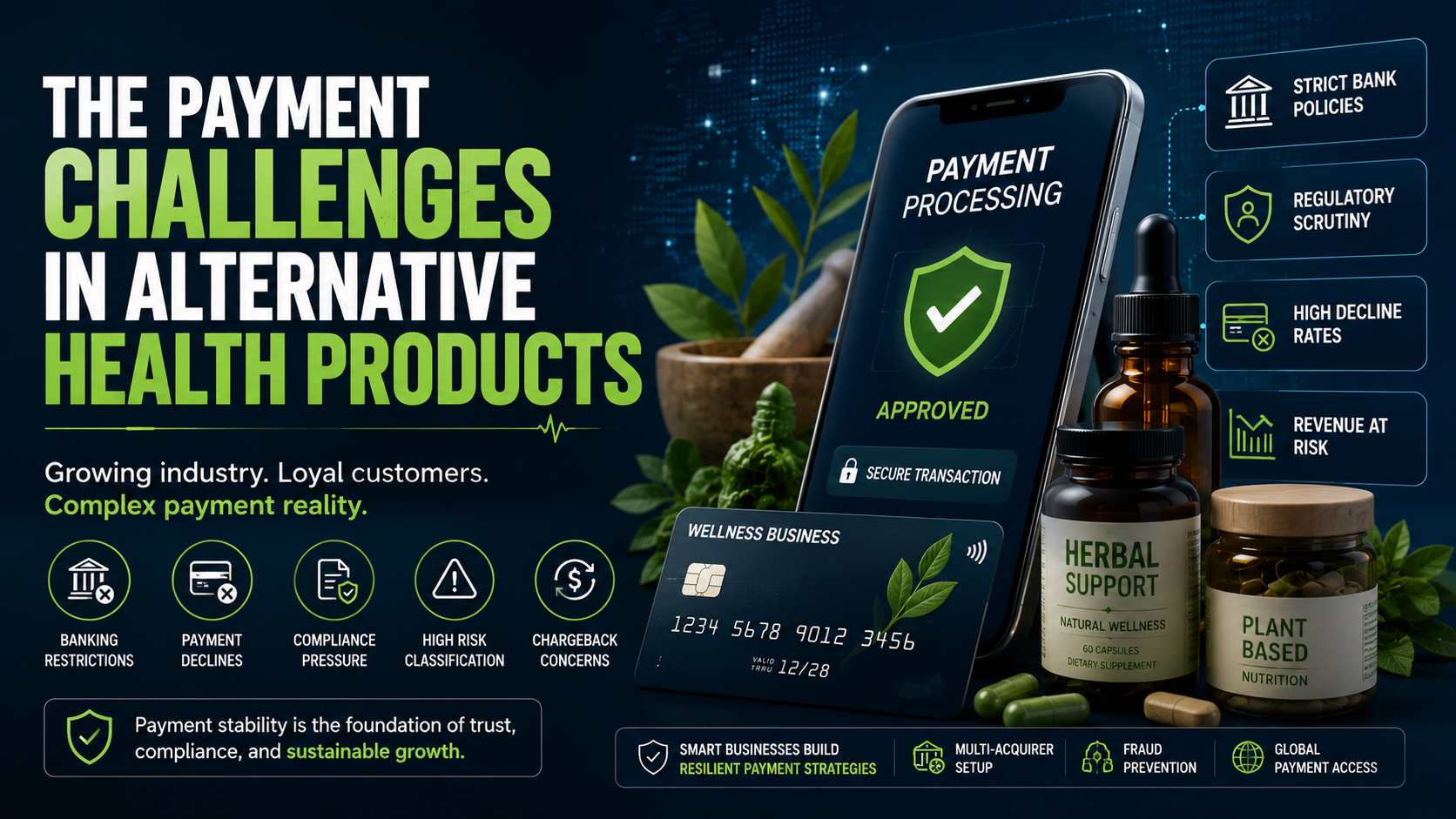
Alternative health is one of the most commercially dynamic sectors in consumer products — and one of the most consistently problematic from a payment processing perspective. The category’s combination of regulatory ambiguity, marketing claim sensitivity, chargeback vulnerability, and processor risk aversion creates a payment environment where operational discipline separates sustainable businesses from those that cycle through processor relationships indefinitely.
The alternative health product category encompasses an enormous commercial territory: dietary supplements, herbal remedies, homeopathic preparations, CBD and hemp-derived products, essential oils marketed for health benefits, traditional medicine formulations, nootropics and cognitive enhancers, and the growing range of functional foods and beverages making health-adjacent claims. The businesses operating in this space range from large, publicly-traded supplement companies with FDA-compliant operations to small direct-to-consumer brands operating in regulatory grey areas, and every size and compliance sophistication level in between.
What unites all of these businesses from a payment processing perspective is that they share a category-level risk classification that applies conservative processing standards to the entire space regardless of individual merchant quality. A company selling a well-documented, clinically studied supplement with conservative marketing claims and exemplary compliance faces the same elevated processing rates and intensive compliance scrutiny as a company making aggressive health claims for unsubstantiated herbal preparations. The category-level risk assessment that payment processors apply doesn’t distinguish between these businesses — and understanding why it doesn’t, and what specific risk factors drive the conservative treatment, is the foundation for addressing those factors operationally.
The Health Claim Problem: When Marketing Becomes a Payment Risk
The most pervasive payment risk in alternative health products is the health claim problem — the tendency of businesses in the category to make marketing claims that attract customers but also attract regulatory scrutiny, consumer protection actions, and the chargeback patterns that both produce. Health claims in alternative health products exist on a spectrum from clearly compliant (structure-function claims supported by evidence and properly disclaimed) to clearly illegal (disease treatment claims for products not approved as drugs) with a vast, contested middle ground where the legality of a claim depends on how it’s interpreted, what evidence supports it, and which regulatory authority is doing the evaluating.
Payment processors are acutely aware of this marketing claim problem because it creates their own regulatory exposure. A processor who knowingly facilitates payment for a business making illegal drug claims on its supplement products is potentially complicit in the distribution of a misbranded drug — a regulatory violation that the FTC and FDA have historically pursued against payment processors in high-profile enforcement actions. Managing this exposure requires that processors evaluate the marketing claims of alternative health merchants as part of underwriting and ongoing compliance — which means that alternative health businesses whose marketing claims are aggressive, poorly substantiated, or legally questionable face processing difficulties that extend well beyond what the product quality alone would generate.
The practical implication for alternative health businesses is that payment infrastructure decisions begin at the marketing copywriting stage — not at the processor application stage. Marketing claims that are reviewed for regulatory compliance before deployment don’t create the processor compliance problems that regulatory-review-bypassing marketing generates. Alternative health businesses that invest in compliance review of their marketing materials — either through in-house compliance expertise or through specialised regulatory counsel — present cleaner compliance profiles to payment processors and access better processing relationships as a result.
Chargeback Drivers Specific to Alternative Health
Alternative health products generate elevated chargeback rates from a specific set of drivers that are different from both standard e-commerce and from the other high-risk categories discussed in this series. The most significant driver is customer expectation mismatch: alternative health customers often purchase products based on ambitious claims about what those products will do for their health, and when the product doesn’t deliver the expected result — because the effect was overstated in marketing, because the customer’s condition required medical rather than supplemental intervention, or because health outcomes are inherently variable and unpredictable — the customer disputes the charge rather than accepting that the product simply didn’t work for them.
Expectation mismatch chargebacks are particularly difficult to prevent through standard customer service measures because the customer’s dissatisfaction is real even if the merchant fulfilled the order completely and accurately. The only effective prevention is marketing accuracy — claims that accurately represent what the product can and cannot do, supported by evidence adequate to the claim’s strength, with clear disclaimers that individual results vary and that the product is not intended to treat or cure any condition. This accurate marketing approach may attract fewer customers than the aggressive claim approach, but it attracts customers whose expectations align with what the product can deliver — dramatically reducing the expectation mismatch chargebacks that the aggressive claim approach generates.
Subscription model chargebacks are the second major alternative health chargeback driver: many supplement businesses use recurring subscription or auto-ship models where customers receive monthly product shipments and are billed accordingly. When customers forget they’re subscribed, when the auto-ship notification communications are inadequate, or when the cancellation mechanism is difficult to access, they dispute the recurring charge rather than cancelling through the merchant. These subscription chargebacks are entirely preventable through the same operational investments that reduce subscription chargebacks in any category — reminder communications before each billing cycle, prominent cancellation mechanisms, and transparent billing descriptors that help customers recognise what they’re being charged for.
The FDA and FTC Intersection with Payment Processing
FDA and FTC enforcement actions against alternative health businesses create payment processing disruptions that go beyond the direct regulatory consequences. When the FDA issues a warning letter to an alternative health company or the FTC files an enforcement action related to health claim violations, the affected company’s payment processors are typically notified through the card network compliance systems that monitor for regulatory actions against their merchants. The processor’s response to a regulatory action notice is typically immediate and protective: account review, potential fund holds, enhanced scrutiny, and in many cases termination — not because the processor has independently determined that the merchant violated regulations, but because the regulatory action creates processing risk that the processor manages through de-risking.
The regulatory-to-payment-disruption connection means that alternative health businesses face payment processing consequences from regulatory actions that occur before any legal determination of wrongdoing. A company that receives an FDA warning letter for marketing claims on a product — which is not a legal finding of violation but a regulatory notice — may find its payment processing disrupted while the regulatory matter is being addressed. This pre-determination payment disruption can create severe cash flow pressure at exactly the moment when the business needs resources to respond to the regulatory action.
The prevention for this regulatory-payment disruption cycle is, again, primary compliance: marketing claims that genuinely comply with FDA and FTC standards don’t generate the warning letters and enforcement actions that trigger payment processing disruptions. But for businesses that have already received regulatory correspondence, proactive communication with payment partners — providing the regulatory correspondence and the company’s legal response simultaneously — is significantly more effective than allowing the payment processor to discover the regulatory action through their own monitoring systems.
Building Alternative Health Payment Infrastructure That Lasts
Alternative health businesses that build durable payment infrastructure share a set of operational practices that address the category’s specific payment challenges directly. Compliance-reviewed marketing is the foundation — every product claim assessed against FDA substantiation requirements and FTC advertising standards before publication, with documentation of the review process that can be demonstrated to processor compliance teams.
Processor selection that prioritises category experience over low rates is the second pillar: processors who specifically understand the alternative health regulatory landscape, who have calibrated their compliance evaluation frameworks to the category’s actual risk profile, and who maintain stable relationships with alternative health merchants through regulatory events rather than terminating at first sign of scrutiny. These processors are typically not the major domestic gateways but specialised high-risk processors whose merchant portfolios include significant alternative health representation.
Chargeback management through subscription transparency and customer expectation management is the third pillar: billing descriptors that customers recognise, renewal notifications that reach customers before charges process, cancellation mechanisms accessible within two clicks, and refund policies generous enough that customers with legitimate complaints resolve through the merchant rather than through their bank. These operational investments are the difference between alternative health businesses that process stably for years and those that churn through processor relationships every few months at escalating rates and with accumulating MATCH list risk.
The payment challenges in alternative health products are real, category-specific, and addressable through operational discipline that most businesses in the category underinvest in. Marketing compliance, subscription transparency, chargeback management, and processor specialisation are not advanced payment strategy — they are the baseline operational requirements for sustainable payment processing in a category where the shortcuts that seem attractive in the short term consistently produce the instability that destroys businesses in the medium term.
Build for compliance first. The customer base built on accurate claims is smaller than the one built on aggressive claims — and it generates chargebacks at a fraction of the rate, processes at better rates, and sustains payment relationships that the aggressive-claim customer base cannot. The payment infrastructure advantage of compliance-first operations compounds over time in a way that the aggressive-claim approach structurally cannot.