The Original NFT: How a 17th-Century Flower Virus Became the World’s First Digital-Style Asset
 UnknownHistory4 min read·Just now
--
World’s first speculative bubble happened all the way back in 17th-century Holland. It became more of a socio-economic phenomenon than a significant economic crisis. The tulip mania had no big influence on the prosperity of the Dutch republic in the 17th century. Which had the highest income per capita in the world for over a hundred years.
Forward markets where already a thing in the Dutch republic. One of the most notable forward markets at that time were centered on the Tulip market. In February 1637 certain tulip bulbs sold for more than ten times the annual income of a skilled artisan.
Background of the Dutch tulip business
The popularity and cultivation of tulips in the Netherlands started around 1593, when botanist Carolus Clusisus established the hortus academicus. Here, he planted a collection of tulips and find out that the tulips could handle the harsh Dutch weather very well. The Tulip differed a lot from the flowers known in the Netherlands, they had a lot more colors. A long with the thriving Dutch economy (named the golden age), due to East Indies Trade, the tulip soon became a luxury item. The tulips were categorized in colors. The most luxurious were actually te tulips with the mosaic virus. This disease causes the tulips to split in two different colors instead of one.
Speculative period
As the flowers grew in popularity, professional growers paid higher and higher prices for bulbs. By 1634, in part as a result of demand from the French, speculators began to enter the market. By November, the price of common, “unbroken” bulbs also began to increase. The price rose to hundreds of guilders (Dutch currency) a bulb. Forward contracts were used to buy bulbs at the end of the season.
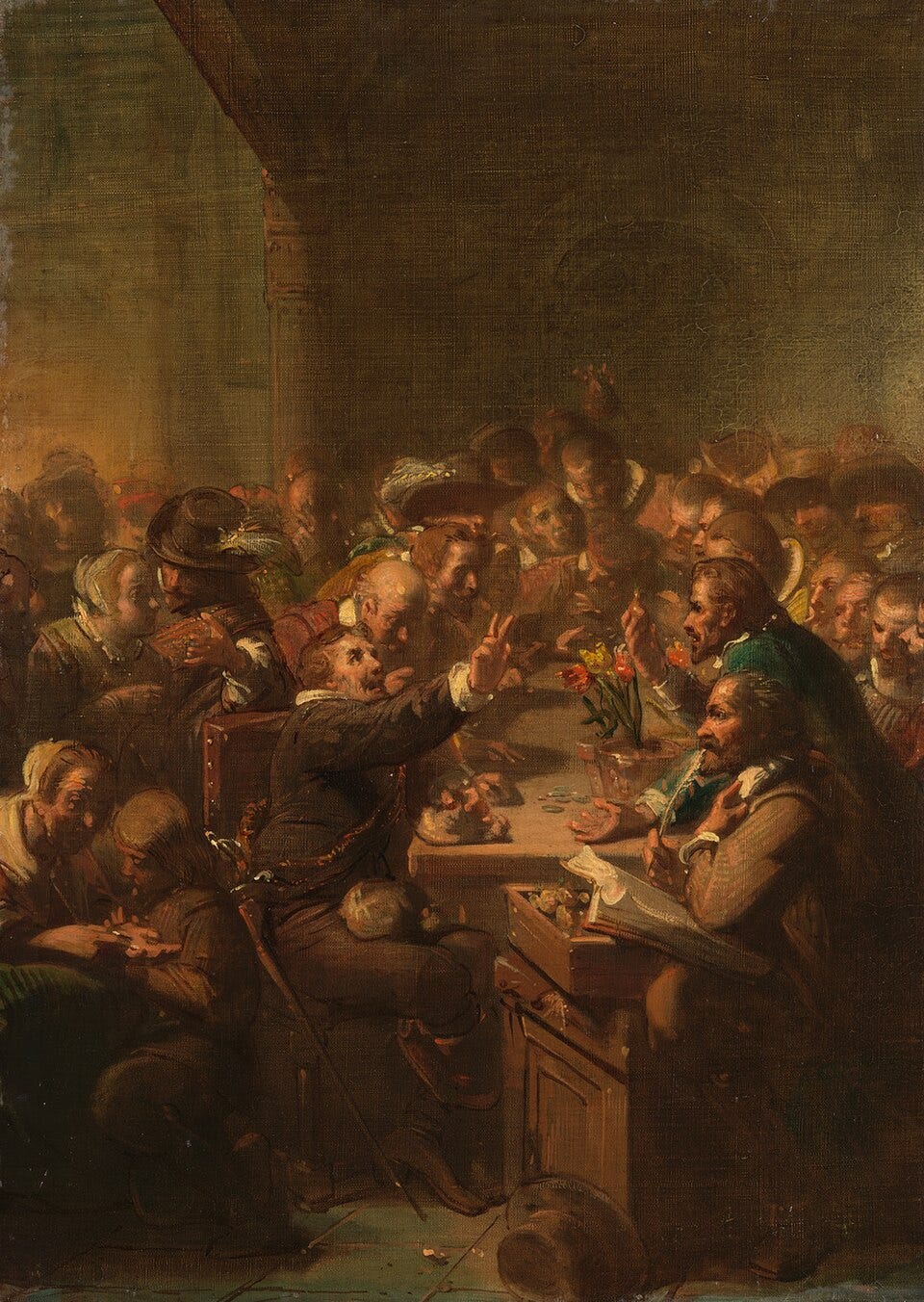
Traders met at taverns and buyers were required to pay a 2.5% “wine money” fee. This could be seen as early broker fees. The Dutch called the tulip trade “wind trade”, because no actual bulbs were being bought.
Tulip mania reached its peak during the winter of 1636–1637, when some contracts were changing hands five times. With no actual delivery of tulips to fulfill the contracts.
The crash
By the 3th of February the price started to come down. Allegedly it started in Haarlem when an auctioneer failed to find willing buyers, despite lowering the price several times. By the 7th of February the price had come down so much that tulip growers in Utrecht elected representatives for a national assembly in Amsterdam. Their situation had become uncertain as the buyers no longer had any interest in honoring the contracts. There was no legal basis for enforcing them.
When the representatives gathered in Amsterdam the decision was made to make a compromise where all contracts entered before December 1636 would be binding. The contracts closed after the could be cancelled by paying a fee amounting to 10% of the rice.
Perspective
The moest expensive recorded sold Tulip bulb was sold for 5,500 guilders. This would nowadays amount to 8 to 10 year salaries. The following is a list of items, that has been traded for one (!) tulip bulb.
- Two lasts of wheat (1 last is around 7,700 kilos)
- four lasts of rye
- four fat oxen
- eight fat swine
- twelve fat sheep
- a thousand liters of wine
- four tuns of beer
- two tuns of butter
- 1000 pounds of cheese
- a complete bed
- a suit of clothes
- a silver drinking up
Comparison to Bitcoin and NFT’s
In 2013 Nout Wellink, former president of the Dutch Central Bank, described Bitcoin as ‘worse than the tulip mania’. He said “At least then you got a tulip, now you get nothing”. I guess at that time this was a valid remark, but Bitcoin has been doing good since 2013.
NFT’s are in my eyes a better comparison. In their peak the NFT’s had a revenue of 17 billion in 2021. Analyses was made at the end of 2023 that 95% of the NFT’s had become worthless and 23 million people now owned worthless assets. This a textbook example of a bubble, all prices were speculative and you did not really own anything other then a digital picture or video. Interesting to see that history also repeats itself in this way. What do you think about it? And could Bitcoin still end up as a bubble?
Read my other stories:
We Remember the Story — Not the Past
The History we know today is based on the stories that survived. Boosted by the way these events are depicted in movies…
medium.com
What If Britain Had Fallen in 1940? The Scenario Hitler Needed — and Never Got ~ Alternate WW2 #1
The big what-if: Fantasy based story with some historically correct details.
medium.com
Siege of Alkmaar, how a small city held of a Spanish Militia
August 21th — October 8th 1583 Alkmaar, North Holland, The Netherlands
medium.com
I published a book! Read it here:
The Unbroken Reich
June 6, 1944 was supposed to be the beginning of liberation. Instead, it became the day Europe was lost. When the…
a.co