Peer-to-Peer Electronic Cats System: an attempt to fix digital collectibles.
 Offchain_Wizard7 min read·1 hour ago
--
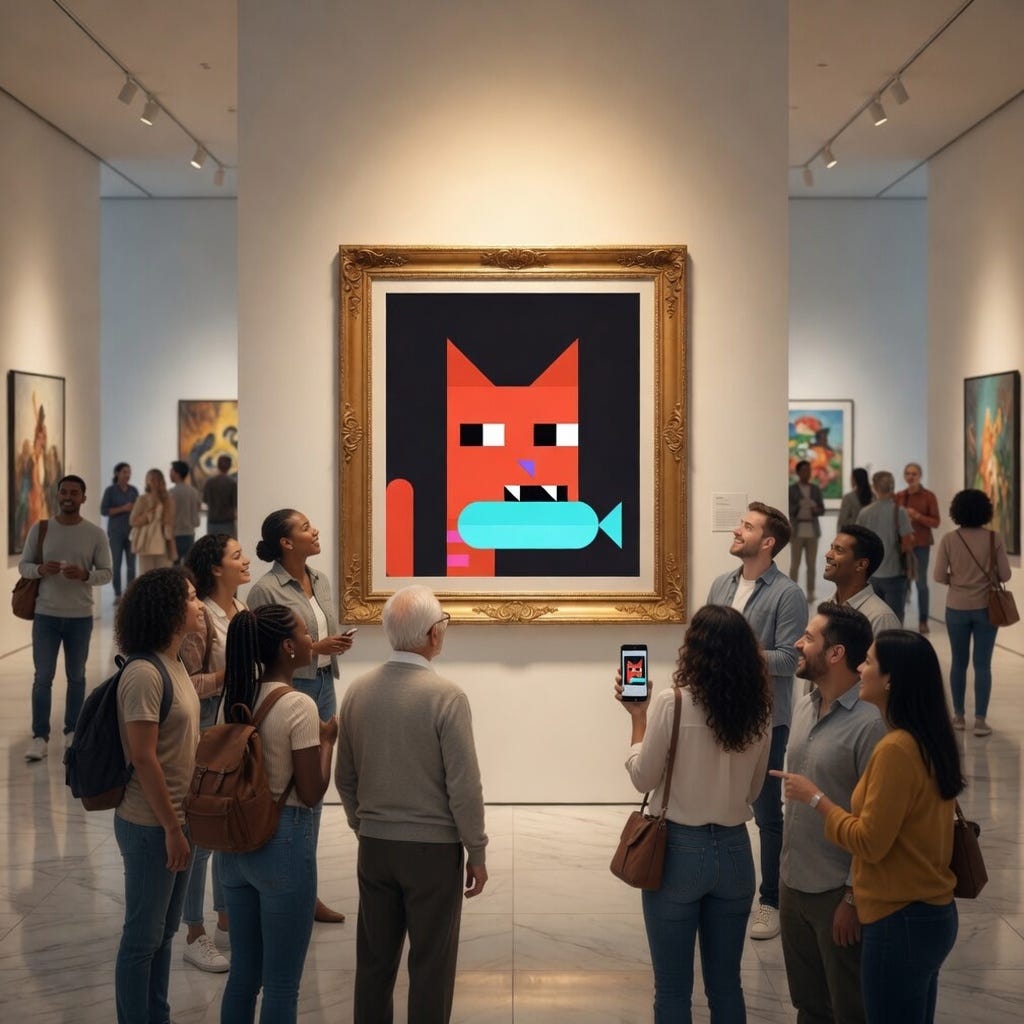
It has been more than three years since Ordinals emerged. For much of that time, its trajectory was defined by recycling established NFT concepts and playbooks. Eventually, the ecosystem began to innovate in earnest, embarking on a journey into largely uncharted territory. The outcome of this experimental phase was the rise of meta-protocols, one of which ultimately gave birth to NatCats: a peer-to-peer electronic cats system. As the initial wave of hype gradually subsided, the cats are still here, purring along.
So what are NatCats? While most Ordinals simply record collections on Bitcoin, NatCats use Bitcoin to generate cats. Each cat represents a Bitcoin block, with its traits and visuals shaped by that block’s number. NAT stands for non-arbitrary. NATcats are discovered rather than arbitrarily created, with the supply emerging from specific pattern in Bitcoin’s blockchain (bits field of blocks containing “3b”). NatCats are essentially turning block patterns into non fungible assets and block height into visual identity. In the era of AI generated slop it’s refreshing to see a Bitcoin generated outlier.
How do NatCats address the existing problems of NFT space ?
Problem: Oversupply and market saturation. Endless new launches flooded the market. Excess diluted scarcity and demand couldn’t keep up. Creators (or teams) control supply, timing, and monetization. Those who successfully launched one collection, immediately followed up with another new collection and kept repeating the process with little to no innovation between launches. Result? Serial launchers diluting their own brand and milking the audience. Killing long-term demand, and turning collectors into exit-liquidity. Scarcity itself became arbitrary, reduced to nothing more than a team or creator’s decision.
Solution: a non-arbitrary design ensures data-driven supply with no centralized issuer. NatCats launched as a free mint on Ordinals on February 2024 then the system took over. The Peer-to-Peer Electronic Cats System runs autonomously on Bitcoin governed exclusively by Bitcoin’s difficulty adjustments. All future supply is now determined by Bitcoin’s own rules, not a creator’s marketing calendar. Every 2,016 blocks (~2 weeks), Bitcoin recalculates the bits field in the block header (network difficulty). New generation of exactly 2,016 NatCats become mintable only when a Bitcoin block’s bits field contains “3b”. This condition has occurred 4 times in Bitcoin’s entire history, producing 4 generations of NatCats. As a result, supply is truly Bitcoin-native and scarce in a way no human controlled mint can replicate.
Problem: NFTs are non-productive assets. This is one of the main reasons for much of the liquidity collapse and value destruction seen since the 2021 peak. The entire value of non-productive assets depends on future resale at a higher price. This creates a “greater fool” dynamic with no intrinsic value floor, turning most NFT collections into speculation vehicles that collapse once buyer sentiment fades. Without productive use, few participants are willing to buy and hold long term.
Solution. NatCat’s P2P Perpetual Distribution system is designed to continuously produce new cats for as long as Bitcoin produces new blocks. Holders of existing cats receive exclusive rights to mint the next generation when Bitcoin produces a “3b” block. No action required on their part, each cat has the same chance of winning the mint rights to next “3b” block. If a cat is selected, the owner can inscribe a new cat at any time, with no expiration period. If the owner chooses not to mint, the inscription rights remain attached to the cat until they are claimed. This creates real yield for long-term holders, rather than relying solely on speculative resale.
Problem: collection launches create uneven entries, rewarding whales, white list farmers and bots while retail pays the premium. In most NFT projects, high rarity pieces are almost always claimed within the first minutes or hours of the mint or initial secondary sales. Anyone arriving even slightly later is forced to buy on the secondary market at significantly higher prices. By then, the rarest assets are typically out of reach for regular collectors, leaving only common pieces accessible. The current NFT model rewards speed and connections far more than commitment and patience. This “early bird gets the grail” dynamic turns every new project into race where missing the initial 1% of the opportunity window leaves participants picking through the leftovers.
Solution: when a new generation of cats becomes mintable, the block hash is used as a deterministic random seed to pick exactly one existing NatCat that receives the minting right for a specific Bitcoin block (potentially ultra-rare). You don’t have to be early to own a future grail, owning any NatCat gives anyone equal chance to secure one. Mint rights are distributed as a lottery among current holders, there is no speed adventage. Latecomers have the same future opportunity as day-one holders. The model rewards holding (your cat might be selected next) and patience (the rarest traits are still unminted, waiting in future Bitcoin blocks), just like Bitcoin.
Problem: flawed airdrops dynamics. Airdrops have been one of the main drivers of speculation in the space. They are based on temporary, one time snapshots, rewarding only those who hold at that specific moment while excluding all future owners. Value often disappears once the airdrop window closes, as most recipients claim at the same time, leading to heavy selling pressure. Late buyers and future holders miss out entirely. Airdrops are, by default, free, with all costs borne by the issuer. To offset these costs, issuers often retain a significant share of the airdropped asset, limiting broader distribution and reducing the potential holder base.
Solution: Blockdrops, a new distribution mechanism. Blockdrops differ from airdrops in design, execution, and long-term behavior. Creators can distribute new NAT assets to holders of existing NatCats (or other NAT assets). Blockdrops are permanent, the right to claim is tied forever to the parent asset (e.g. your NatCat) and travels with it on every sale or transfer. There is no claim window that suddenly closes and erases value. The issuer sets the price to claim the blockdrop asset (it can be free, with claimers only paying network fees). Because claimers pay, there is no cost burden on the issuer and no need for the issuer to hoard a large share of the supply. Holders can choose not to claim if they don’t like the price or if they want to preserve the unclaimed value within the parent asset. In both cases, this significantly reduces immediate selling pressure. Future owners retain the same rights, meaning that all future generations of NatCats that are yet to be minted will be eligible to claim past blockdrops. Blockdrops turn existing Bitcoin-native assets into permanent keys that can unlock new value over time, while traditional airdrops are temporary marketing events. The result is wider, fairer, and more sustainable distribution across a larger and longer-term holder base.
Every NatCat holder can claim one B0A that shares the exact same Bitcoin block number as their cat.
Problem: PFP monoculture. The NFT ecosystem became a monoculture. Visually and structurally repetitive, with most new PFP projects copying the same fixed (typically 10k) generative PFP formula, leading to lack of diversity in NFT art, utility, or formats.
Solution: NatCats breaks the PFP monoculture by replacing one-and-done collections with a living, self-perpetuating system that can keep producing cats for over 150 years. It introduces new format of a system owned by holders running on Bitcoin rules. Instead of repetitive generative art styles (pixel, cartoon, ape, etc.), NatCats produces unique procedural cats whose colors and traits are derived from Bitcoin-generated data. Each cat represents a piece of Bitcoin’s immutable history. The visuals and rarity are fundamentally different from collections previously seen on other chains because they are rooted in Bitcoin itself.
Problem: regulatory uncertainty. Even though in March 2026 the SEC reaffirmed that NFTs generally fall under the digital collectibles category and are not securities, NFTs as a fast-evolving asset class still face uncertain legal classifications, especially outside the U.S. (e.g. China).
Solution: NatCats does not eliminate every possible future regulatory risk, since no crypto asset can, but being generated by Bitcoin pushes it as far as possible into the safe ‘digital collectible’ zone. With no central issuer and on‑chain clarity, it removes most of the triggers that would otherwise turn a typical NFT into a potential security.
NatCats demonstrates how real DeFi primitives can run entirely on Bitcoin Layer 1. Issuance, yield like rewards, treasury funding through 10% auto allocation, and Blockdrops all operate autonomously on Bitcoin’s base chain, without relying on sidechains, rollups, or 3rd party platforms. Features that once required smart contracts, oracles, governance votes, snapshots, and constant team maintenance are now enabled by immutable block data and recursive inscriptions.
NatCats realigns incentives, counters short-termism, and eliminates the risk of creator abandonment and broken promises. Trust is fragile and easy to break. If ordinals want to avoid repeating the mistakes NFTs made, we must stop building projects that depend on human goodwill and instead embrace Bitcoin’s core ethos: radical trustlessness. NatCats is a working demonstration of how it should be done: fully autonomous, Bitcoin native system built on rules, not promises.