--
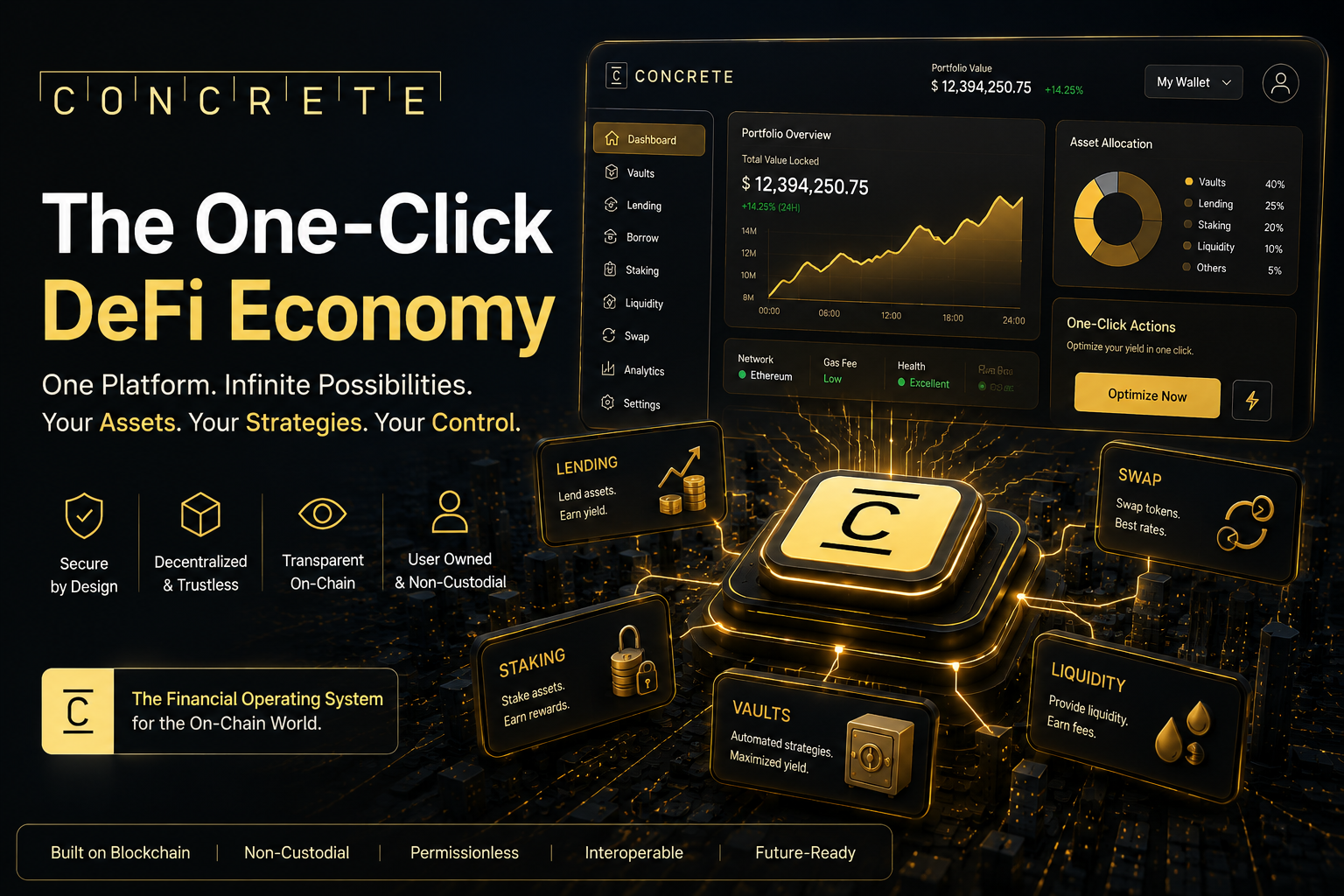
The One-Click DeFi Economy
DeFi was supposed to make finance more accessible.
In many ways, it succeeded.
Anyone with an internet connection can access lending markets, liquidity pools, derivatives, and yield opportunities that were once reserved for institutions.
But accessibility created a new problem.
Complexity.
Today, participating in DeFi often means making dozens of decisions every week.
Which protocol offers the best yield?
Which chain should capital be deployed on?
When should positions be rebalanced?
How should risk be managed?
What happens when incentives change?
The promise was open finance.
The reality often feels like a full-time job.
And that raises an important question:
What happens when infrastructure takes over the work?
The Operational Burden of Modern DeFi
Most users enter DeFi with a simple goal:
They want their capital to work.
What they often discover instead is a constant stream of operational tasks.
To remain competitive, users frequently need to:
- Monitor opportunities across protocols
- Move capital between chains
- Track rewards and incentive programs
- Manage risk exposure
- Rebalance positions as market conditions change
Every action requires time, attention, and execution.
The result is friction.
Not because opportunities are scarce, but because accessing them efficiently requires continuous effort.
Most users are looking for outcomes.
Not operations.
Why DeFi Became So Complex
The complexity of DeFi isn't accidental.
It is a byproduct of growth.
As new protocols, chains, and financial products emerge, opportunities become increasingly fragmented.
A single yield strategy may involve:
- Multiple protocols
- Multiple assets
- Multiple chains
- Ongoing adjustments
To capture the full value of these opportunities, users often need to behave like portfolio managers.
They evaluate allocations.
They monitor performance.
They decide when to move capital.
They execute transactions.
In effect, the user becomes the execution layer.
And while that model may work for highly active participants, it does not scale for everyone.
The Rise of the Infrastructure Layer
This is where the next phase of DeFi begins.
Instead of expecting every user to manage every decision, infrastructure can absorb the complexity.
The user provides capital.
The system handles operations.
This is the idea behind structured DeFi.
Infrastructure coordinates capital, automates execution, and continuously manages opportunities behind the scenes.
Rather than turning every participant into a full-time strategist, it allows them to access sophisticated systems through a simpler interface.
This is the foundation of what many describe as one-click DeFi.
How Concrete Vaults Simplify Capital Deployment
Concrete Vaults are designed around this principle.
Instead of requiring users to constantly reposition funds, the vault structure handles much of the operational workload.
Through a combination of:
- Automated compounding
- Strategy automation
- Onchain execution
- Structured vault systems
- Quantitative capital allocation
Concrete enables a more streamlined approach to onchain participation.
A key component of this framework is ctAssets, which help connect capital to a broader infrastructure layer designed for efficient deployment and management.
The result is a system where users can gain exposure to opportunities without manually managing every underlying action.
This is a significant shift from traditional DeFi workflows.
Instead of interacting with multiple protocols directly, users interact with infrastructure that coordinates those interactions on their behalf.
Why This Model Matters
Better infrastructure creates better outcomes.
When operational burdens are reduced, capital can be managed more efficiently.
Benefits include:
- Improved capital efficiency
- Reduced manual intervention
- Consistent strategy execution
- Better access to risk-adjusted yield
- More scalable onchain capital deployment
- Greater accessibility for both retail and institutional DeFi participants
Most importantly, infrastructure allows users to focus on allocation rather than execution.
The distinction may seem subtle, but it changes the entire experience.
Users spend less time managing positions and more time benefiting from them.
The Bigger Shift
As DeFi continues to evolve, the industry faces an important question:
Do users actually want more features?
Or do they want fewer decisions?
The answer may shape the future of the ecosystem.
Manual strategy management becomes harder as markets grow more complex.
Infrastructure scales more effectively.
This is why DeFi vaults are increasingly becoming the default interface for deploying capital.
The future of DeFi may not belong to users clicking between protocols all day.
It may belong to systems that coordinate capital more efficiently than individuals ever could.
That is what one-click DeFi really means.
Not removing complexity from the ecosystem.
But removing it from the user experience.
And that may be one of the most important upgrades DeFi has ever delivered.
Explore Concrete at https://concrete.xyz/