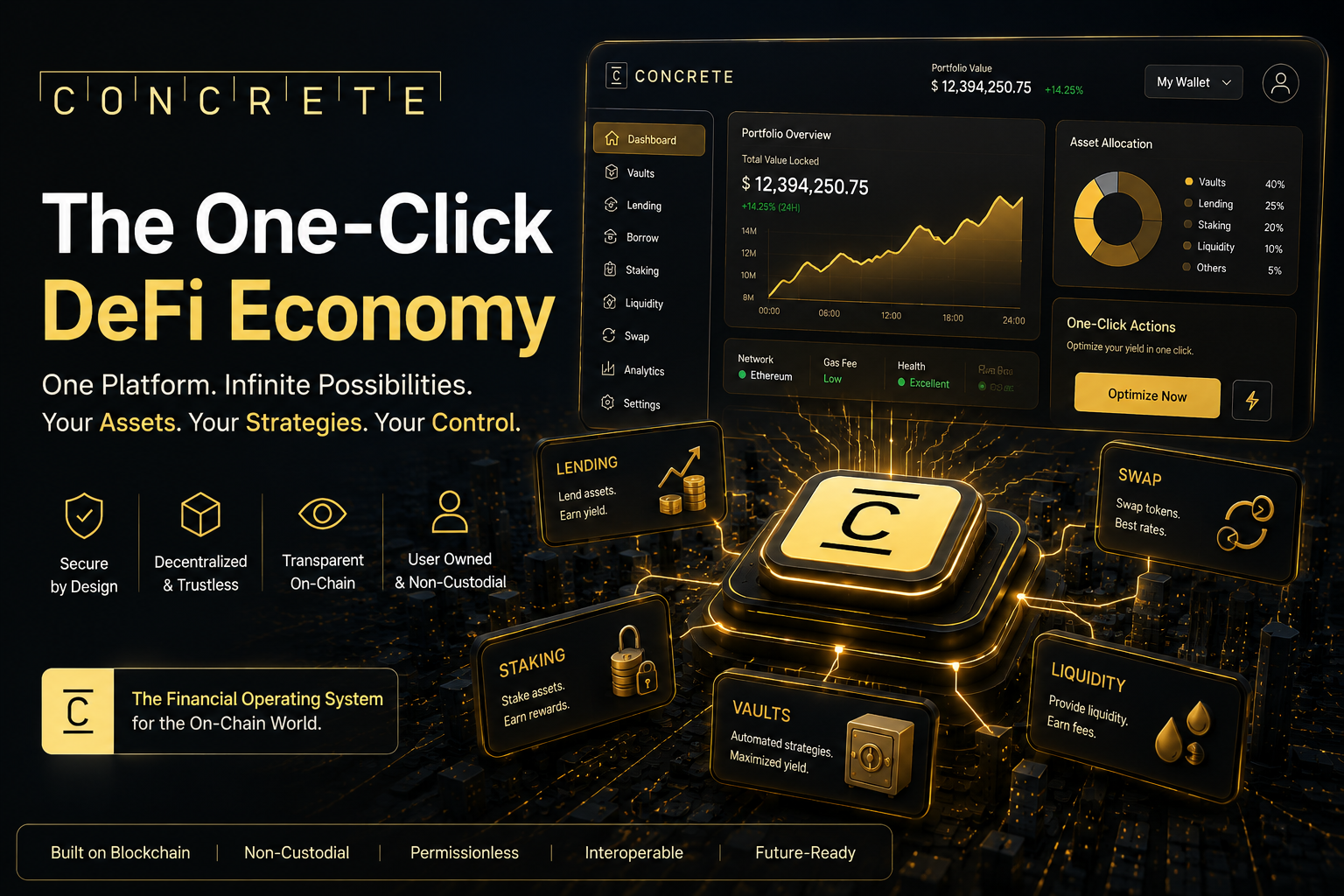
The One-Click DeFi Economy
 Fairerfair3 min read·Just now
--
DeFi was supposed to make finance more accessible. The promise was democratization: anyone with an internet connection could access high-yield opportunities previously reserved for Wall Street elites.
Instead, users often find themselves managing dozens of daily operational decisions. Which protocol offers the best yield today? Which chain should capital be on? When should positions be rebalanced? How should risk be managed? What happens when incentives change?
As the ecosystem grows, complexity grows with it. For the average participant, navigating this landscape has turned into a demanding chore. But the industry is hitting a tipping point, forcing us to ask a simple question: What happens when infrastructure takes over the work?
1. The Friction of Modern DeFi
The reality of participating in DeFi today is far from passive. To stay competitive, users must constantly monitor opportunities, manually move capital between protocols, track fleeting incentives, and rebalance positions as market conditions shift.
This operational burden creates massive friction. It favors those with the time to stare at screens all day, leaving casual participants and institutional allocators at a disadvantage. The fundamental issue is that most users want outcomes, not operations. They want sustainable, risk-adjusted yield, not a second job as an onchain execution clerk.
2. Why the System is Broken by Design
DeFi isn’t complicated by accident; its fragmentation is a byproduct of rapid innovation. Capturing premium yield frequently requires interacting with multiple protocols across multiple chains, each with its own smart contract risks, liquidity depths, and UX quirks.
When users are forced to act as their own portfolio managers, they effectively become the execution layer. They bear the brunt of gas spikes, slippage, timing errors, and cognitive fatigue. This manual approach to onchain capital deployment simply cannot scale.
3. Enter the Infrastructure Layer
The solution isn’t to make users smarter or faster — it’s to build an infrastructure layer capable of absorbing the complexity.
Instead of forcing individuals to manually route their own capital, mature financial systems rely on structured, automated layers to handle execution. This is where structured DeFi systems and smart DeFi vaults come into play. By automating execution and utilizing quantitative allocation models, the underlying infrastructure can coordinate capital dynamically behind the scenes.
The division of labor becomes clear: the user allocates capital; the infrastructure handles operations.
4. How Concrete Vaults Automate the Onchain Experience
Concrete Vaults are built specifically to bridge this gap, transforming a fragmented ecosystem into a seamless, one-click DeFi experience.
When you deposit capital into Concrete, the infrastructure takes over the heavy lifting:
• Strategy Automation: Capital is algorithmically routed to optimal yield sources based on rigorous risk parameters.
• Automated Compounding: Rewards are harvested, swapped, and reinvested automatically, maximizing mathematical efficiency while saving on gas.
• ctAssets: Users receive ctAssets (Concrete Assets) that represent their share of the vault, turning complex, multi-protocol positions into a single, liquid token.
Vault infrastructure allows you to capture institutional-grade opportunities without ever needing to micro-manage a position.
5. The Benefits of an Infrastructure-First Approach
Shifting the operational burden to dedicated code architecture unlocks several structural advantages:
• Capital Efficiency: Eliminates idle capital by ensuring funds are always deployed in the highest-yielding, risk-cleared environments.
• Reduced Operational Burden: No more manual bridging, gas tracking, or constant portfolio rebalancing.
• Consistent Execution: Algorithms don’t sleep, don’t panic-sell, and don’t miss yield adjustments due to a timezone difference.
• Institutional DeFi Infrastructure: Brings the risk-management rigor and execution precision of traditional finance straight onto the blockchain.
6. The Bigger Shift: Fewer Decisions, Better Outcomes
The future of decentralized finance will not be defined by giving users more buttons to click, more charts to read, or more decisions to make. Manual strategy management is a relic of DeFi’s infancy.
We are moving rapidly toward an environment where vaults and smart aggregation layers become the default interface for deploying capital onchain. Users don’t want a front-row seat to the plumbing of finance; they want a reliable utility that works.
The “one-click DeFi” economy means shifting from a world of frantic yield chasing to a world of durable, automated wealth management. The future won’t belong to the users clicking between protocols all day. It will belong to the infrastructure that does the work for them.
Step into the next generation of automated finance.
Explore Concrete at: https://concrete.xyz/