The Robot Paid for Itself: The Machine Economy Has Begun
--
On May 12, 2026, a delivery robot completed a job, settled payment in USDT on Solana, and moved on — with zero human involvement. This wasn’t science fiction. It was a working demo of the machine economy. Here’s what peaqOS is, why it matters, and what it signals about where crypto is heading.
It received the order. It mapped a route to the destination. Midway, a construction zone blocked the road. It rerouted autonomously. It completed the delivery. It paid the merchant.
Not once did a human intervene.
Payment method: USDT. Payment layer: Solana. Navigation: NAVER Maps.
And the operating system that made all of it possible:
peaqOS.
What Actually Happened
In a demo released by peaq on May 12, 2026, a Serve Robotics delivery robot navigated a simulated urban environment using NAVER Maps, completed a delivery, and processed an on-chain payment using Tether’s Wallet Development Kit with Solana as the settlement layer.
LG’s CLOi ServeBot was also demonstrated — running a simulated hotel room service scenario.
Two things need to be stated clearly upfront.
First: this was a demo in a simulated environment. This was not a real delivery on the streets of Seoul. It is a Proof of Concept stage.
Second: this is why it still matters. The underlying infrastructure worked. NAVER Maps API, the Solana payment layer, and peaqOS were genuinely integrated and functional together.
What Is peaqOS?
Think of peaqOS as Android — but for robots and machines.
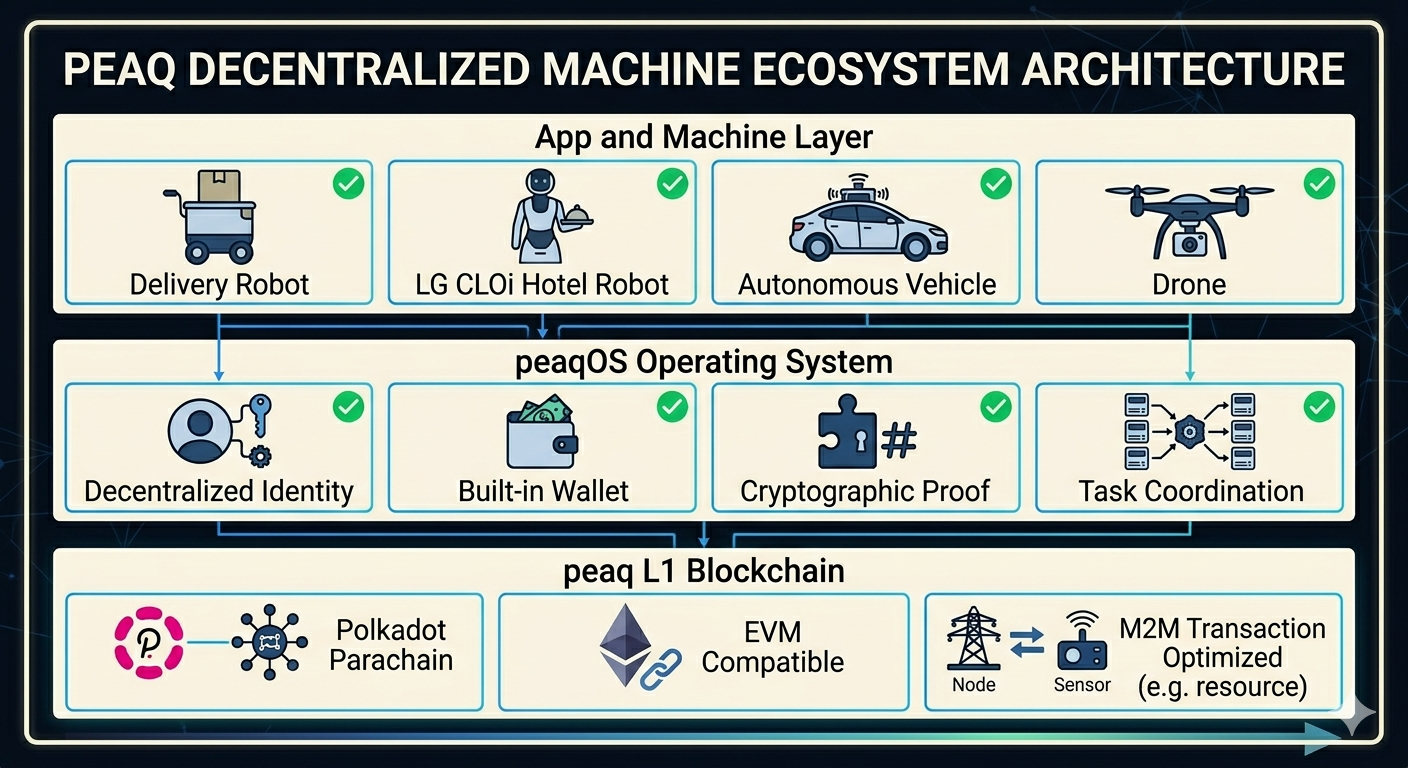
Instead of running apps and syncing calendars, it handles decentralized identity activation, built-in wallets, cryptographic proof of task completion, real-time task coordination, and telemetry verification.
In plain terms:
A robot has a blockchain-based identity. It has a built-in wallet. It can mathematically prove that it completed a task. And once that proof is verified, payment executes automatically.
This is why no human needs to be involved. The robot proves “I completed this task” cryptographically. The blockchain verifies that proof and releases the payment.
peaq — The Layer 1 Built for the Machine Economy
peaq is a Layer 1 blockchain designed specifically to power the machine economy — enabling DePIN (Decentralized Physical Infrastructure Networks) and autonomous machine-to-machine interaction.
peaq ecosystem as of February 2026:
- 60+ DePINs hosted across 22 industries
- Machine wallet TVL: $180 million
- Daily active devices: 12,000+
- Smart contract support: both EVM and ink!
The peaq technology stack:
peaq L1 (the computer): A Polkadot parachain with sub-second finality, EVM compatibility, and M2M transaction optimization.
peaqOS (the operating system): A blockchain-native OS for robots and machines — handling decentralized identity, built-in wallets, and cryptographic proof processing.
App and Machine Layer: Delivery robots, autonomous vehicles, drones, solar panels — real physical devices.
Why NAVER Maps — Korea and the Asia Strategy
NAVER is South Korea’s dominant search and mapping platform — the country’s equivalent of Google in the United States. Building the delivery robot’s navigation on NAVER Maps is a signal that peaq is thinking beyond a proof of concept toward real deployment in the Asian market.
Why does this matter?
South Korea is a robot-friendly environment. LG and Samsung are developing service robots. Delivery robots, hotel service robots, and hospital robots are already operating in the real world.
NAVER Maps is what Koreans use. Delivery workers navigate with NAVER Maps. Now delivery robots do too.
And the payment settles automatically on Solana.
Why Solana — The Conditions for Machine Payments
Solana Foundation president Lily Liu has argued that traditional card networks cannot economically support micropayments, making blockchain rails essential for AI agent and machine-to-machine transactions.
This is the core of it.
A delivery robot delivers a $3 coffee and earns $0.50 in delivery fees. A card network fee is too expensive for this transaction. A bank transfer is too slow.
Solana settles in 0.4 seconds at a cost of $0.00025 per transaction. Thousands of robots can process simultaneous micropayments without the network slowing down.
This is why Solana is being chosen as the payment rail for the machine economy.
LG CLOi — Enterprise Is Starting to Participate
LG’s CLOi ServeBot was included in this demo, running through a simulated hotel room service scenario.
Why does LG’s involvement matter?
LG already deploys CLOi robots in real hotels, airports, and restaurants. They are live in major Korean hotel chains today.
When a company the size of LG tests peaqOS, it signals that this technology has a credible path out of the lab.
Dubai VARA — Regulation Is Following
peaq and Dubai’s Virtual Assets Regulatory Authority (VARA) signed an MOU at GITEX 2025, covering the regulation of on-chain robotics, DePIN, and tokenized machines.
Technology moves first. Regulation follows. Dubai VARA is beginning to build the regulatory framework for the machine economy — addressing what had been one of the largest risk factors for the entire sector.
The Bigger Picture — What Is the Machine Economy?
This demo is not about robot delivery. It is about a fundamental economic shift.
The machine economy is a model where autonomous machine-to-machine transactions happen without business-to-business intermediaries.
The economy we know is human-centric. Humans place orders. Humans deliver. Humans pay.
The machine economy is different.
A robot purchases map data from NAVER Maps (M2M). Upon delivery completion, payment executes automatically (M2M). A share of the robot’s earnings is automatically distributed to the robot’s owner.
No human in the middle. Everything processed automatically on blockchain.
When this infrastructure matures:
- Owning a robot generates income
- Owning an autonomous vehicle earns rideshare revenue automatically
- A solar panel sells surplus electricity to neighbors and gets paid automatically
- A drone completes a delivery, autonomously refuels, and pays for it
Honest Assessment — There Are Still Walls to Clear
First, the demo was simulated.
This was not a real delivery in the streets of Seoul. It was a controlled environment demo. Handling sudden obstacles, pedestrians, and weather variables in an actual urban environment is an entirely different challenge.
Second, daily active addresses remain relatively stagnant.
peaq’s ecosystem has shown encouraging growth in new wallet addresses and total transactions, but daily active addresses have remained relatively flat. Technology and ecosystem are growing, but conversion to everyday real-world usage is still slow.
Third, regulation remains ambiguous.
Tokenized machines and DePIN operate in regulatory gray zones. Different jurisdictions will classify machine-generated revenue, tokenized infrastructure, and AI agents differently. Dubai is moving first, but global regulatory consistency is still far away.
Fourth, PEAQ token supply pressure.
Token unlock schedules continue into and beyond 2026, increasing circulating supply.
Closing Thoughts
On May 12, 2026, a robot paid for itself.
It was a demo. But the underlying infrastructure worked. NAVER Maps provided the route. Solana processed the payment. peaqOS orchestrated everything.
LG participated. Dubai is building a regulatory framework. 60 DePINs across 22 industries are running on peaq.
The machine economy is not a distant future. Right now, infrastructure is quietly being assembled.
Crypto is not a trend. It is an inevitability.
History repeats itself. Only the prepared will capture the opportunity.