Chain of Thoughts 2026–06–05
Saylor reframes the crash as capital fleeing to AI infrastructure, the same week chip stocks crack, a $1.75tn SpaceX IPO lines up, and Fear sits frozen at 12.
The Verdict
BTC — Short-term (3–5 months): BTC at $63,327 (-3.14%) — the $65K line that was the tape yesterday is now resistance overhead, and the round number below it is doing the work. The Block tallied the damage as a 14% week, near $62K intrasession, driven by Strategy’s sale, $4.2B in ETF outflows and macro headwinds #1, with CoinTelegraph putting the cumulative wipeout at $2T in crypto market cap and $60K as the support bulls now rest on #2. Gates: $65K (reclaim, now overhead), $60K (round-number support, live), $55K (Myriad target still standing), $68K (momentum repair, far).
BTC — Long-term (1–3 years): Fixed 21M supply, post-halving issuance, a settlement asset still accruing corporate-treasury and sovereign-reserve demand across jurisdictions. None of that moved this week; what moved is the destination of marginal risk capital. Two forecasts now bracket the same asset: a “Dr. Doom”-backed Atlas Capital CEO says BTC could fall 70% before eventually reaching $500,000 #3, while a Schwab strategist marks BTC’s ~$60K production cost as a possible energy-based cycle floor #4. Both can be right: the long-horizon valuation case and the next-quarter flow case run on different clocks. The position is the underlying, spot and self-custodied, sized to survive the gap between those two clocks.
ETH — Short-term: ETH at $1,764.40 (-2.83%) — through the $1,800 support that was the whole question yesterday, now trading under it. The level that mattered gave way without a fight; $1,500 is the prediction-market downside that flagged earlier this week and it sits closer now than it did. Gates: $1,800 (lost, now resistance), $1,500 (downside target, live), $2,000 (reclaim, far).
ETH — Long-term: Ethereum remains the settlement layer for the regulated rail this drawdown is still paving — supervised stablecoins, tokenized funds reaching into brokerage stacks, staking yield that lets treasuries service capital costs from cash flow rather than principal. Goldman Sachs’ tokenized real-estate fund added new service providers this session and ether.fi committed $100M to a real-world-asset vault — the institutional plumbing keeps getting laid while the token bleeds. The thesis is the layer and the cash-flow asymmetry, not the price; the price is what you pay to hold the layer through a quarter when capital is rotating out of all long-duration risk at once.
ADA — Short-term: ADA at $0.1810 (-10.99%) — the worst-performing major by a wide margin, and the sub-$0.20 break that was a signal-to-watch yesterday is now realized. Cardano is trading in multi-year uncharted territory with no chart memory beneath it and no fresh catalyst to arrest the slide — just broad-beta selling hitting the highest-beta name hardest. Gates: $0.20 (reclaim, now overhead), sub-$0.18 (uncharted), $0.15 (no structural reference until you get there).
ADA — Long-term: ADA market cap sits near $6.7B against ETH’s $213B — roughly a 32x gap between two networks claiming overlapping smart-contract and settlement use cases. A double-digit down day widens that gap rather than closing it, and the burden of proof is unchanged: the case requires shipped product routing real, fee-paying volume, and that evidence has not arrived. You are sizing for an outcome the data does not yet support — hold the position small enough that being early, or wrong, does not force your hand.
SOL/BNB/XRP: SOL $67.95 (-5.61%) — extending its run of post-2023 lows, leading the large-cap majors down. BNB $600.67 (-3.95%) — defending the $600 round number, broad-market beta with no wrapper story left. XRP $1.16 (-4.05%) — gave back yesterday’s relative outperformance and slid with the field, holding above $1.15.
Why The Market Is Here
The story finally got a destination. For a week the question was who stopped buying; this session the most-quoted seller in the market answered it, and the answer was not “no one” — it was “AI.”
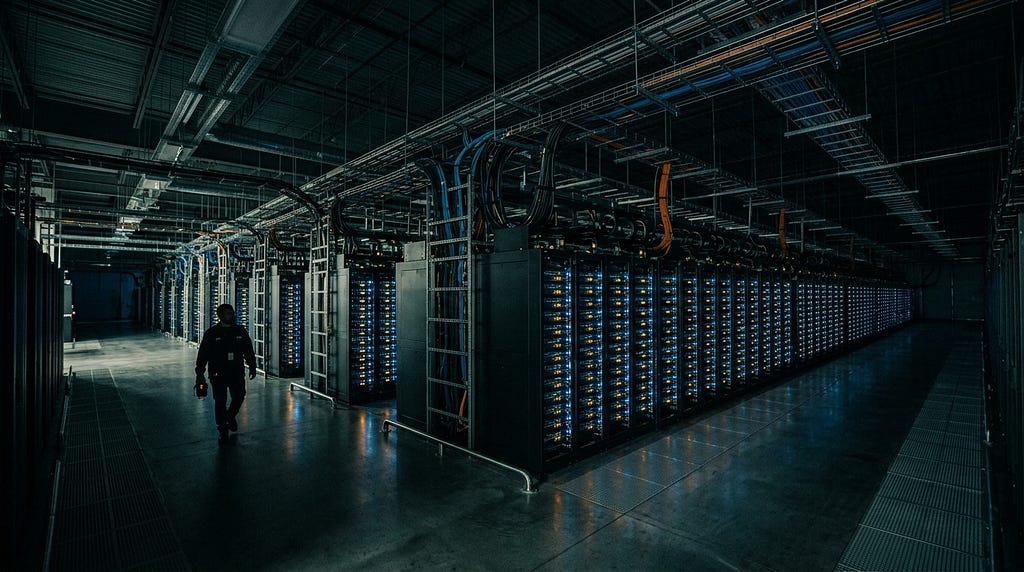
Saylor named the buyer, and it isn’t crypto’s. Strategy’s Michael Saylor blamed the selloff on a capital rotation into AI infrastructure rather than weakening Bitcoin fundamentals, even as his own firm sits on an $11B paper loss #5, a reframe Decrypt logged as Saylor pointing at the AI boom while BTC sits nearly 50% off its peak #6. Take it at face value or read it as a treasury holder talking his book — either way it sharpens yesterday’s “empty doorway.” The marginal buyer didn’t evaporate. It walked into a different building. That matters because it changes the fix: a halt in selling doesn’t bring that buyer back, and neither does a single ETF inflow day. What brings it back is AI losing its claim on the same risk budget — and nothing this session suggested that.
The doom-loop question got asked out loud. The trigger underneath the tape was mechanical: CoinTelegraph reported BTC fell as much as 21% after Strategy’s debt-buyback news tightened its liquidity and paused its buying, prompting a direct Terra-Luna-style “doom loop” question #7. The mere fact that the reflexive-leverage question is being asked about the largest corporate holder is itself the signal — it is what a market does near the bottom of a confidence cycle, whether or not the loop is real.
Equities cracked where it counts — the AI trade itself. S&P 500 -0.33% to 7,584 and Nasdaq -0.97% to 26,831, with the damage concentrated in the exact sector Saylor pointed at: Broadcom’s stock fell hard after it declined to raise its AI revenue outlook into a market “clamoring for material beats” #8, dragging Micron into a record market-cap wipeout as the semiconductor trade lost steam #9. The irony is sharp: capital rotated out of crypto and into AI, then AI itself wobbled the same week. When the destination trade stumbles, the risk-off bid doesn’t rotate back to Bitcoin — it goes to cash and the dollar. DXY at 99.44 held flat; gold at $4,502 (+1.48%) was the lone risk asset that gained.
Oil eased even as the headlines didn’t. Brent fell -2.73% to $95.14, unwinding part of the geopolitical premium that bid it this week — and it did so against a backdrop that didn’t soften: the House passed a war-powers measure rebuking Trump over Iran, which he called “unpatriotic,” after an Iranian drone strike on Kuwait’s airport #10. Price ignoring escalation headlines is the market pricing de-escalation odds, not confirming peace. The energy channel that fed yesterday’s inflation-and-yields story released a notch — but the relief is conditional, one tanker headline from reversing.
Fear stopped falling and just sat there. The Fear & Greed Index printed 12, fractionally up from yesterday’s 11, deep in the “fire sale” band Bitcoin Magazine ties to the FTX-crash zone #11. Yesterday the index gapped; today it froze. A sentiment gauge that stops dropping at the floor is not a bottom signal — it is the market holding its breath. Extreme Fear can grind sideways at single digits for weeks, and a flat print is only useful as the absence of fresh panic, not the presence of returning bid.
Institutional Pulse
The pulse this session is a composition shift, not just an outflow — and a policy rail whose window is being timed by its skeptics.
Who is leaving the ETFs matters more than the headline outflow. Beneath the $4.2B in outflows is a sorting: filings show professional investors dumped roughly 52K BTC worth of ETFs in Q1, with hedge funds exiting while banks and long-term allocators kept building exposure #12. That is the momentum money leaving and the patient money staying — a healthier holder base on the other side of the pain, but not a bid that shows up on today’s tape. Who is selling and why: fast money is de-risking, slow money is accumulating, and the price is set by the faster clock.
Adoption infrastructure kept shipping into the drawdown. Coinbase confirmed the first Fannie Mae-backed conventional mortgage closed using Bitcoin as collateral, with token-backed down payments rolling out this summer #13. This is the structural bid the flow data can’t see yet — collateral demand that exists regardless of where the index sits, the kind of plumbing that compounds across a cycle rather than a week.
The policy window is being timed in weeks, not seasons. JPMorgan analysts said the Clarity Act may have only a narrow window for passage this year #14, even as the White House’s crypto adviser defended the bill as the Senate process grinds forward. The legislative rail is still the one bullish structural input printing while the tape bleeds — but a “narrow window” framed by a major bank is the crypto-as-policy-risk read in numbers: the legislative runway may be shorter than markets holding for it assume, and a thinned buyer base would feel a stall harder than a crowded one would.
The OTC bid has thinner standing this week. Large spot accumulation still clears OTC to avoid moving the tape, and the bank-and-allocator buying in the ETF data is exactly the cohort that routes there. But OTC needs a willing seller and a patient buyer in the same room; with fast money exiting and the marginal new buyer parked in AI, the desks are matching a smaller book against a deeper one. That asymmetry is the mechanical face of “the buyer went somewhere else.”
Calendar Watch
US jobs report — today (Friday). A war-weary Treasury market faces a fresh test from the print, with investors already demanding higher compensation to hold US debt #15. A hot number firms yields and squeezes long-duration risk; a soft one hands the dovish read crypto wants. Nearest catalyst on the board.
AI IPO wave — into September. Arthur Hayes said he dumped HYPE and NEAR, warning markets may peak before September as a wave of mega AI IPOs drains liquidity #16 — a thesis the $1.75tn SpaceX listing now targeting the largest debut on record #17 makes concrete. Every large AI listing is a competing claim on the same risk budget crypto needs.
Clarity Act window — JPMorgan’s “narrow” framing turns the summer push into a countdown. Pass stabilizes the rail; slip activates the policy-risk read.
Signals Worth Watching
- BTC close below $60K — round-number break; the $55K Myriad target becomes the live floor and the Schwab “$60K mining-cost floor” thesis gets tested directly
- BTC reclaim of $65K — the lost line flips back to support; the AI-rotation read pauses
- First positive BTC ETF flow day — the fast-money exit stops setting the price; patient-money accumulation gets visible
- Any sign AI risk appetite cracks further (more chip weakness, a failed mega-IPO) — directly tests whether crypto is the rotation’s victim or just sharing the same risk-off
- ETH reclaim of $1,800 — lost support repairs; the path to $1,500 stalls
- ETH close below $1,650 — confirms the $1,500 downside is in play
- ADA reclaim of $0.20 — the sub-$0.20 break gets rejected; without it, there is no structural reference until lower
- F&G print below 10 — the frozen floor breaks into single digits; historically a washout zone, not a guarantee
- F&G reclaim above 25 — sentiment unfreezes upward; first dent in the panic
- Brent sustained below $90 — the geopolitical premium fully unwinds; yields ease; one macro headwind releases
- Friday jobs print — hot firms yields against crypto; soft opens the dovish door
- Kuwait / Iran escalation — the kinetic lane that bid oil this week reverses the relief if it flares
Big Picture
The most important sentence in the market this week came from a seller defending his own position, and it is still worth taking seriously: the money didn’t leave risk, it changed which risk it wants. Saylor’s “capital rotation into AI” is self-serving, but the tape corroborates the shape of it. Crypto and the AI complex are now competing for the same pool of speculative capital, and for most of the past year AI was winning that competition without crypto even noticing the contest. The selloff is partly the moment the contest became visible.
What makes this structural rather than a one-week narrative is the supply of AI claims arriving on that risk budget. A $1.75tn SpaceX debut #17, a pipeline of mega AI listings Hayes is positioning ahead of #16, and an industry whose own leaders describe AI now writing most of its own code #18 — every one of those is a vehicle that lets generalist capital own the AI story without touching a token. For years the bull case for crypto was that it was the only liquid way to bet on the future. AI just became a more liquid, more institutionally legible way to bet on a future, and it is soaking up the marginal dollar that used to have nowhere else to go.
The catch — and the reason this cuts both ways — is that the AI trade is leveraged to the same risk appetite crypto is. This week’s chip-stock crack is the tell: when the AI complex itself wobbles, the rotated capital doesn’t come home to Bitcoin, it goes to cash. So the near-term path for crypto is uncomfortable in both directions: if AI keeps winning, it keeps draining the bid; if AI breaks, the de-risking hits everything at once. The clean version of the bull case — that crypto re-rates the moment the rotation reverses — requires AI to lose its grip on the risk budget without taking the whole risk complex down with it. That is a narrow needle, and it is the one worth watching for the rest of the year.
If I Had $100 This Month
The buyer didn’t disappear, it relocated to AI, and the destination trade cracked the same week — leaving every risk asset selling the dollar’s exit at once. Fear is frozen at the floor, not bouncing off it. This is colder than yesterday and still a DCA window precisely because nobody wants it to be: you accumulate into the rotation, not against the next bounce.
- $60 → BTC. $60K is the line and the cited miner-cost floor; the long-horizon supply case is intact even as the marginal dollar shops elsewhere.
- $25 → ETH. $1,800 broke and $1,500 is the flagged downside; you are buying the settlement layer and its yield, not the level.
- $15 → ADA. Sub-$0.20 is uncharted and the gap to ETH only widened; size it for being early and possibly wrong, not for a snapback.
Hold actual coins. Not ETF shares, not equity proxies.
This is how I’d think about it. Make your own call.
Sources
- #1 — ‘The rally that wasn’t’: Bitcoin slides 14% in one week as ETF outflows, Strategy sale and oil hit sentiment — The Block
- #2 — Bitcoin bulls’ fate rests on $60K support as crypto erases $2T in market cap — CoinTelegraph
- #3 — ‘Dr. Doom’-backed Atlas Capital CEO says bitcoin could crash 70% before reaching $500,000 — CoinDesk
- #4 — Schwab Strategist: Bitcoin’s $60,000 Mining Cost Could Mark the Cycle Bottom — Bitcoin Magazine
- #5 — Saylor downplays Bitcoin slide as Strategy faces $11B paper loss — CoinTelegraph
- #6 — Strategy’s Michael Saylor Blames ‘Capital Rotation’ Into AI as Bitcoin Dives 13% — Decrypt
- #7 — Bitcoin fell 21% after Strategy’s debt buyback news — Is a Terra Luna-style doom loop next? — CoinTelegraph
- #8 — Why Broadcom’s stock is falling so hard after earnings — MarketWatch
- #9 — Micron suffers record market-cap wipeout as Broadcom casts a shadow over chip stocks — MarketWatch
- #10 — Trump hits back at ‘unpatriotic’ vote after House rebukes him over Iran — BBC World
- #11 — Bitcoin Price Plunges Below ‘Fire Sale’ Territory as Fear Index Reads 12 — Bitcoin Magazine
- #12 — Professional investors dumped 52K BTC worth of ETFs in Q1, filings show — CoinTelegraph
- #13 — Fannie Mae-Backed Bitcoin Home Mortgages Are Finally Here, Coinbase Says — Decrypt
- #14 — JPMorgan says crypto bill may have only a narrow window for passage this year — The Block
- #15 — A war-weary Treasury market faces a fresh test with Friday’s jobs report — MarketWatch
- #16 — Arthur Hayes dumps HYPE, NEAR as he warns of AI IPO wave — CoinTelegraph
- #17 — SpaceX says it’s worth $1.75tn as it targets largest stock market debut — BBC Business
- #18 — AI Is Already Developing AI, Says Anthropic — And Humans May Be Slowing Things Down — Decrypt
Market Data
Asset             Price          24h
──────────────────────────────────────
Bitcoin (BTC)     $63,327        -3.14%
Ethereum (ETH)    $1,764.40      -2.83%
Cardano (ADA)     $0.1810        -10.99%
Solana (SOL)      $67.95         -5.61%
BNB               $600.67        -3.95%
XRP               $1.16          -4.05%

Fear & Greed: 12 — Extreme Fear  (was 11 yesterday)
S&P 500: -0.33%  ·  Nasdaq: -0.97%  ·  DXY: 99.44 (-0.09%)  ·  Gold: $4,502 (+1.48%)
Chain of Thought is a daily crypto and macro market digest. Not financial advice.
The Missing Buyer Showed Up — In AI was originally published in Coinmonks on Medium, where people are continuing the conversation by highlighting and responding to this story.