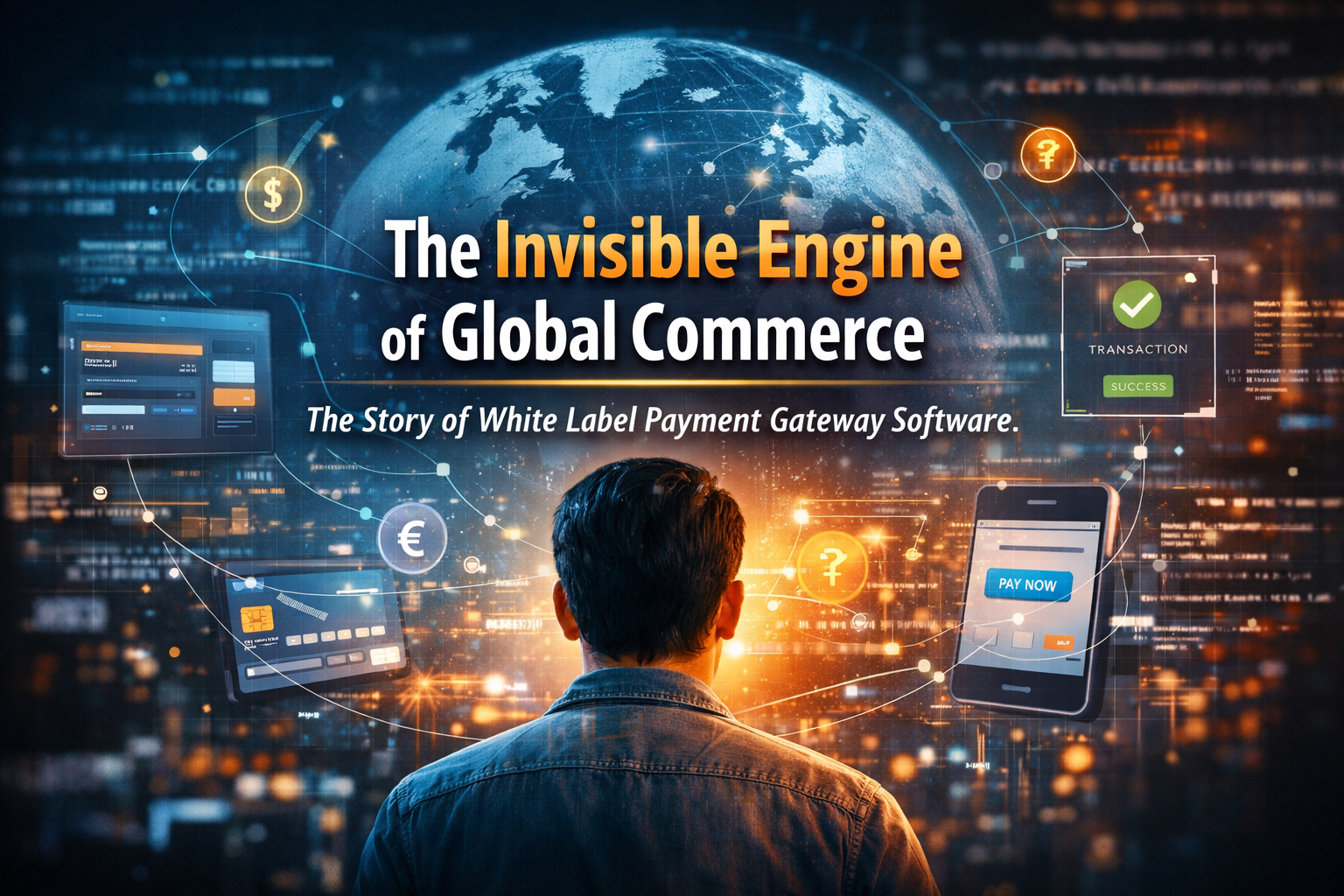
The Invisible Engine of Global Commerce: A White Label Payment Gateway Story
There are moments in business when everything looks simple on the surface… but underneath, an entire invisible machine is working relentlessly.
 Antriksh Bansla6 min read·Just now
--
Every time a customer clicks “Pay Now,” a complex world wakes up in milliseconds — fraud checks, routing decisions, currency conversions, bank approvals, compliance filters, and settlement layers.
Most people never see it.
But for Arjun, a fintech founder in his early thirties, this invisible world became his obsession — and eventually, his opportunity.
Chapter 1: The Problem No One Talks About
Arjun didn’t start with payments. He started with e-commerce.
He built small online stores, helped local merchants go digital, and even experimented with dropshipping businesses. Everything worked fine until one recurring problem kept breaking growth:
Payments.
One week a payment gateway would work flawlessly. The next week, transactions would fail without explanation. International payments? Even worse. High fees, unpredictable approvals, and long settlement delays.
One merchant told him something that stuck:
“I don’t need customers — I need payments that don’t fail.”
That sentence changed everything.
Arjun realized something important:
• Businesses don’t lose sales because of bad products
• They lose sales because of broken payment experiences
• And most of them don’t even control their payment infrastructure
That was the gap.
Not just a payment gateway — but ownership of the payment experience itself.
Chapter 2: The Discovery of White Label Infrastructure
While researching alternatives, Arjun stumbled upon a concept that sounded almost too powerful:
White label payment gateway software
At first, it seemed like something only banks or massive fintech companies could use. But as he dug deeper, he discovered something surprising:
A white label payment gateway allows companies to launch their own branded payment system — without building the entire infrastructure from scratch.
In simple terms:
• You don’t build the engine
• You brand it, control it, and resell it
• You become the payment provider in your customer’s eyes
It was like owning a bank’s technology — but without building a bank.
That idea stayed with him.
And then came the real insight:
“If merchants trust your payment system instead of a third party… you don’t just solve payments — you own the relationship.”
Chapter 3: The First Prototype That Failed Miserably
Arjun partnered with a developer friend and started building.
They underestimated everything.
Payment routing logic? Complex.
Compliance requirements? Heavy.
Bank integrations? Slow and restrictive.
Fraud prevention systems? Constantly evolving.
Their first version barely worked.
Transactions failed silently. Dashboards lagged. Refund flows broke randomly. And merchants lost trust within days.
One angry user message read:
“This is worse than the gateway I already had.”
That hurt.
But it also revealed something critical:
Building a payment gateway is not just engineering — it’s trust engineering.
And trust, once broken, is almost impossible to recover.
Chapter 4: The Shift; From Product to Platform
Instead of giving up, Arjun changed direction.
He stopped thinking like a product builder and started thinking like an infrastructure provider.
He asked a different question:
“What if businesses could launch their own payment gateway under their own brand — without worrying about backend complexity?”
That was the turning point.
They rebuilt the system as a modular platform:
• A core payment engine
• A white label branding layer
• A merchant dashboard builder
• A routing and optimization system
• A compliance and risk module
Now, instead of selling a tool, they were offering something much bigger:
A complete payment infrastructure that companies could rebrand and own.
Chapter 5: The First Real Customer
Their first serious client wasn’t a tech company.
It was a mid-sized remittance business operating between India and the Middle East.
They had a big problem:
• High cross-border transaction fees
• Slow settlement cycles
• Lack of brand control over payment experience
They wanted independence.
When they discovered Arjun’s platform, they didn’t ask “How does it work?”
They asked:
“Can we make it look like our own system?”
That was the moment Arjun knew they were onto something.
They onboarded the client, customized the branding, and launched their first white label gateway instance.
Within 60 days:
• Transaction success rate improved significantly
• Settlement times reduced
• Customer complaints dropped sharply
• Brand trust increased in new markets
But most importantly…
The client started referring to it as their own payment system.
Not Arjun’s product.
Theirs.
Chapter 6: Why White Label Payment Gateways Matter
As more clients came in, Arjun noticed a pattern.
Businesses didn’t just want payment processing.
They wanted control.
White label payment gateways gave them three powerful advantages:
1. Brand Ownership
Instead of redirecting customers to third-party payment pages, businesses could offer a seamless branded checkout experience.
2. Revenue Control
Companies could add custom fees, margins, or subscription layers on top of transactions.
3. Data Independence
They could analyze transaction behavior, customer patterns, and revenue flow without relying on external providers.
In short:
They stopped renting payment infrastructure… and started owning it.
Chapter 7: The Hidden Complexity Behind Simplicity
What users saw was simple:
• A branded checkout page
• A dashboard
• A transaction history
What they didn’t see was everything behind it:
• Multi-acquirer routing logic
• Real-time fraud detection systems
• Currency conversion optimization
• Bank failover mechanisms
• Regulatory compliance layers across regions
• Encryption and tokenization systems
Arjun often joked:
“The simpler the checkout looks, the more complicated the backend becomes.”
And he wasn’t wrong.
Because in payments, simplicity is engineered — not accidental.
Chapter 8: Scaling Pain and the Trust Barrier
As adoption grew, so did the challenges.
Every new client meant new requirements:
• Different currencies
• Different compliance rules
• Different payout cycles
• Different fraud thresholds
And every failure had consequences.
One failed transaction wasn’t just a bug — it was a lost sale, sometimes even a lost customer relationship.
Arjun’s team realized something brutal:
In payments, you don’t just scale technology — you scale trust.
So they introduced stricter systems:
• Smart routing engines that auto-select the best payment path
• AI-based fraud scoring systems
• Redundant bank integrations
• Real-time monitoring dashboards
Slowly, reliability improved.
But the pressure never disappeared.
Chapter 9: The Moment Everything Clicked
One evening, Arjun received a message from a client CEO:
“We’ve stopped thinking about you as a vendor. This is now our payment backbone.”
That line hit differently.
Because it meant the transformation was complete.
They weren’t selling software anymore.
They were enabling businesses to become fintech companies themselves.
That’s the true power of white label payment gateway software:
It turns non-fintech businesses into fintech operators — without them ever building infrastructure from scratch.
Chapter 10: What Most People Get Wrong About Payments
Over time, Arjun noticed a misconception in the industry.
People think payment gateways are just transaction processors.
But in reality, they are:
• Trust systems
• Revenue systems
• Data systems
• Growth systems
A broken payment experience doesn’t just fail a transaction — it breaks the entire customer journey.
That’s why white label solutions became so important.
Because businesses don’t just want payments to work.
They want payments to feel like their own ecosystem.
Chapter 11: The Future Arjun Saw
As the platform matured, Arjun began seeing a bigger trend:
Every business would eventually become a fintech layer.
Not because they want to.
But because they have to.
Customers expect:
• Faster payments
• Seamless checkout
• Multi-currency support
• Embedded financial experiences
And white label payment gateways are becoming the foundation of that shift.
Arjun put it simply:
“In the future, every company will either integrate payments — or become a payment company.”
Final Chapter: The Invisible Revolution
Today, Arjun’s platform powers businesses across multiple industries — e-commerce, remittance, SaaS, and digital services.
Most end users never know it exists.
And that’s the point.
Because the best infrastructure is invisible.
It doesn’t ask for attention.
It just works.
And somewhere behind every successful transaction, there’s a quiet system ensuring that money moves safely, instantly, and seamlessly across borders.
A white label payment gateway isn’t just software.
It’s the invisible engine of modern commerce.
And for Arjun, it all started with a simple frustration:
“Why do payments fail when everything else is working fine?”
That question didn’t just build a product.
It built a platform.
And eventually… it built a new way businesses think about money itself.