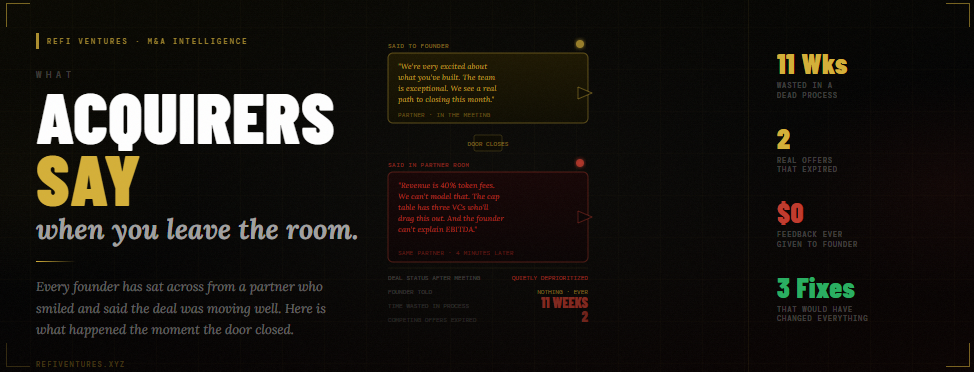
WHAT ACQUIRERS SAY WHEN YOU LEAVE THE ROOM
 VICTOR RAPHAEL3 min read·Just now
--
The Four Minutes That Decide Whether Your Deal Lives or Dies — And What You Can Actually Do About It
You will never be in that room.
The meeting ends. You shake hands. You say it went well because it felt like it went well. The partner smiled. They asked smart questions. They said the team is impressive and the product is differentiated and they see a real path to getting something done. You walk to the elevator feeling like you are close.
The door closes.
You have four minutes before the conversation becomes the one that actually matters. Not the one you were part of. The one you will never hear.
Here is what gets said in that room. Not as speculation. As the consistent pattern across hundreds of acquisition conversations in Web3 and AI over the last three years.
The first thing an investment committee evaluates is not the product. It is the translation problem. Can they model what you built? If your revenue is 40 percent token fees, 30 percent protocol incentives, and 30 percent grant income, they cannot put you in a DCF without a conversation they are not equipped to have. The partner who liked your demo cannot defend a valuation to a committee that does not understand what they are buying. You leave the room convinced you have a champion. Your champion leaves the committee meeting having been unable to close the room. Nobody tells you this. The process quietly dies.
The second thing they discuss is cap table complexity. Three VCs with blocking rights, a DAO treasury with governance requirements, and a founding team split across four jurisdictions is not a problem you need to solve before the meeting. It is a problem you need to have already solved. Acquirers do not buy complicated. They buy clean. When the committee asks what the closing process looks like and the honest answer is eighteen months of governance votes and investor negotiations, the deal moves to the back of the queue and stays there.
The third conversation is about you. Specifically, whether you can operate inside their structure. Founders who talk exclusively about their vision and cannot speak fluently about margins, retention curves, and integration roadmaps send a signal that the relationship will be expensive to manage post-close. The partner who met you may believe in you completely. The CFO who has to model the earnout needs to believe in the numbers. Your ability to speak both languages in the same meeting determines whether your champion has anyone to champion you to.
None of this gets communicated back to the founder. The feedback loop in M&A is almost entirely closed. You get a polite email about timing or strategic fit or internal priorities. You never get the real answer. And because you never get the real answer you cannot fix the actual problem before you walk into the next meeting and make the same mistakes with a different partner.
The founders who close consistently are the ones who understand what is being evaluated in that second conversation and prepare for it before the first one. They restate their revenue in familiar frameworks before anyone asks. They arrive with a clean cap table summary that shows a clear closing path. They can move between founder language and operator language in the same breath because they have practiced it enough that it does not feel like code-switching.
They do not leave anything to the champion to explain. They make the champion’s job easy. A partner who can walk back into the committee room and answer every question before it is asked is a partner who closes deals.
You are not in that room. But everything you do in the room you are in determines what gets said in the one you are not.
The four minutes after you leave are decided in the sixty minutes before you arrive.
Prepare for the conversation you will never hear.
That is the one that counts.
Get acquisition-ready before your next meeting at refiventures.xyz