The Future of Insurance: Will AI Transform or Replace the Industry?
 Shagun Bhardwaj7 min read·Just now
--
The $7 Trillion Industry About to Be Eaten by AI Agents
The Bargain That Held for a Century
Insurance works because of information asymmetry. Insurers aggregate loss data across millions of customers; no individual can replicate that view. The underwriter knows more about your risk than you do — and charges accordingly. That knowledge gap is the moat.
AI is draining it.
An agent trained on decades of claims data, real-time behavioral signals, IoT feeds, satellite imagery, and financial records doesn’t just approximate what a skilled underwriter knows. It surpasses it — for every customer, simultaneously, at zero marginal cost, faster and more accurate. The information advantage that justified the insurer’s position in the value chain is becoming a commodity.
Places AI Already Outperforms
The transformation isn’t theoretical. The following functions show where the gap is already open.
Claims. Lemonade settled a theft claim in three seconds in 2016 — no human involved, 18 data points reviewed, payment issued. That was nearly a decade ago. Tractable now uses computer vision to assess vehicle and property damage from photos, cutting settlement cycles from weeks to hours. The human adjuster survives for complex, contested, or emotionally sensitive cases. Everything else is being automated.
Product Design. Parametric insurance — coverage that triggers automatically when a defined event occurs, with no claims process — is only viable at scale with AI. Arbol writes parametric weather contracts for farmers that pay out the moment satellite data confirms a drought. No adjuster, no assessment, no delay. The product couldn’t exist without the model.
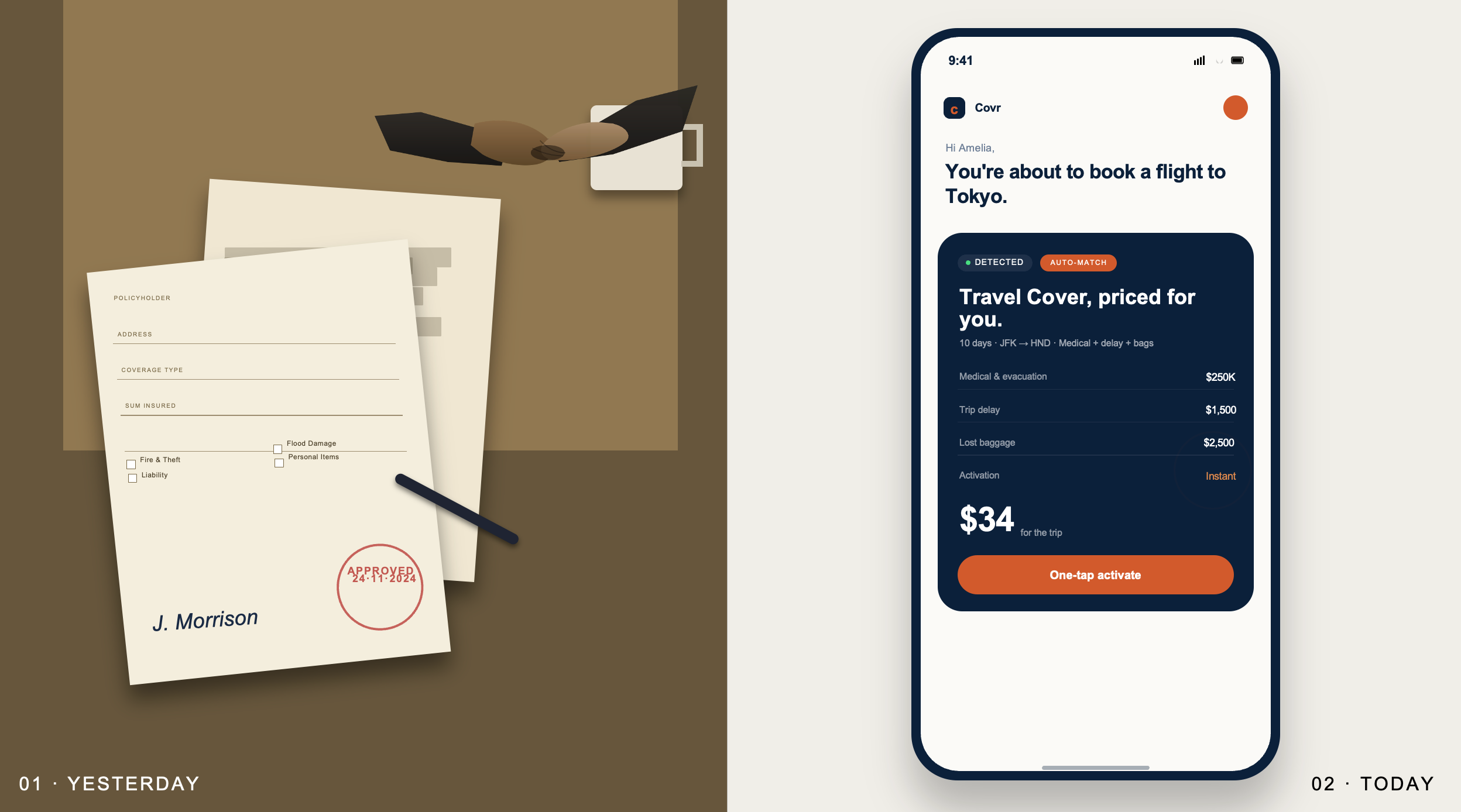
Distribution. Cover Genius has embedded insurance into over 50 of the world’s largest digital platforms — airlines, fintechs, e-commerce marketplaces. The customer never visits an insurance website. Coverage appears at the moment of need, priced in real time, underwritten invisibly. Distribution has been fully decoupled from the insurer brand.
These aren’t edge cases. They’re early signals of a direction.
The Four Stages
Here’s the framework I keep returning to when I think about where this ends. The four stages aren’t parallel futures — they’re a progression. A ladder you can only descend.
Stage 1: The Adaptive Insurer
A claims team at a major carrier adopts AI-assisted triage. An underwriting desk uses a model to flag risks a human would have missed. Ping An builds one of the world’s most sophisticated AI research operations — inside an insurance company. The insurer still owns product, distribution, capital, and customer. AI is a tool. Humans remain in the loop. The business improves. Nothing has fundamentally changed.
Most large insurers today are somewhere in Stage 1. Some are proud of it. That’s precisely what makes the next stage so easy to miss.
Stage 2: The Capital Shell or Embedded Insurance
The AI agent owns the customer. The insurer owns the balance sheet.
A freelance designer in Berlin buys professional liability coverage inside her invoicing app. She has no idea which insurer underwrote it. She doesn’t need to. The experience is frictionless. The insurer’s brand never appeared — only their capital did.
This is the embedded insurance model at its logical conclusion. The insurer has become infrastructure: a regulated, risk-bearing API that AI-native distributors plug into. The margin is thinner. The volume is enormous. And the insurer has quietly surrendered the thing that matters most in financial services — the relationship.
This stage is already underway. The question is whether incumbents are entering it by choice or by default.
Stage 3: The Great Bypass
What if the AI doesn’t need the primary insurer at all?
Reinsurance markets, catastrophe bonds, and Insurance-Linked Securities funds already provide the capital sitting behind primary insurers. If an AI platform can model risk accurately enough to satisfy institutional investors directly — and regulatory frameworks evolve to permit it — the primary insurer layer becomes expensive overhead. The transaction becomes: individual risk → AI model → capital market. No carrier in between.
The Insurance-Linked Securities (ILS) market has grown to over $100 billion. Sophisticated investors are already comfortable with algorithmic risk transfer. The technical architecture for direct access is being built. Regulation is the last barrier — and regulation follows market pressure.
Stage 4: Insurance Without Insurers or the Protocol Layer
In 2022, Etherisc — a decentralized insurance protocol — paid crop failure claims to smallholder farmers in Kenya via smart contract, minutes after satellite data confirmed the loss. No company processed the claim. No adjuster assessed the damage. A protocol did it.
Scale this. Layer in more sophisticated AI. Add sufficient capital from decentralized pools. You no longer have an insurance company. You have a protocol that performs the economic function of insurance — risk pooling, pricing, claims settlement — without a legal entity at the center.
This stage requires regulatory reinvention, not just adaptation. But the proof of concept already exists.
Signals That Will Reveal Which Future Is Forming
These developments, more than any forecast, will indicate which of the four futures is taking shape — and where incumbents still hold agency.
01 — AI Ownership · Who owns the interface layer Do insurers build proprietary agents, or cede the layer to third-party distributors? The party that owns the agent owns the relationship. Every major insurer that outsources its AI distribution is quietly entering Stage 2 — whether it acknowledges it or not.
02 — Regulatory Architecture · AI-native vs. legacy mapping Do regulators create AI-native licensing frameworks, or force AI into legacy insurance categories? New frameworks unlock new entrants and new business models. Legacy mapping entrenches incumbents — but only temporarily. Regulatory arbitrage has a way of finding its level.
03 — Capital-Market Interfaces · Programmable ILS and cat bonds Do ILS funds, catastrophe bonds, and reinsurance markets develop direct AI-accessible interfaces? If capital becomes programmable — callable by an algorithm rather than a carrier — the primary insurer layer becomes optional overhead. Watch this space closely: the ILS market is already experimenting.
04 — Embedded Dominance · Insurance at the point of sale Does coverage offered at the point of purchase — mortgage, car, travel, health — become the dominant distribution channel? If it does, traditional insurance marketing is bypassed entirely, and the customer never chooses an insurer again. They simply accept or decline what the platform offers.
05 — Data Monetisation · Loss and behavioural data as product Does any insurer successfully sell its historical loss and behavioural data as a standalone product to AI platforms, fintechs, or capital markets? Those who do will have found their role in the AI-native stack. Those who don’t risk watching their most valuable asset extracted by others who move faster.
None of these signals will announce themselves clearly. They will arrive as product launches, regulatory consultations, partnership announcements, and quiet acquisitions. The question is whether the industry is paying attention to the right ones.
The Only Question That Matters
Every insurer holds an asset AI cannot easily replicate: decades of proprietary loss data. The institutions sitting on that data have a window — narrowing — to build the intelligence layer themselves. To become the AI-native platform rather than the capital sitting behind someone else’s.
The industry survived the internet largely intact because distribution changed but underwriting expertise and capital requirements kept incumbents central. This time is different. AI erodes the expertise moat. Capital is the last line of defense.
The defining question isn’t whether AI will transform insurance. It already is. The question is whether the people running insurance companies are moving fast enough to shape what comes next — or whether they’ll look up in five years and find themselves firmly, and irreversibly, in Stage 2.
Where This Ends
I don’t think Stage 4 is inevitable. I do think Stage 2 is.
The trajectory from there depends on decisions being made right now — in product roadmaps, technology investments, and regulatory strategies. The insurers who treat AI as an efficiency tool will find themselves The Capital Shell before they see it coming. The ones who treat it as an existential strategic question may still be The Insurer.
Which stage is your organisation actually on? And more importantly — is that where you intended to be?
Shagun Bhardwaj is Head of Data and AI at Alpha FMC, and a Data and AI executive with 16+ years at Accenture, Deloitte, and EY, leading AI and enterprise transformation programs across financial services and global markets. A trusted advisor to C-suite leaders on AI strategy, and a builder of alliances with platforms including Databricks, Snowflake, OpenAI, and Anthropic. Writes on the intersection of AI, business transformation, and the industries being remade by intelligent systems.
Follow for more on the future of financial services, AI, and the business models being quietly remade beneath them.