The DeFi Paradox: Why Your “Earnings” Might Be Your Exit
 Ball3 min read·Just now
--
In the world of decentralized finance, visibility is a double-edged sword. We have never had more data at our fingertips, yet we’ve never been more confused about where value actually originates.
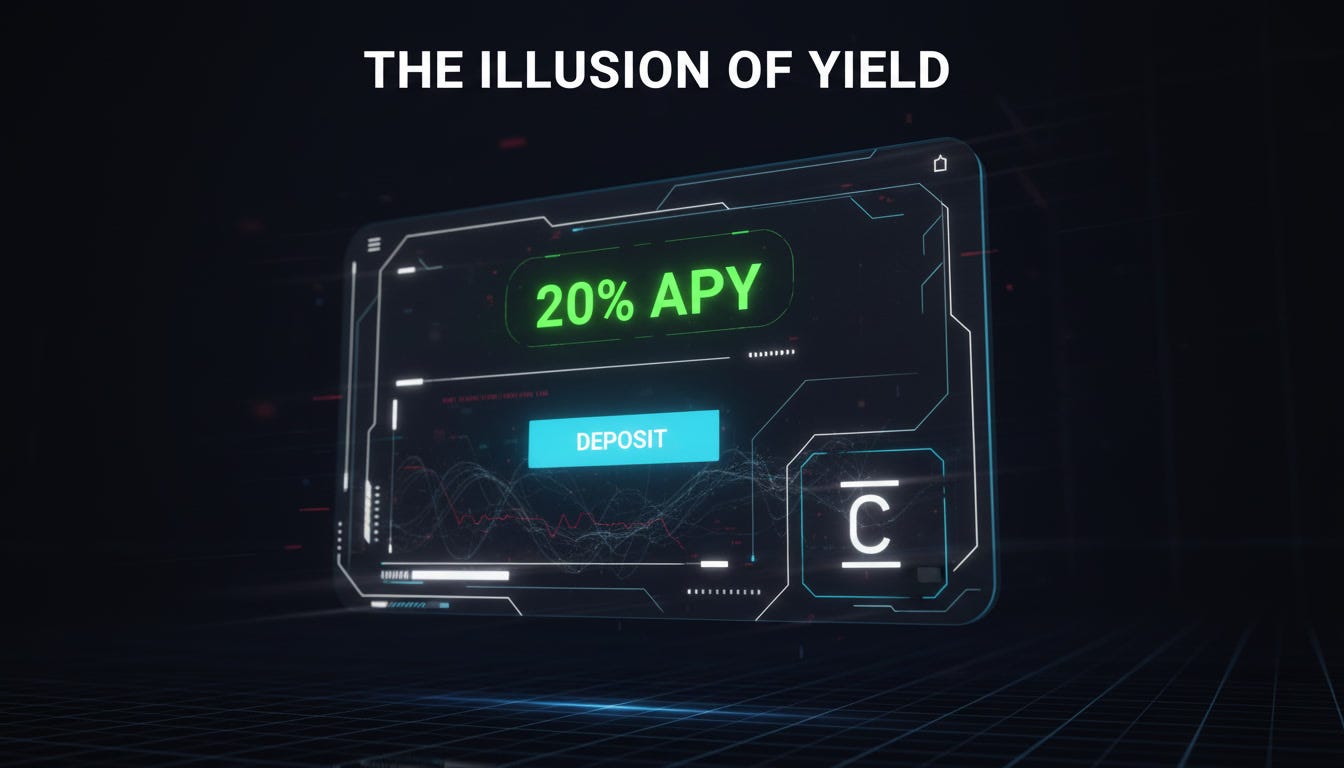
Your dashboard screams 20% APY. The UI is clean. The “Deposit” button is inviting. But there is a ghost in the machine. In any financial market, if you cannot identify the counterparty paying your interest, there’s a high probability that the counterparty is you.
Phase 1: The Smoke and Mirrors of “The Number”
DeFi has mastered the art of the “Easy Win.” Protocols strip away the complexity of financial engineering and replace it with a single, glowing percentage.
Most users stop here. They see a simple flow: Capital In → Yield Out. This simplicity is a mask. On the surface, it looks like passive growth; underneath, it is a high-velocity environment where “displayed yield” is often a distraction from “realized return.”
Phase 2: The Leakage — Where Your Profit Vanishes
Why does your wallet balance rarely grow as fast as the APY suggests? Because the “Headline Number” is a gross figure, not a net reality. To find the truth, you have to subtract the friction:
- Execution Decay: Gas fees and slippage that nibble at your principal.
- The IL Tax: Impermanent loss isn’t just a “paper loss” — it is a direct transfer of value from liquidity providers to arbitrageurs.
- The Volatility Trap: High yields in an asset that is losing purchasing power is simply a subsidized exit for others.
When you account for these, that 20% APY often compresses into a 2% net return — or worse, a loss.
Phase 3: Hunting for Real Revenue
Sustainable yield isn’t “found” — it is generated. To stay solvent, you must distinguish between temporary incentives and organic revenue. Real yield comes from only a few places:
- Utility Fees: People paying to move assets.
- Credit Spreads: Borrowers paying for the privilege of leverage.
- Efficiency Gains: Liquidators and arbitrageurs keeping the system healthy.
If the yield comes from printing new tokens (emissions), you aren’t an investor. You are a participant in a hidden value transfer, providing the liquidity necessary for others to cash out.
Phase 4: From Yield Chasing to Yield Engineering
The gap between winners and losers in DeFi isn’t luck; it’s modeling.
The “Yield Chasers” react to the dashboard. They move capital based on what was profitable yesterday. Conversely, “Yield Engineers” focus on the future. They model outcomes, manage risk parameters, and prioritize Net Yield over Headline APY.
This is the shift from guessing to structure.
Phase 5: The Concrete Solution
The manual era of DeFi is over. It’s too fast, too complex, and the “patsy” at the table is usually the one with the fewest tools. This is where Concrete Vaults intervene.
Concrete moves the goalposts. Instead of you manually chasing numbers, the infrastructure handles the heavy lifting:
- Automated Strategy Management: No more manual rebalancing.
- Risk Mitigation: Positions are managed to protect against downside, not just chase upside.
- Optimized Net Returns: Every move is calculated to reduce friction and maximize what stays in your wallet.
The Closing Insight
Yield is more than a reward for showing up. It is Revenue minus Costs, adjusted for Risk.
If you haven’t done that math, someone else has — and they are likely using your liquidity to fund their success. Stop being the fuel for the system and start being the architect of your own returns.
Move beyond the dashboard.
Master your outcomes at app.concrete.xyz