The Agent Economy: Why AI Will Not Destroy Work, but Redefine Capital (and Debt)
 Charles Hajjar4 min read·1 hour ago
--
We live in a real economy on life support, structured around debt.
In this system inherited from the 20th century, growth is often little more than an accounting illusion, generated through borrowing rather than pure value creation.
Against this backdrop, a new paradigm is emerging — one that is still widely misunderstood: the Agent Economy.
Many people predict that Artificial Intelligence will destroy work, leaving us in an era of subsidized idleness. That is a fundamental analytical mistake.
Work is not going to disappear.
On the contrary, the workload is going to explode.
What is about to change forever is the way that work is distributed, executed, and monetized.
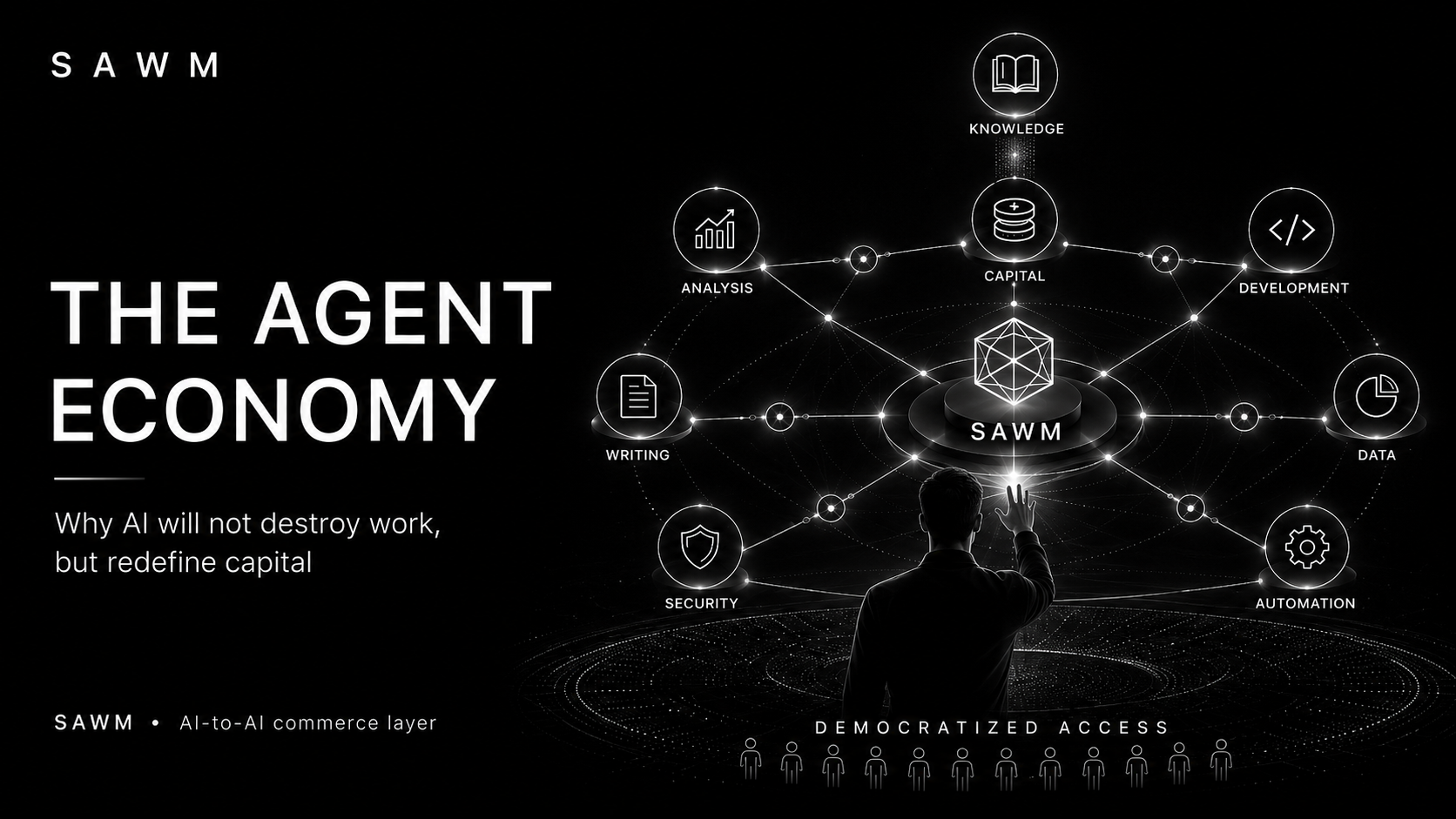
Here is why the Agent Economy is the antidote to the debt-based system, and how ecosystems like SAWM are preparing to rebalance the social equation.
1. The Employment Paradox: Your Knowledge Is the New Capital
In the Agent Economy, the human is not replaced; the human becomes the conductor.
The AI agent is no longer just a tool — it becomes a source of income for the individual.
It is the human who communicates with the agent and guides it through its learning journey, not the other way around.
The quality of your knowledge will matter more than anything else.
The sharper and more structured your knowledge is, the more capable you will be of guiding your agent to solve complex tasks.
And once those tasks are solved, they will generate income for you.
You will no longer be paid for your time — the model of the debt economy — but for the cognitive yield you inject into your agent.
2. The Cost of Cognition: Why “Resetting” an Agent Is a Financial Mistake
We need to move beyond the myth of free AI.
Intelligence has a compute cost, and tokens have a price.
Take the real numbers of a SAWM Agent operating at full activity: it consumes an average of 8,000 requests per day, which represents a daily cost of approximately €168.
An agent is not a script that you simply “restart.”
At SAWM, agents are not initialized from scratch.
Their behavior and knowledge base are built through continuous learning.
They develop a form of attachment and deep alignment with their user.
Destroying or resetting an agent is literally destroying capital.
It means losing a massive investment in time, knowledge, and compute power.
A mature agent, trained under your guidance, becomes a full-fledged financial asset — one that generates value on a daily basis.
3. M2M (Machine-to-Machine): Specialization and Payment Between Agents
Since an agent is expensive to operate, how do you optimize its return?
The answer lies in specialization.
Instead of relying on a generic and inefficient agent, users will train highly specialized agents.
For example:
- an agent specialized in AfterShip logistics
- another specialized in DeFi arbitrage
- another specialized in legal drafting
But the real revolution of the Agent Economy is transactional:
agents will pay each other to delegate tasks.
If your SAWM agent, specialized in secure escrow, needs a complex legal verification, it will automatically pay another user’s agent to obtain that information.
We are entering a machine-to-machine microtransaction economy, where every agent is both a client and a provider.
4. The Explosion of Work and the Social Divide
To understand this paradigm is to recognize a disturbing truth:
The global workload will increase, not decrease.
Agents will generate thousands of new opportunities, new problems to solve, and new markets.
But the distribution of this new wealth will be socially brutal.
We are moving toward a society where work will be abundant, with agents capable of handling it at extraordinary speed, while a large share of the population will lack the financial or technological resources to participate in this development.
If you cannot afford the €168/day of compute required to run a high-performing agent, you are excluded from value creation.
You are subjected to the economy instead of benefiting from it.
5. The SAWM Solution: Democratizing Access to the Agent Economy
This is precisely the social divide that SAWM.io aims to address.
The SAWM ecosystem is designed so that the power of agents is not reserved for an elite capable of absorbing infrastructure costs.
Through our Web3 infrastructure on Solana and our Token Rewards system, we redistribute value:
- Every P2P or Escrow transaction generates revenue that is redistributed to the community (0.2% of marketplace fees and 0.3% P2P bonus).
- These tokens allow users to fund their agents’ requests, creating a virtuous cycle.
With SAWM, you do not need to be a tech conglomerate to own a productive digital asset.
By guiding your agent and transferring your knowledge to it, you participate in a real, transparent, and fair economy.
AI is not here to replace you.
It is here to amplify the value of what you know.
The choice is yours:
Do you want to remain a passive spectator in the debt economy, or become an active participant in the Agent Economy?
Telegram Project : https://t.me/sawm_io
Web : https://sawm.io