The majority of businesses are secretly losing GPU money that they can’t even see. Here’s how to surface it, reclaim it, and use funds that have already been approved to self-fund your full GenAI roadmap.
No one — not your cloud team, not your data scientists, and most definitely not your CFO — has informed you of the amount that is now sitting inside your AI budget. This isn’t a rounding error. You didn’t miss a vendor discount. Every major corporation purchases, distributes, and operates GPU compute with structural waste built in. At scale, it usually consumes 30–40% of your entire AI infrastructure, which is either grossly underutilized or completely idle.
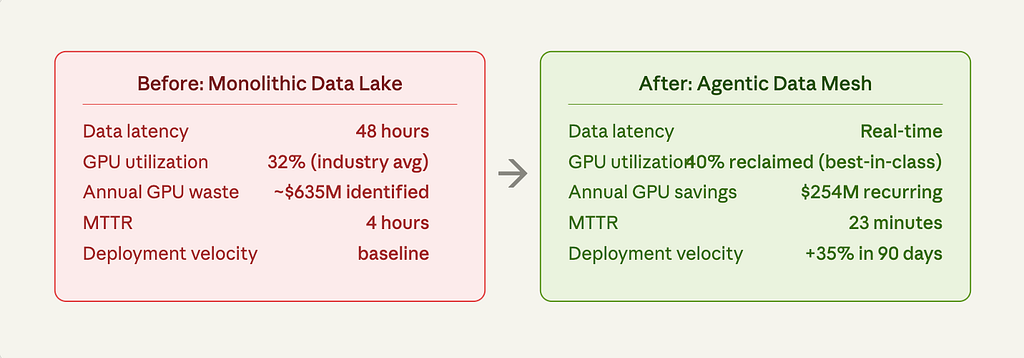
We spent $635 million on GPUs at the $4.7 billion multinational technology and media company where I most recently managed infrastructure. Every year, we recovered $254 million. Our whole GenAI roadmap was self-funded with that money, requiring no additional board approval or new funding.
Why This Problem Is Invisible to Most Organizations
One line item appears to your CFO: “Cloud and Compute.” The usage dashboards that your CTO views display “averages.” The money vanishes because neither of them can see what’s actually going on at the individual workload level.
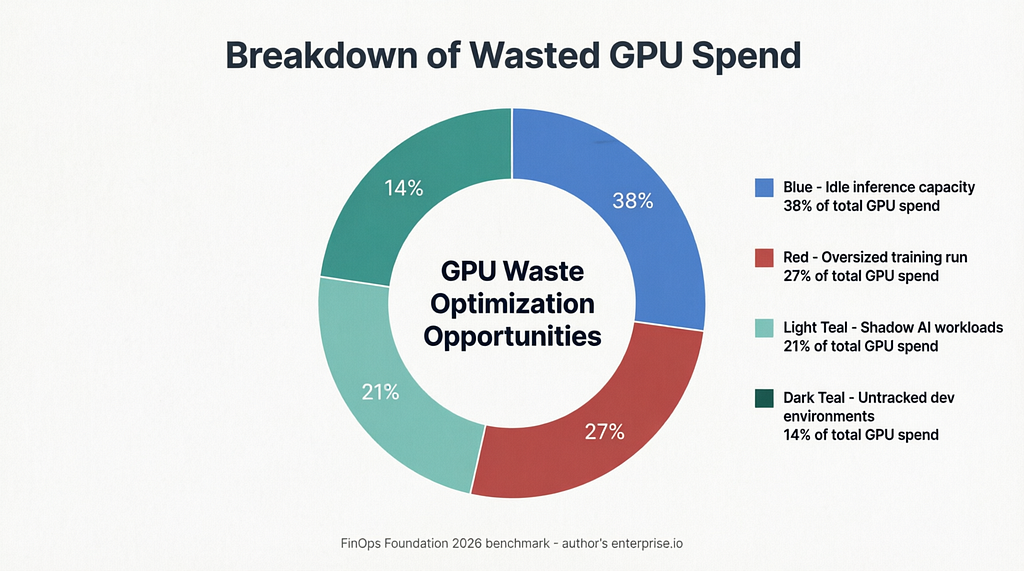
GPU waste is hidden in four locations, as the pie chart illustrates. The majority of businesses are simultaneously blind to all four.
1. Idle inference capacity (38% of total GPU expenditure) You budget for Black Friday traffic every day of the year. These GPUs don’t cost pennies like conventional web servers when real demand drops to 20% of capacity; instead, they cost hundreds of dollars per hour, plus power, cooling, and egress fees that can double the real cost by two to three times.
2. Training runs that are too large (27%) Because it’s speedier and they don’t feel the expense, data research teams frequently ask for the largest GPU configuration possible. A $2,000/hour monster is used to complete a task that could be completed effectively on a $200/hour arrangement.
3. Workloads related to shadow AI (21%) Engineers create their own instances on personal cloud accounts, payment cards, or rogue vendors when they feel that the central platform is too slow or bureaucratic. Months of expenditure have disappeared by the time finance finds out.

4. Development environments that are not monitored (14%) Development models frequently need the same amount of computing power as production models, operating around the clock, on weekends, on vacations, and even long after a project has been discreetly discontinued.
The Question Your CFO Should Be Asking — But Isn’t
“Are we spending enough on AI?” is a question that most boards pose.
“What percentage of what we’re already spending is actually producing value?” is the question they ought to be asking.
The industry average is only 68%, according to the FinOps Foundation 2026 benchmark. This indicates that 32 cents of every dollar spent on AI computation is wasted.
With a $50 million annual GPU budget, $16 million is lost annually. It is $64M at $200M. At our actual amount of $635 million, it becomes a game-changer for the company.
Because no one has provided them with the appropriate framework, CFOs don’t raise this question. There are measures for GPU use, but these are technical averages and cannot be converted into cold, hard dollar waste for the boardroom. What I refer to as GPU FinOps 2.0 is built on that translation.
GPU FinOps 2.0: The Three-Pillar Framework
Traditional FinOps was built for predictable VMs and storage. GPU economics are completely different. A GPU running at 15% utilization isn’t “mostly efficient”—it"'s almost entirely wasted.
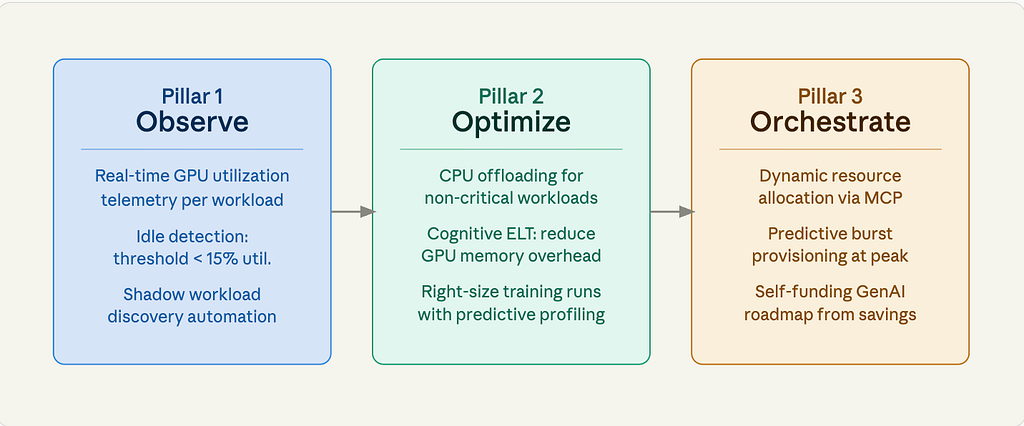
Pillar 1: Observation of Workload Level Give up focusing on infrastructural averages. Provide real-time telemetry-GPU utilization, memory bandwidth, tensor core activity, and idle windows for each inference endpoint, training task, and development environment. A reclamation alarm should be triggered automatically if the workload is less than 15% for longer than 30 minutes. To comprehend genuine inference economics rather than just raw GPU hours, include token metering.
Pillar 2: Methodical Recovery Directly target the largest waste categories:
1) CPU offloading instantly recovers 15–20% for all non-GPU workloads (pre/post-processing, data manipulation).
2) To prevent loading whole datasets into GPU memory, cognitive ELT was redesigned.
3) Rather than using “give me the biggest box” queries, right-sizing training uses predictive profiling.
4) Token-aware routing and model quantization for inference.
Pillar 3: Intelligent Orchestration, make a self-funding flywheel with the recovered capacity. Peak capacity is no longer permanently reserved thanks to dynamic allocation via model context protocol (MCP), anticipatory burst provisioning, and adaptive scaling. The next-generation roadmap is paid for by the system itself.
What 90 Days of Execution Actually Looks Like
No magic wand was waved by us. We adhered to a methodical process that any business can imitate.
Weeks 1–3 (Audit): Workload-level telemetry was implemented without any interruption over the whole estate. By week three, we had complete visibility: every workload was labeled by waste type, and $635 million had been classified. The moment that leaves you speechless? For more than 72 hours, 23% of all GPU instances had no active workloads.
Weeks 4–6 (Pilot): Automated shutdowns on development environments, appropriate training pipeline sizes, and applied CPU offloading. The outcome is a small-scale waste reduction of 40% with no effect on developer pace or model performance.
Weeks 7–12 (Enterprise Rollout): Expanded it to every market, team, and task. Ultimately, a program that paid for itself in less than six months resulted in savings of $254 million.
The Organizational Question That Actually Matters
The challenging aspect is not the technology. Ownership is the difficult part.
In the majority of businesses, IT handles cloud charges, data science handles workload decisions, and finance handles the budget.
The intersection — exactly where the rubbish resides — is not owned by anyone.
We established a GPU FinOps Council with genuine responsibility before we wrote a single line of code. Waste reclamation figures, accuracy, and velocity measures were all included in the performance appraisal of one identified owner. More important than any tool was that one organizational change.
“Do we have a budget?” becomes “Why are we still waiting?” when the CFO sees the waste stated in real dollars.
What to Do This Week
These three steps will provide you with boardroom-ready numbers in 30 days if you’re a CTO, CAIO, or technology leader:
Sort each dollar by workload type (inference, training, development, shadow/unclassified) after retrieving the GPU billing over the previous ninety days. You’ll be shocked at the unclassified bucket.
Request the actual average GPU use on all inference endpoints for the previous 30 days from your infrastructure team. You’ve identified the visibility issue before the waste issue if they are unable to provide you with the number within a day.
Calculate your yearly GPU expenditure by multiplying it by the industry waste average of 0.32. Ask your CFO, “What would we do if we could reclaim this?” while holding that number in front of them.
Your GenAI roadmap is the response to that query.
The Idea No One Is Talking About: Cosmic FinOps
This is the more profound reality that hardly anyone has yet to publicly express.
Not all idle GPU-hours are a waste of money. The irreversible computational potential of tensor entropy is being permanently destroyed. These idle cycles may have been used to solve protein puzzles, improve climate models, or advance the next major discovery.
The new operational philosophy is called Cosmic FinOps.
Reclaim the garbage with vigor. Next, ring-fence 10% of everything you find as a discovery quota and set aside it solely for truth-seeking activities without any quarterly OKRs. Give your brightest researchers and open-source partners access to intelligence whose sole purpose is to increase human understanding.
The $254 million is returned to your CFO. Humanity makes the next big advancement. The cost of the GPUs has already been covered.
The only real question left is, what will you do with the intelligence you just set free?
What to do this week
Three steps will provide you with the information you need to conduct this discussion with your CFO within 30 days if you are a technology executive, CTO, or CAIO.
First, extract the GPU compute billing for the previous ninety days and categorize it according to the types of workloads: inference, training, development, and unclassified. You’ll be surprised by the unclassified category.
Second, find out the average GPU use % for each inference endpoint for the previous 30 days from your IT team. You have a visibility issue that comes before the waste issue if they are unable to respond to this within a day.
Third, do the math: increase your entire yearly GPU expenditure by the industry average waste percentage of 0.32, then present the result to your CFO along with the query, “What would we do with this if we could reclaim it?”
Your GenAI roadmap is the response to that query.
Nehhaa Purohit is a chief AI officer and technology executive specializing in agentic AI operating models, sovereign data governance, and GPU economics at enterprise scale. She has led AI platform transformations generating $6B+ in enterprise value across global organizations. Connect on LinkedIn or reach her at [email protected]. More articles from Neha here: @neha.purohit.ai
The $254 Million Mistake Hidden in Your AI Budget—And Why Your CFO Still Doesn’t Know It Exists was originally published in DataDrivenInvestor on Medium, where people are continuing the conversation by highlighting and responding to this story.