In 2026, the conversation around career growth has shifted dramatically. The headlines say it all — “Pay Gap Widens for Fresh Grads.” But beneath that headline lies a deeper truth: the world no longer rewards what you know; it rewards what you can do with what you know.
As an entrepreneur who has built teams, hired across industries, and watched careers rise and fall, I’ve learned that the gap between potential and performance isn’t defined by degrees — it’s defined by adaptability. And adaptability today means AI literacy, sustainability awareness, and communication mastery.
🎓 The Myth of the Degree as a Guarantee
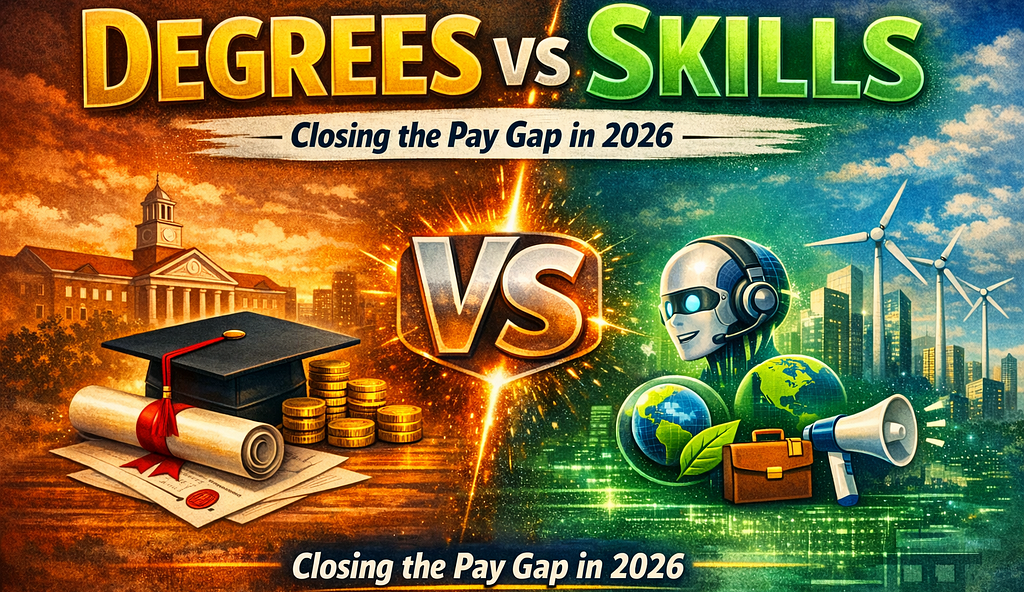
For decades, a degree was the golden ticket. It signaled competence, discipline, and readiness. But the market has evolved faster than academia. Employers aren’t just hiring graduates — they’re hiring problem solvers who can navigate automation, data, and global collaboration.
A degree opens the door, yes. But once you step inside, the real test begins. Can you learn new tools? Can you communicate across cultures? Can you align your work with sustainability goals and digital transformation?
Those who can — thrive. Those who can’t — plateau.
⚙️ The Rise of Skill‑Based Hiring
Across industries, hiring managers are shifting focus from credentials to capabilities. Platforms like LinkedIn, Coursera, and Microsoft Learn have democratized skill acquisition. A fresher who understands prompt engineering, ESG frameworks, or data visualization can outperform a graduate who only memorized theory.
This isn’t a rejection of education — it’s an evolution of it. The smartest professionals I know treat their degree as a foundation, not a finish line. They build on it with continuous learning, certifications, and hands‑on projects.
In my own ventures, I’ve seen candidates with modest academic backgrounds outperform those from elite institutions — simply because they were curious, self‑driven, and digitally fluent.
🤖 AI Literacy: The New Career Currency
Let’s talk about AI — not as a buzzword, but as a skill. Understanding how to use AI tools like Copilot, Gemini, or Claude isn’t optional anymore; it’s the new literacy.
AI doesn’t replace creativity — it amplifies it. It doesn’t eliminate jobs — it transforms them. The professionals who learn to collaborate with AI will lead the next wave of innovation.
When I mentor young professionals, I often say: “AI won’t take your job. Someone who knows how to use AI will.”
Learning how to prompt, analyze, and automate tasks is now as essential as learning Excel was in the 2000s. Those who master it will command higher pay, faster promotions, and global opportunities.
See content credentials
🌱 ESG Awareness: The Hidden Differentiator
The second equalizer is ESG — Environmental, Social, and Governance awareness.
Companies are under pressure to align profits with purpose. Sustainability isn’t just a corporate checkbox; it’s a career advantage. Graduates who understand how ESG impacts operations, branding, and investor confidence are more valuable than ever.
In my experience, clients and investors increasingly ask one question: “How sustainable is your business model?”
Employees who can answer that — who can connect their role to long‑term impact — stand out. Whether you’re an engineer optimizing energy use or a marketer crafting ethical campaigns, ESG literacy signals maturity and foresight.
🗣️ Communication: The Skill That Multiplies All Others
Here’s the truth most professionals overlook: technical skills get you noticed; communication keeps you relevant.
You can be brilliant, but if you can’t articulate your ideas, collaborate effectively, or tell your story, your brilliance stays invisible.
In every successful team I’ve built, the common thread wasn’t just intelligence — it was clarity. People who could explain complex ideas simply became natural leaders. They earned trust, attracted opportunities, and built influence.
Communication isn’t about speaking more — it’s about connecting better. In a world of automation, empathy and articulation remain irreplaceable.
💼 The Entrepreneur’s Perspective: What I Look For
When I hire or collaborate, I don’t just look at resumes — I look at mindsets.
I ask:
- Does this person learn fast?
- Do they take ownership?
- Can they adapt when the plan changes?
Degrees tell me what you studied. Skills tell me what you can contribute. Mindset tells me how far you’ll go.
The most valuable professionals are those who combine all three — education, execution, and evolution. They treat every project as a learning opportunity and every challenge as a growth catalyst.
📈 Closing the Pay Gap: A Practical Blueprint
If you’re a fresh graduate wondering how to close the pay gap, here’s a simple roadmap I share with my mentees:
- Master one AI tool deeply. Don’t just use it — understand how it works and how it can improve your workflow.
- Learn the language of sustainability. Read ESG reports, follow green startups, and understand how ethics shape business decisions.
- Build a digital portfolio. Showcase your projects, insights, and collaborations. Employers value proof of skill more than promises.
- Network intentionally. Engage with professionals who inspire you. Comment thoughtfully, share insights, and build visibility.
- Communicate your growth. Every skill you learn should translate into a story — how it improved your work, your team, or your perspective.
This approach doesn’t just close the pay gap — it builds career resilience.
🌍 The Bigger Picture: India’s Workforce in Transition
India stands at a fascinating crossroads. With millions entering the workforce each year, the challenge isn’t just employment — it’s employability.
The next decade will belong to those who blend technical fluency with human insight. AI will handle data; humans will handle direction.
Our graduates must evolve from job seekers to value creators — professionals who understand technology, sustainability, and storytelling. That’s how India will lead globally, not just in numbers, but in innovation.
💬 Final Thought: The Real Equalizers
The pay gap isn’t just about money — it’s about mindset.
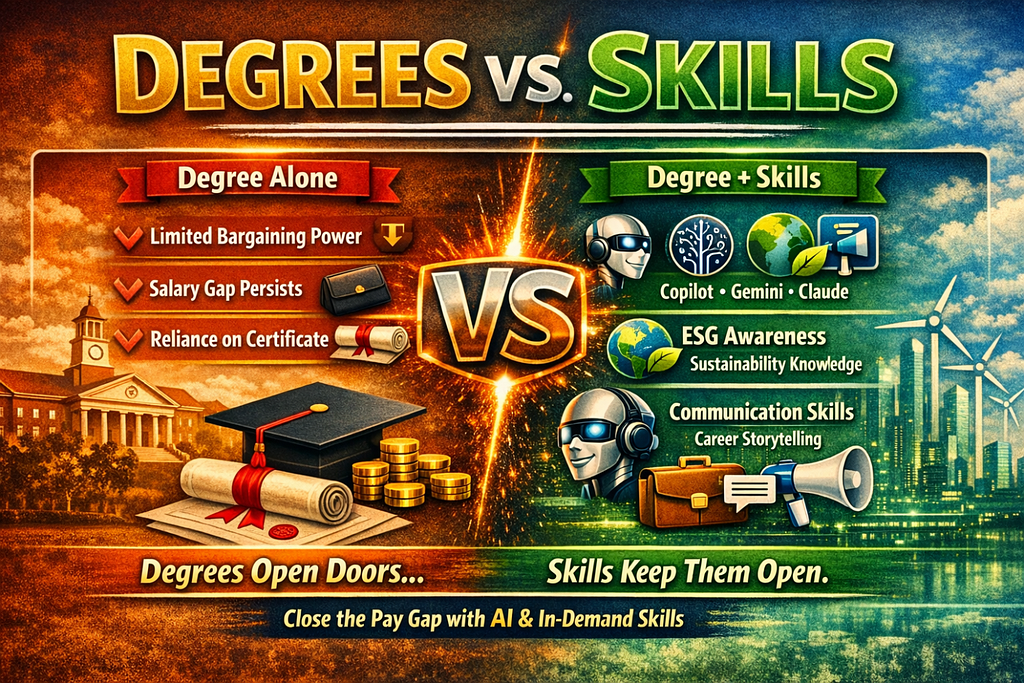
Degrees open doors. Skills keep them open. But curiosity — that’s what builds new doors altogether.
In a world where technology changes faster than textbooks, the most powerful investment you can make is in yourself. Learn relentlessly. Adapt fearlessly. Communicate authentically.
Because the future doesn’t belong to those with the most credentials — it belongs to those with the most courage to keep learning.
✍️ About the Author
D. Jenish is a digital creator and independent journalist who turns everyday tech dilemmas and global disruptions into practical survival guides. From fuel shortages to budget laptops and AI agents, Jenish helps families, students, and small businesses make smarter, future‑proof decisions.
Their work blends ground‑level reporting, visual storytelling, and accessible education, focusing on clarity, empathy, and real‑time solutions that empower people to adapt and thrive in a changing world.
Recent articles include:
What Your Body Really Needs This Summer
AI Set to Reshape, Not Replace Jobs
AI Agent Literacy for Teams & Entrepreneurs
📲 Follow @djenishofficial on LinkedIn & Instagram for smart guides, visual explainers, and everyday resilience tips.
Degrees Open Doors. Skills Keep Them Open. was originally published in DataDrivenInvestor on Medium, where people are continuing the conversation by highlighting and responding to this story.