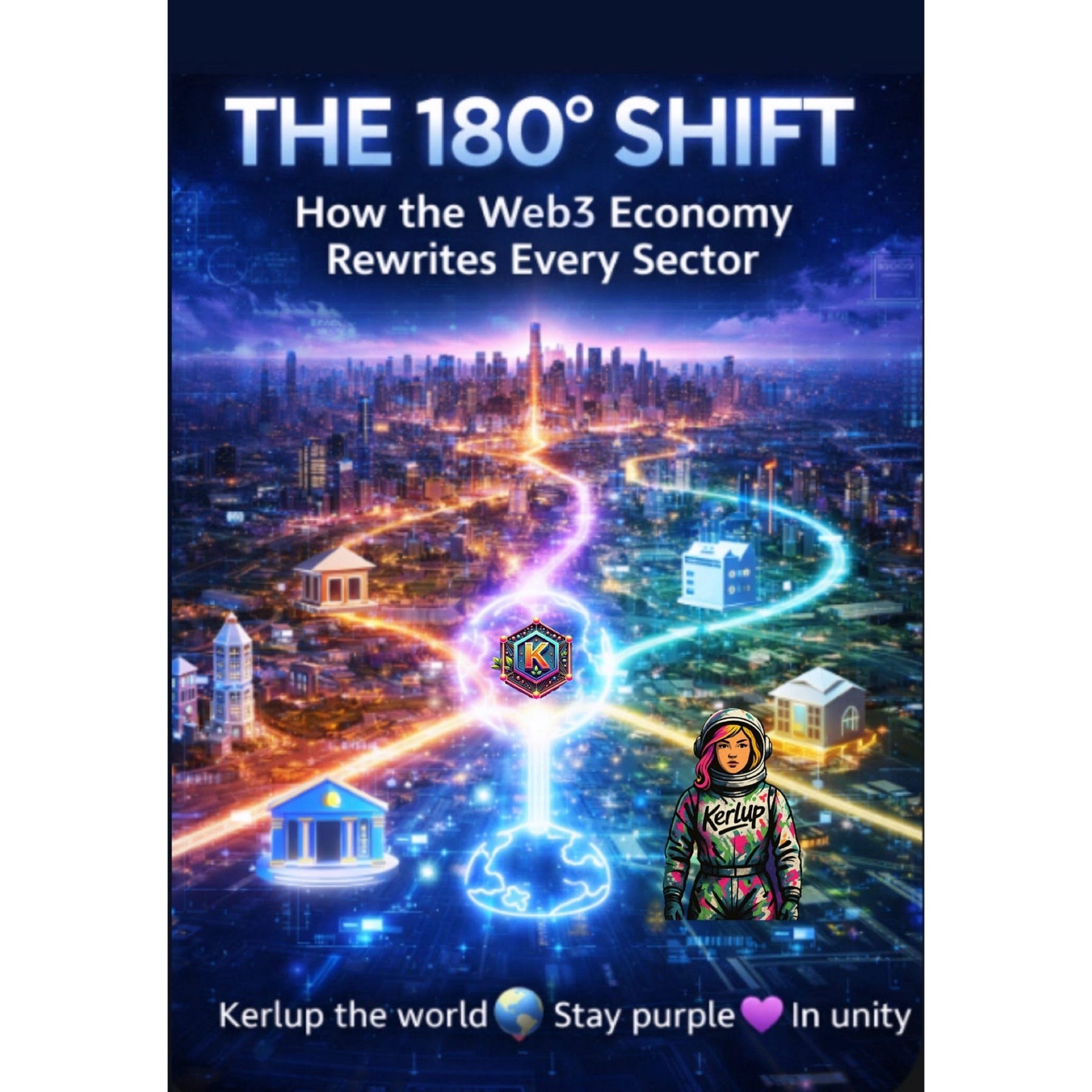
The 180° Shift: How the Web3 Economy Rewrites Every Sector
--
Part II: Closing the Gap in Web3 Economic Awareness
Author: Katie Kerl, Kerlup with Kate Consulting
4.14.2026
Abstract
This paper presents a systems-level analysis of the transition from Web2 to Web3 economic infrastructure, showing how the shift restructures global systems across every sector. Drawing from professional experience in technology, behavioral science, media, and entertainment, I observed patterns of structural instability in Web2 models, where growth was prioritized over sustainability and individual ownership was absent. Independent research conducted prior to AI proliferation revealed the signals of this collapse early, and today there is no excuse for inaction. The Web3 economy restores ownership to individuals, creates new lanes for participation, and redefines control and freedom within every industry.
Introduction
This transition is not simply a digital evolution — it is a full systemic realignment. Web3 extends far beyond the internet into finance, healthcare, education, agriculture, real estate, government, and communities. It reshapes how value is created, distributed, and experienced.
Through direct experience, I observed that Web2 systems scale while failing the participants they claim to serve. Participation was mistaken for ownership; growth metrics masked structural instability.
Free knowledge, available long before AI existed, revealed these shifts early. The challenge is no longer access — it is interpreting the information and seeing multiple probable outcomes, while acting within the emerging system.
Web3 opens new lanes where individuals can engage fully, own outcomes, and participate in self-governed systems without surrendering autonomy.
Evolution of the Digital Economy: Web1, Web2, and Web3
Web1 was a read-only landscape, controlled by a few, where users consumed information without participation or ownership.
Web2 added interactivity and content creation, yet ownership remained centralized. Platforms dictated monetization, visibility, and control, extracting value while appearing to empower users.
Web3 is a structural reversal: ownership is embedded in infrastructure. Individuals control data, assets, and identity. Blockchain, DAOs, tokenization, and decentralized governance redefine participation, creating systems that reward engagement with real ownership (Web3 — Wikipedia).
The Web2 Economic Model and Its Failures
Web2 optimized for scale, engagement, and efficiency, but the infrastructure failed participants. Value was extracted from users, and automation amplified inefficiencies. Behavioral science was absent from system design, producing environments where failure was inevitable. Traditional economic authorities, dismantled over time, could not stabilize these systems; they were never intended to repair them. Web3 does not fix; it replaces.
Behavioral Science: The Missing Link
Behavioral alignment is critical. Our experiments show that without integrating human behavior, autonomous and automated systems scale inefficiency instead of solving it. Observing how individuals interact with emerging infrastructures demonstrates that sustainable outcomes require understanding behavior at every layer. Web3 structures embed autonomy while providing accountability, creating an alignment between human patterns and systemic design.
Findings: Sector-Level Transformation and Workforce Impact
The Web3 economy transforms every sector:
Finance: DeFi platforms offer direct participation and ownership, while centralized digital assets maintain stability for risk-averse participants (Frontiers in Blockchain).
Education: Credentialing becomes continuous and portable, moving beyond diplomas to verifiable blockchain-based skills. Workforce re-credentialing will be constant.
Supply Chain & Agriculture: Blockchain enables traceability and accountability, giving producers and communities control over production and distribution (arXiv).
Healthcare: Patient-owned medical data improves privacy, interoperability, and care coordination (PMC article).
Real Estate & Insurance: Fractional ownership and smart contracts automate transactions, reduce intermediaries, and expand participation.
Government & Voting: Blockchain-based voting prevents duplication and reduces fraud while requiring stable infrastructure, enabling communities to rebuild self-governance.
Defense: Decentralized security models reduce central vulnerability while integrating AI-driven operational capabilities.
Across sectors, ownership shifts to individuals, redefining work. Roles tied to centralized control decline; roles requiring adaptability, technical literacy, and continuous learning expand. Transition occurs in phases: early adopters implement decentralized models, mid-stage participants integrate workflows, and late-stage participants must re-skill to remain relevant.
Identity, Security, and Infrastructure
Identity underpins access, governance, and accountability. In Web3, identity systems control both human participants and autonomous agents, ensuring trust and verifiable engagement. Security is inseparable from identity; proper frameworks enable adoption, resilience, and integrity across sectors.
Discussion
Behavioral alignment, identity control, and phased adoption are essential. Risks such as infrastructure dependency, uneven adoption, regulatory uncertainty, and cybersecurity vulnerabilities exist and must be managed. Web3 replaces outdated systems — it does not repair them. Engagement is proactive; passivity leads to displacement.
Conclusion
The Web3 economy is a full systemic reset. Ownership returns to individuals, communities regain cohesion, and automation aligns with human behavior. Centralized and decentralized systems coexist, each with distinct principles. Understanding, integrating, and acting on these shifts is essential. The tools are accessible; the infrastructure is forming. The choice is yours: participate fully or remain an observer.
References
- Web3 — Wikipedia
- Web3 Literature and Use Cases — IntechOpen
- Pew Research — Blockchain Overview
- Frontiers in Blockchain
- Tokenomics in Web3 — arXiv
- Blockchain in Agriculture & Supply Chain — arXiv
- Decentralizing Health Care Data — PMC
- Bitcoin Whitepaper
- Ethereum Whitepaper
- https://www.sciencedirect.com/science/article/pii/S2772503025000192