SpaceX × Cursor: How a $60B AI Supercomputer Deal Could Reshape Crypto’s Infrastructure Race
--
As of April 23, 2026, the intersection of aerospace, artificial intelligence, and decentralized finance has hit a boiling point. Yesterday’s announcement that SpaceX has secured an exclusive option to acquire Cursor (Anysphere Inc.) for $60 billion is not just a Silicon Valley headline — it is a structural earthquake for the cryptocurrency market.
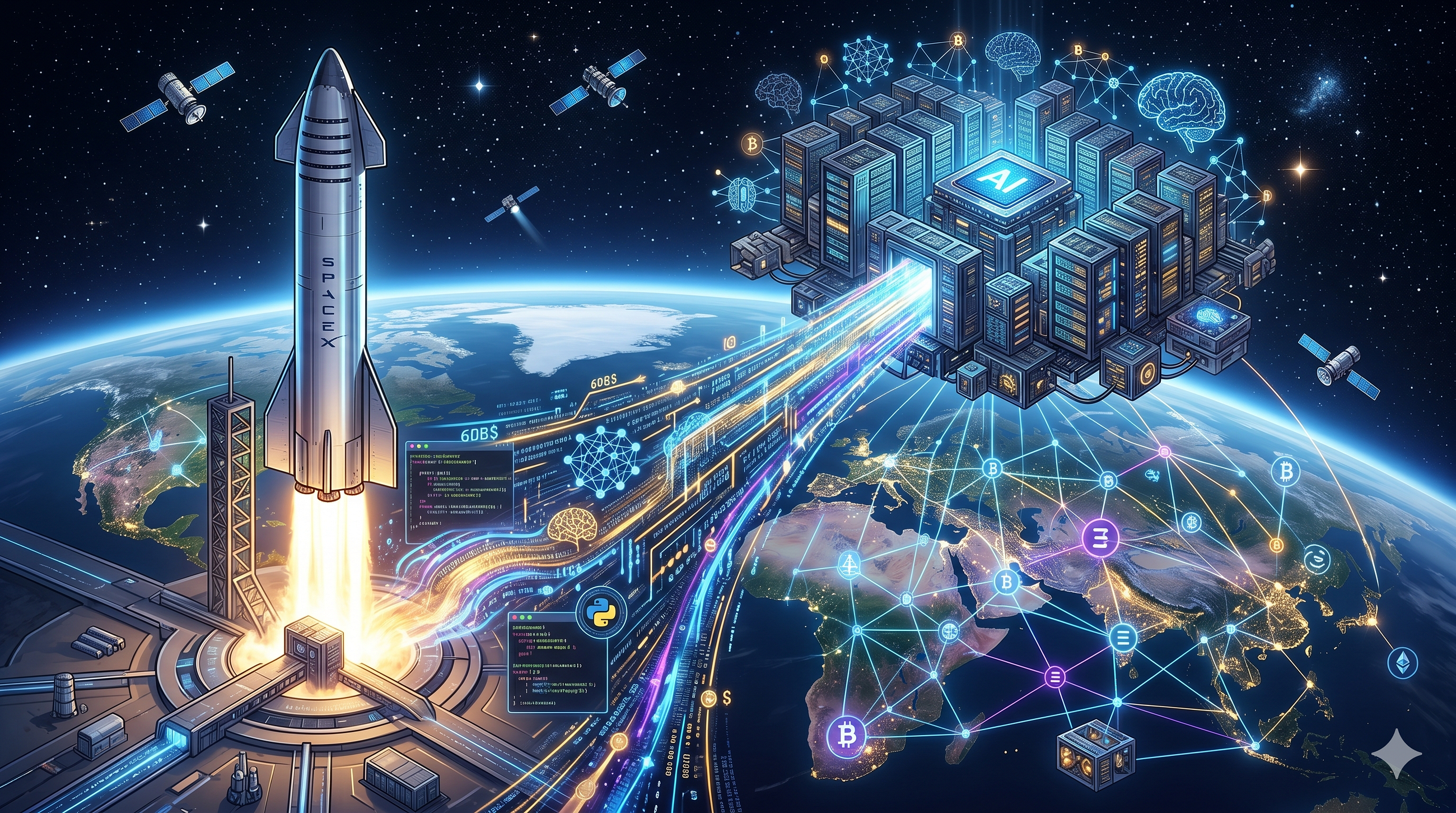
By combining the “vibe coding” mastery of Cursor with the raw horsepower of the Colossus supercomputer (boasting 1 million Nvidia H100 equivalents), Elon Musk is creating a vertically integrated AI stack that could fundamentally rewrite the rules of blockchain development, security, and decentralized physical infrastructure (DePIN).
1. The Deal: $60 Billion for the “OS of Developers”
The acquisition structure is as bold as the valuation. SpaceX has the right to buy Cursor for $60 billion by the end of 2026. If it declines, it will still pay a $10 billion “partnership fee” — effectively the largest termination fee in corporate history.
Why Cursor? In 2025, Cursor moved from a niche AI code editor to the dominant “AI Operating System” for software engineers. Its “Composer” feature allowed developers to build complex systems by simply describing the “vibe” or logic of the application. By April 2026, Cursor’s annualized revenue surpassed $2 billion, making it the fastest-scaling software company in history.
Why SpaceX? For SpaceX, this isn’t about rockets; it’s about compute and distribution. Integrating Cursor into xAI’s Colossus infrastructure creates a feedback loop:
- Hardware: Colossus provides the massive training compute.
- Software: Cursor provides the high-level interface for millions of developers.
- Data: Real-time telemetry from SpaceX and Starlink provides “hard-tech” data to train models that understand physical and digital systems.
2. Impact on Crypto: The Death of the $100M Exploit
Historically, the biggest bottleneck in crypto has been security and auditing. Smart contracts are immutable, meaning a single logic flaw can lead to hundreds of millions of dollars in losses.
With the SpaceX × Cursor integration, we are entering the era of AI-Shielded Protocols.
- Real-Time Formal Verification: Cursor 2.5 (powered by Colossus) can now perform formal verification as a developer “vibes” code. It identifies reentrancy attacks and flash-loan vulnerabilities before the code is even saved.
- Automated Audits: The cost of a top-tier security audit has dropped from $100,000 to nearly zero, as AI agents trained on the entirety of on-chain history can spot edge cases better than human teams.
- Faster Prototyping: Developers are now building entire cross-chain liquidity aggregators in a single weekend. This “speed of thought” development is expected to lead to a 10x surge in dApp deployments by late 2026.
3. The DePIN Revolution and Orbital Compute
The most profound impact of this deal lies in DePIN (Decentralized Physical Infrastructure Networks). While SpaceX is a centralized entity, its infrastructure provides the “Hard Tech” layer that decentralized protocols are now racing to leverage.
- Orbital ZK-Proof Generation: Zero-Knowledge (ZK) rollups are the primary scaling solution for Ethereum. However, generating ZK proofs is computationally expensive. SpaceX is reportedly testing “Orbital ZK-Nodes” that use Starlink’s excess solar power and cold-vacuum cooling to generate proofs at 1/10th the cost of terrestrial data centers.
- AI-Crypto Hybrids: We are seeing the rise of Agentic DeFi. These are not static smart contracts but “living” AI agents built with Cursor that manage risk, hunt for yield, and rebalance portfolios across dozen of chains simultaneously.
4. Market Sentiment: The “Digital Scarcity” Hedge
When a $60 billion AI deal is announced, the market reacts in two ways. First, there is a rotation into AI-themed tokens (like those in the decentralized compute and LLM space). Second, there is a flight to Bitcoin.
The prevailing macro thesis of 2026 is that AI drives the cost of creation to zero, which makes the value of scarcity infinite. As SpaceX and Cursor automate the production of code, software, and digital assets, the fixed supply of Bitcoin (21 million) becomes the ultimate hedge against “digital abundance.”
5. Regulatory Friction: A Catalyst for Decentralization
The $60B deal has already triggered antitrust probes from the FTC and scrutiny from the SEC. Regulators are concerned that a single entity (SpaceX) now controls the rockets, the satellites, the supercomputer, and the tools used to write the code for the future economy.
For the crypto market, this is bullish. The more Musk centralizes AI power, the stronger the argument for Decentralized AI. Investors are increasingly hedging by buying into protocols that offer open-source, permissionless alternatives to the SpaceX/Cursor stack.
Conclusion:
The SpaceX × Cursor deal marks the end of “narrative-only” crypto. In late 2026, the winners will be the projects that can integrate with massive AI compute while maintaining the core tenets of decentralization. Whether it is through AI-shielded smart contracts or orbital DePIN networks, the infrastructure of the future is being built at the speed of a rocket launch.
Read More:
- What is Portfolio Rebalancing in Crypto?
- What is tokenized securities in crypto?
- XRP Has Surged by 50,000% Since Inception; Can It Break Its All-Time High Again and Reach $4 in 2026?
- Best Ordinals Wallets 2026: Top 10 for Bitcoin NFTs, BRC-20 & Runes
Disclaimer: This article is for informational purposes only and does not constitute financial, legal, or investment advice. The cryptocurrency and AI markets are highly volatile; always conduct your own research.