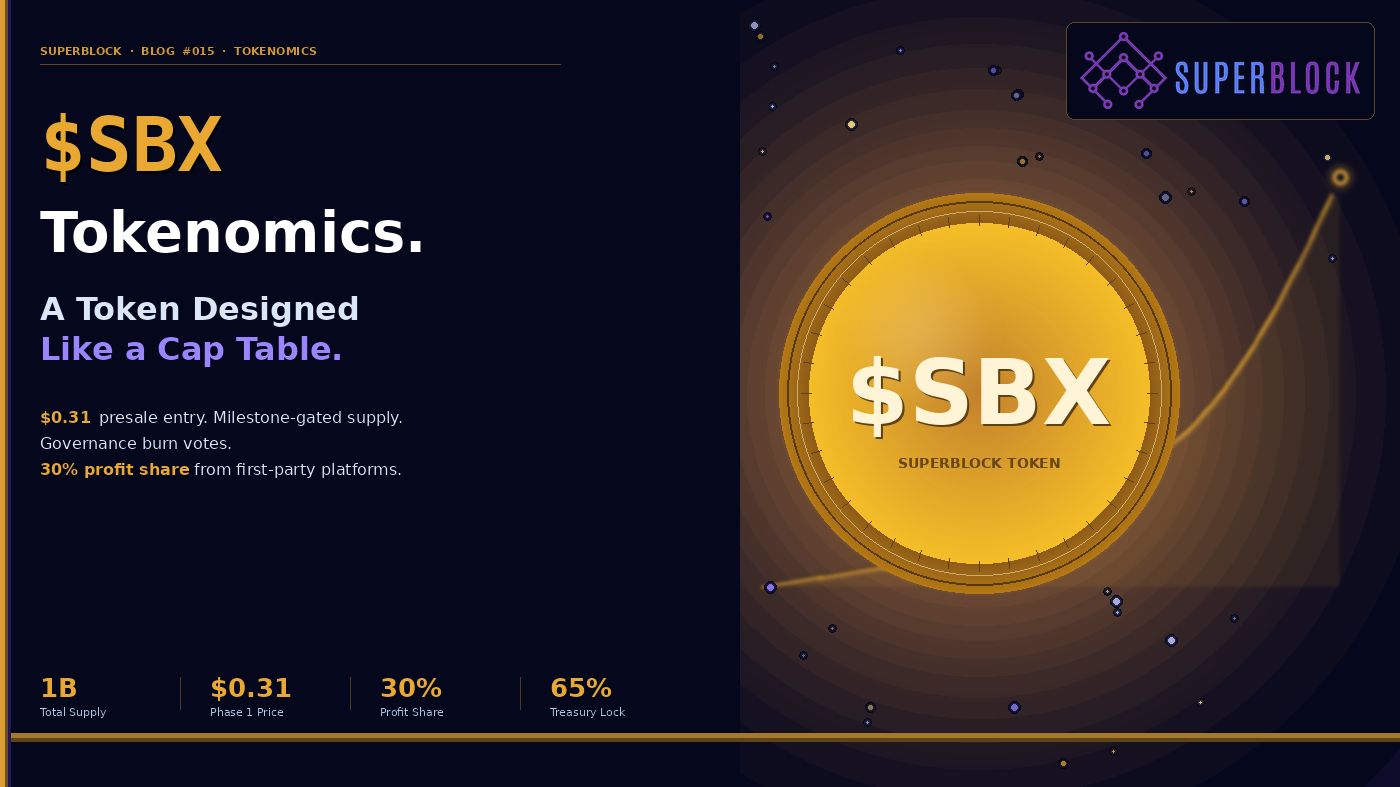
$SBX Tokenomics:
A Token Designed Like a Cap Table
--
Most tokens launch, dump, and disappear. The $SBX token is designed differently — modelled on a venture cap table with milestone-gated releases, governance burn votes, and a 30% profit share from first-party SUPERBLOCK platforms. Presale starts at $0.31. Here is exactly how it works.
Most token launches follow the same broken playbook: raise capital from a presale, dump on retail at launch, and disappear within six months. The $SBX token was designed to break that pattern by borrowing the discipline of venture capital — milestone-gated funding, governance accountability, and a clear path to revenue. This is not a meme coin or a governance-only token. It is a stake in a working financial infrastructure business, structured to behave like a cap table.
The Problem with Most Token Launches
Look at the data. The vast majority of tokens launched in 2021–2024 are now trading below their initial offering price. Many are below 90% of their launch valuation. The reasons are predictable:
- Front-loaded supply — teams unlock most of the supply early, creating constant sell pressure
- No revenue link — the token has no claim on cash flows, no profit share, no economic substance
- No accountability gates — capital is raised in one round and disappears regardless of delivery
- Misaligned incentives — insiders profit at launch; long-term holders are diluted
- Governance theatre — voting rights exist on paper but matter to no real economic decision
$SBX is structured to solve all five problems. The mechanism is simple in concept and meaningful in practice: treat the token launch like a series of venture rounds, with token holders as the cap table.
“We designed $SBX the way a sensible founder would design their own cap table. Capital comes in stages, tied to delivery. Holders get governance over what unlocks next. And the token has a direct claim on revenue from the platforms it funds.”
SUPERBLOCK Tokenomics Whitepaper v3
The $SBX Supply: One Billion Tokens, Five Buckets
Total $SBX supply is fixed at 1,000,000,000 — one billion tokens, no inflation, no future minting. The supply is divided into five clearly defined allocations:
Only the Initial Presale — 10% of total supply — circulates at the Token Generation Event. Every other tranche is locked behind a governance gate that token holders themselves control. This is the central design principle: supply expansion is permissioned, not automatic.
The Venture Round Analogy
People also ask: Why is $SBX structured like a venture cap table? Because it solves the core failure mode of most token launches: capital arrives all at once, with no accountability for delivery. By splitting fundraising into stages tied to milestones — just like Seed, Series A, and Series B venture rounds — capital scales with execution, valuation reflects real progress, and token holders retain governance over what unlocks next.
In traditional venture investing, a startup does not raise its entire lifetime capital in one round. A Seed round funds the first 12–18 months of work. If milestones are hit, a Series A is raised at a higher valuation. If Series A milestones are hit, a Series B follows at an even higher valuation. Capital scales with execution. Valuation reflects progress. Investors at each stage take on appropriate risk for the stage they enter at.
$SBX applies the same structure to a token cap table:
Each stage has higher pricing because each stage represents a fundamentally less risky position in the company. By the time Public Sale B opens, the SUPERBLOCK ecosystem already includes live revenue-generating platforms, audited financials, regulatory licences in motion, and verifiable on-chain proof of execution. A Series B investor in a traditional company does not pay seed prices — and neither does a Public Sale B participant in $SBX.
The Presale Mechanics: 10 Phases × 10 Million Tokens
The Initial Presale is divided into 10 phases of 10,000,000 $SBX each. Phase 1 opens at $0.31. Subsequent phases ladder up as supply is absorbed — rewarding early participants with the lowest entry price.
The critical detail is what happens to unsold tokens at the end of each phase. They do not silently roll forward. They do not get reallocated to insiders. They are subject to a governance vote: burn or send to treasury.
The Milestone Gates
People also ask: What are the SUPERBLOCK milestones? Three execution gates control supply expansion. Milestone 1: Core platform deployment and first regulated tokenization issuances on SBX Prime. Milestone 2: Expansion of SBX AURA settlement infrastructure and SBX ID compliance passport into live institutional use. Milestone 3: First-party platforms generating audited revenue at scale and 30% profit share distributions begin to $SBX holders.
Each milestone is a verifiable deliverable, not a marketing statement. The SUPERBLOCK Foundation publishes milestone criteria in advance, third-party audits confirm completion, and only then does a governance vote open for the next supply tranche.
Milestone 1 — Funded by Presale
Core platform deployment. SBX Prime production launch with first regulated tokenization issuances. Multi-chain ERC-3643 deployment. Initial institutional customer onboarding. Foundation operating with full legal, compliance, and finance functions established.
Milestone 2 — Funded by Public Sale A
Ecosystem expansion. SBX AURA settlement layer live across 30+ corridors. SBX ID compliance passport operational with multiple institutional KYC issuers integrated. First $100M+ in assets tokenized through the ecosystem. Public revenue reporting.
Milestone 3 — Funded by Public Sale B
Revenue maturity. First-party platforms generating audited revenue at scale. 30% profit share distribution mechanism live and paying out to $SBX holders. Audited annual financials published. Treasury monthly release schedule begins under governance control.
If a milestone is not delivered, the next sale does not open. The treasury does not unlock. Holders retain the supply discipline that protects their position. This is the core accountability mechanism that traditional token launches lack.
The 30% Profit Share: The Revenue Link
This is the part of $SBX tokenomics that fundamentally separates it from utility tokens. $SBX holders are entitled to a 30% share of profits from first-party platforms in the SUPERBLOCK ecosystem — including SBX Prime, SBX AURA, SBX ID, SUPERBLOCK Ventures, and other Foundation-owned products.
The mechanism works like this:
- First-party platforms (SBX Prime SaaS revenue, tokenization fees, AURA settlement fees, etc.) generate revenue
- Audited financials calculate quarterly net profit
- 30% of that profit is converted to a stable settlement asset (USDC or equivalent)
- The pool is distributed pro-rata to $SBX holders on the snapshot date
- Distribution executes on-chain — transparent, verifiable, automatic
This makes $SBX economically closer to a revenue-share security than a typical governance or utility token. The token has a direct, mechanical claim on cash flows from the underlying business. As platform usage grows, distribution per token grows. As the network of first-party platforms expands, the pool grows.
“A token without a claim on cash flow is a financial instrument without economic substance. $SBX is engineered with substance: 30% of platform profits, paid quarterly, on-chain, to the cap table that funded the build.”
$SBX Token Design Whitepaper
The Treasury: 65% Locked Until Milestone 3
The single largest allocation — 650,000,000 $SBX, two thirds of total supply — sits in the SUPERBLOCK Foundation Treasury. None of this circulates until Milestone 3 is complete. None of it gets sold to fund operations during the build phase — that is what the staged sales are for. None of it gets transferred to insiders.
After Milestone 3 verification, a strict monthly release cap applies: maximum 1–2% of treasury per month, subject to governance vote. At the 2% upper limit, a full treasury release would take roughly 50 months — over four years — ensuring long-duration supply discipline well past the initial growth phase.
Treasury releases are not at the discretion of the team. Every release tranche requires an active holder vote with stated purpose — ecosystem grants, strategic acquisitions, market-making operations, or community programs. The governance contracts enforce this on-chain.
The Burn Vote: Aligned Deflation
People also ask: Why are unsold tokens subject to a burn vote? Because token holders should control supply. If presale phases do not sell out fully, the tokens have not been distributed and the Foundation has not received the corresponding capital. Existing holders — whose position is affected by what happens to those tokens — vote on whether to burn them (permanently reducing supply, increasing scarcity) or send them to treasury (preserving optionality for future ecosystem use).
At the end of every presale phase, unsold tokens are not silently rolled into a future phase or reallocated to insiders. They go to a structured governance vote with two options:
- BURN — tokens are sent to a verifiable burn address, permanently reducing total supply. Deflationary outcome for existing holders.
- TREASURY — tokens move to the Foundation Treasury, subject to standard treasury governance rules. Preserves optionality.
The decision rests with the existing token holders whose position is directly affected. This is genuinely consequential governance — not theatrical voting on minor parameters. Every burn vote that passes reduces the total supply permanently and tilts the long-term tokenomics toward holders. Every treasury vote that passes preserves optionality but extends timeline considerations.
Why This Structure Outperforms Standard Tokenomics
Compare $SBX directly against the standard token launch template:
The Practical Path for Early Participants
If you participate at the Phase 1 presale at $0.31, you hold $SBX at the lowest entry price in the project’s history. The next time tokens enter circulation through a primary sale, the floor is targeted at $1.00–$1.50 — only after Milestone 1 is verifiably delivered. The time after that, the floor is targeted at $5.00–$10.00 — only after Milestone 2 is verifiably delivered.
This is not a price prediction. It is a structural property of the sale design. The pricing tiers are pre-committed and on-chain. Whether subsequent secondary market trading hits or exceeds those targets depends on execution, market conditions, and demand — but the primary sale cannot open at a lower price than the prior tier without a governance vote of existing holders.
Additionally, every $SBX token holder — from Phase 1 presale through to Public Sale B — receives the same pro-rata share of the 30% profit distribution from first-party platforms. The mechanism does not favour later entrants. Early holders benefit from both the lowest entry price and the longest exposure to compounding distributions.
What This Means for SUPERBLOCK
From the Foundation’s perspective, this structure imposes serious discipline. We cannot quietly raise more capital if execution slows — the next sale needs holder approval. We cannot dilute the cap table opportunistically — supply is fixed at 1B and treasury is locked. We cannot ignore the revenue requirement — the entire economic logic of $SBX collapses if first-party platforms do not generate audited profit to share.
This is the intended design. A token that disciplines its issuer is a token worth holding. A token that issues whenever its team chooses is a token to avoid. We chose the discipline.
What Happens at TGE
At Token Generation Event:
- $SBX deploys as an ERC-20 contract on Ethereum mainnet (multi-chain wrapping to follow)
- 100M tokens from the Initial Presale circulate to verified presale participants
- 50M tokens release to centralised exchange and DEX liquidity provisioning
- 850M tokens remain locked: 100M (Sale A) + 100M (Sale B) + 650M (Treasury)
- Governance contracts go live; first holder votes become possible from Day 1
From that point forward, every supply event — every new sale, every treasury release, every burn vs treasury decision — passes through on-chain governance. The cap table belongs to the holders.
Important: This article is for informational purposes only and does not constitute an offer to sell or solicitation to buy securities or digital assets. $SBX is not available for purchase in jurisdictions where its offer or sale would be unlawful. Participation in the presale or any subsequent sale is subject to applicable KYC, AML, and regulatory screening. Token pricing tiers described above are design targets and are subject to final governance ratification. Nothing in this article constitutes investment, legal, or tax advice. Always consult a qualified professional before participating in any token sale.