Bitcoin Magazine
Relics of a Revolution, Part I: Standing Outside in the Cold
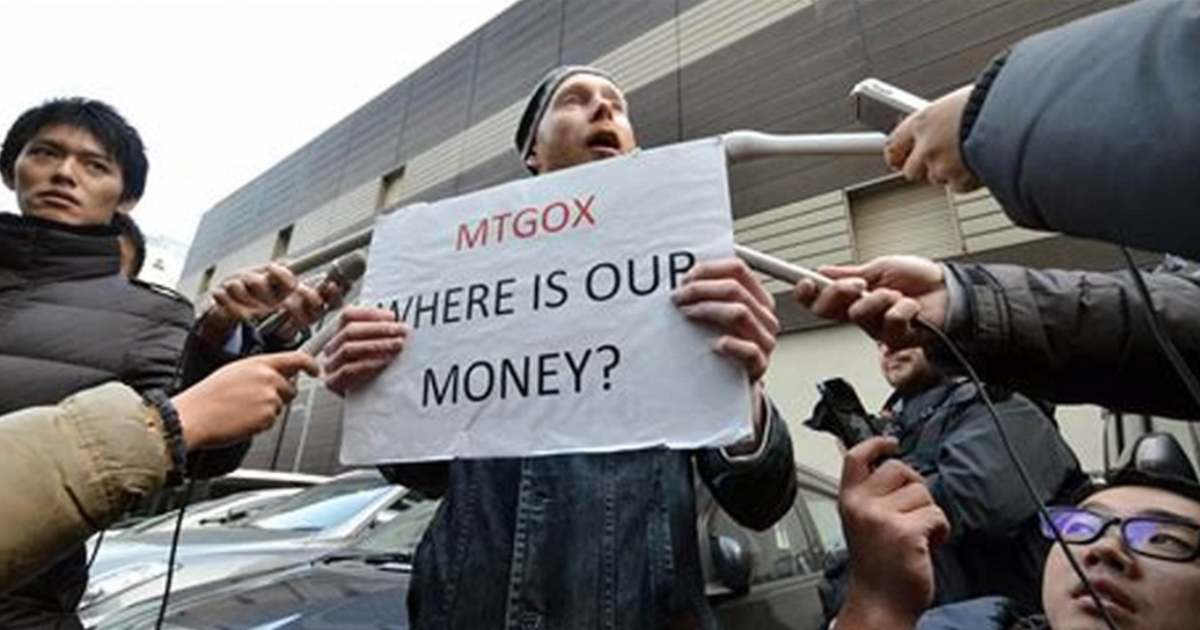
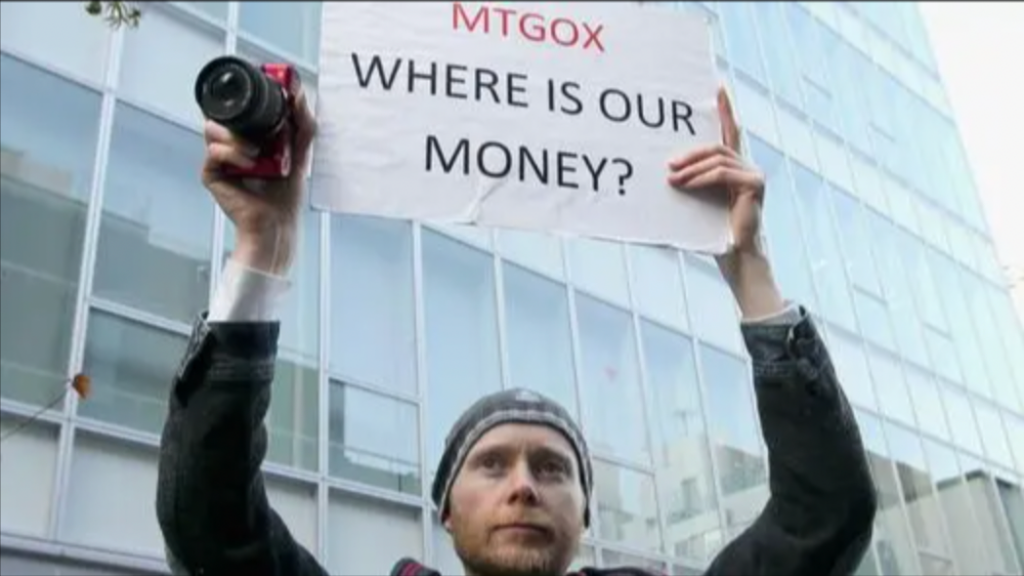
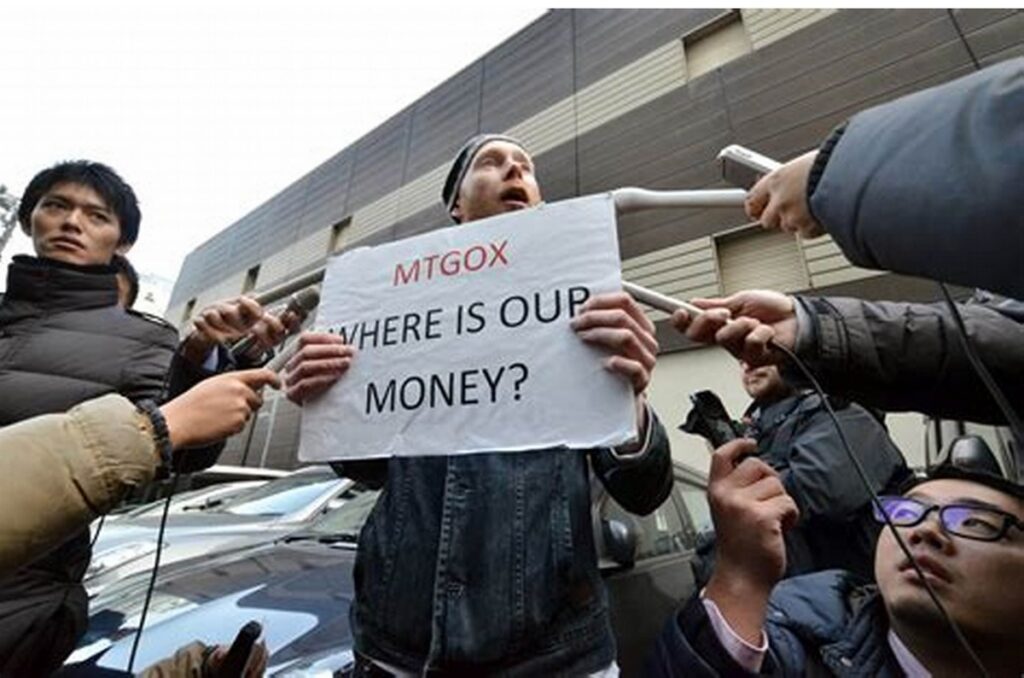
Revolutions leave behind artifacts. Sometimes they end up in museums. Sometimes they spend a decade in a suitcase. Kolin Burges became one of the defining figures of Bitcoin’s first financial crisis when he flew from London to Tokyo in February 2014 and stood outside the offices of Mt. Gox — then the world’s largest Bitcoin exchange, handling an estimated 70–80% of global Bitcoin trading volume — with a hand-lettered cardboard sign reading “MTGOX — WHERE IS OUR MONEY?” Day after day, in the snow, he held that sign while international media gathered and the exchange’s leadership scrambled to contain the fallout. Mt. Gox filed for bankruptcy shortly after, revealing that approximately 850,000 Bitcoin — belonging to customers, not the exchange — had been lost. The sign Burges carried during those weeks has become one of Bitcoin’s most iconic artifacts.
The works gathered in Relics of a Revolution at Bitcoin 2026 trace a lineage of dissent that connects street-level protest to the birth of Bitcoin itself. Also a part of this exhibition is an original copy of The Times from January 3, 2009 — the newspaper whose front-page headline, “Chancellor on brink of second bailout for banks,” Satoshi Nakamoto permanently embedded in the Bitcoin Genesis Block. It was not included as solely a timestamp. It was a thesis. The financial crisis was not a flaw in the system — it was the system. And as of that block, an alternative was live. The Mt. Gox protest sign displayed beside that newspaper is proof that the revolution did not end with the Genesis Block. Sovereignty demands permanent vigilance, and the people willing to fight for it have always been willing to stand outside in the cold.
I sat down with Kolin Burges ahead of his panel at Bitcoin 2026 to talk about protest, broken trust, and what happens when you stop waiting for someone else to hold the sign.
BMAG: Kolin, for people encountering this story for the first time — can you set the scene? You were a customer of Mt. Gox. Your withdrawals stopped. What made you decide that the right response was to get on a plane, fly to Tokyo, and stand outside their office with a sign?
Kolin: This was January 2014 – I only deposited my BTC into Mt. Gox for a few days but it was the wrong few days. When I tried to withdraw, my account was debited but the coins didn’t arrive. The same happened to all the other customers, leading to an attempted “bank run” on Mt. Gox and claims from the company that there were simply some technical issues with the withdrawals.
Over the next ten days the tension built up and everyone just wanted to know whether their bitcoins were safe. (We didn’t have “safu” back then). Mt. Gox were just fobbing people off with template customer support replies and making public statements which were not particularly believable.
It was mentioned on Reddit that someone called “CoinSearcher” from Australia had travelled to Tokyo to talk to management and to protest, but then had to return home for work. Banking law expert (and Mt. Gox customer) Karl-Friedrich Lenz passed by that protest on his way from work and began a conversation which would set later events in motion.
Over in London I was quietly outraged that Mt.Gox were just fobbing me off. I knew that there was nothing I could do unless I went there, and so I woke up one morning with the realization in my head that I was going to Tokyo.
BMAG: You’ve said you didn’t have a detailed plan when you arrived. You just knew you had to be there. Can you walk us through what those first days were like — confronting Karpelès, the media showing up, the pressure Mt. Gox put on you to stop?
Kolin: Before I arrived in Tokyo I had contacted Karl and CoinSearcher. Karl set up the initial media contacts with the Wall St Journal and Coindesk. We met with the WSJ who went with me to Mt. Gox to request to talk. I was refused a meeting with anyone, either at that time or in the future, and I left. That was the diplomatic route at a dead-end and so it was time to look for attention via protest and to try to force a meeting.
I went to the Bitcoin Tokyo meetup and met another customer Aaron, who informed me he was coming to join the imminent protest – instant doubling of size. I also met Coindesk reporter Jon Southurst who arranged to cover it.
The next morning the Wall St Journal and Coindesk were waiting with me in the snow for CEO Mark Karpeles to come by. The last thing you expect when you’re ambling into work on a Tokyo morning is that you’ll be confronted by a mildly angry Glaswegian waving a large cardboard sign. And so the video and photos went viral later that day and set the crypto internet alight. It became an iconic and heavily memed moment in bitcoin history. Not something I had expected.
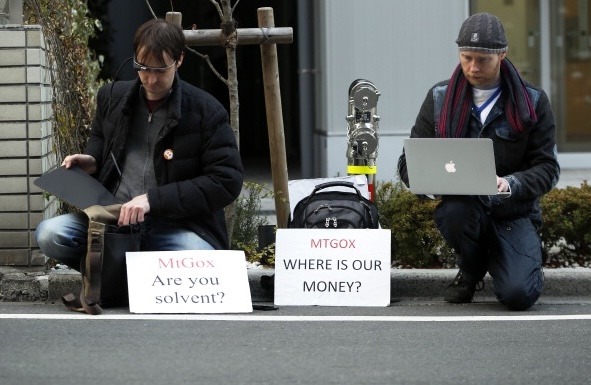
Aaron arrived shortly after the confrontation and together we began the Mt. Gox protest, initially two people standing in rain and snow holding signs and umbrellas in front of an empty street.
By the end of that day the Financial Times and NHK (Japanese state broadcaster) had sent reporters to cover it and we realised that this was becoming much bigger news than we expected. From then on the media came in larger and larger amounts every day.

BMAG: There’s a remarkable detail in your account — Mt. Gox representatives met with you privately and told you that if you kept protesting, everyone would lose their Bitcoin. They essentially asked you to stop holding them accountable in order to preserve confidence in their failing system. How did you process that in the moment?
Kolin: He said he couldn’t allow the protest to continue and also that everyone would lose their bitcoin if it did. When I heard those words I felt an unusual sensation that can only be described as my blood running cold. It felt like reality had suddenly taken a dark turn. For context, the big question on everyone’s minds at that time was whether the bitcoins were missing or safe. I went to my hotel and had a long call with Aaron. Although the Mt. Gox person claimed to not have visibility on whether the bitcoins were still in Mt. Gox, the statement about people losing their BTC suggested otherwise. The protest was not somehow going to make the bitcoins disappear – so if people really were going to lose their money then the bitcoins must already be gone.
The next day Mt. Gox made another, even more bizarre, attempt to stifle the protest. They feigned concern that Aaron and I were cold and invited us to move the protest to the inside of their offices! I can just picture going into their office every day to stand for 8 hours holding signs in front of their developers.
After we refused that they started getting technical about our position on the street – demanding that we shift a couple of inches further forward to ensure we didn’t encroach even an inch over the airspace of the property boundary (which wasn’t even their property). It was like they were descending to kindergarten level.
BMAG: Mt. Gox collapsed two weeks after your protest began. In retrospect, do you think the media pressure your protest generated forced the situation to a head faster than it otherwise would have — and was that a good thing?
Kolin: I have no doubt that the collapse timeline was accelerated by the pressure. Certainly Mt. Gox thought so or they wouldn’t have been in such a panic about the protest.
What’s more interesting is the knock-on effect that it likely had on the longer term. We now know what was going on within their walls at that time. They were scrambling to get their hands on 200,000 bitcoins to keep the exchange running (and presumably to keep the CEO out of jail). For them it was a race against time to get the bitcoins before everything went fubar. The media was starting to mob the street and the global attention was glaring in through their windows like the Eye of Sauron.
They created an infamous document which they privately sent to other bitcoin exchanges begging for 200,000 bitcoins to help bail them out of an 845,000 bitcoin loss, which was then leaked by Ryan Selkis. It was stunningly desperate as all the other bitcoin exchanges combined wouldn’t realistically have that much money unless they stole it from their own customer funds and destabilised the entire ecosystem even further. The document showed their plan was to use these bitcoins to pause operations, rebrand Mt. Gox as Gox, then restart the exchange, “owing” the customers their bitcoins that they could hopefully pay off at some vague point in the future. The bitcoins would enable them to allow a very limited amount of customer withdrawals and create a semblance that there was a proper exchange running.
We also now know that within a few days of them finally giving up and announcing their collapse they found 200,000 missing customer bitcoins in an old wallet file. This was by coincidence the exact amount they had needed for their plan.
If the protest had not pressured the timeline it seems pretty likely they would have found those 200,000 bitcoins while Mt. Gox was still operating. In that case it would have been highly unlikely that they would have voluntarily gone into liquidation and returned the coins through the bankruptcy process. Instead it seems probable they would have attempted to execute their stay-open plan using those bitcoins.
It was a good thing that they were forced into liquidation and the government took control of the coins. There is no universe in which Mt. Gox could possibly have made a success of the plan and paid off the remaining 645,000 BTC. So if they had kept going we’d just have ended up with something even messier further down the road.
BMAG: The sign you carried during those weeks is now a recognized artifact of Bitcoin history. When you made it, did you have any sense it would take on that kind of significance — or was it just the most direct tool you had?
Kolin: I had no idea of its future significance. I got up at 6am on the morning of the protest and drew the sign. After a couple of days I covered over the handwriting with printed text of the same words. This was to make it more TV camera friendly. If I had been thinking about the future symbolic significance I would probably have kept it as it was. After the protest it sat for 10 years undisturbed in a suitcase. When I saw Bitcoin Sign Guy’s “Buy Bitcoin” sign sell at auction for 16 bitcoins I decided it was time to get it out and dust it off.
BMAG: More than a decade later, does the Mt. Gox protest sign feel like a relic of a problem Bitcoin has solved, or a warning that’s still relevant? We’ve seen exchange failures since — the lesson about self-custody and not trusting intermediaries seems to need repeating.
Kolin: That problem has definitely not been solved! How many exchanges from 2014 or 2015 have even survived until today?
There are two main types of problem – exchanges being hacked and exchanges plundering their customer money. Both are still happening. Keeping money away from exchanges all the time isn’t really practical if you need to exchange it, trade derivatives, etc. More recently, advanced dexes have become common on other chains and they remove a lot of the risk but not all of it.
With hacks, the real issue is ultimately human laziness – corner-cutting on security procedures. When an exchange gets hacked you nearly always find out it had a gaping security hole or procedural weakness. Why are so many exchange CEOs who manage billions of dollars not making sensible efforts to secure their deposits? A lone coder could design a secure wallet procedure before breakfast time, at least a basic one which does the job. You don’t need large resources and the more complexity you add the riskier it becomes.
Part of the problem is that exchanges like to say they use cold storage and that makes customers feel more secure, but the definition of “cold storage” is becoming more vague as technologies advance. In theory it means that a wallet’s private keys have never been exposed to an internet-connected device. But things have become more complex and now it can be used to describe wallets for which transactions are created on external websites and then imported to be signed. Those signing devices may not themselves be directly connected to the internet but if they end up signing transactions originating from the net then the funds are still indirectly exposed to the malicious forces on the net. And we’ve seen the disastrous consequences of that. It goes against the original ethos of cold storage. Exchanges should always be running the full pipeline used for cold storage transactions on highly secure internal devices rather than relying on the integrity of external websites.
Perhaps we need more precise definitions of the security setup of wallets so that exchanges can’t hide behind a vague term.
BMAG: There’s a pattern that extends beyond bitcoin or crypto grifting — FTX replaying the Mt. Gox script with a bigger budget, the 2008 bank bailouts before that, the US savings & loan crisis of the late 1980s before that (which I first learned about from a Punisher comic book as a kid), and now ballooning national debt running the money printer. It’s a cycle of leverage, collapse, and reset where ordinary people absorb the losses every time. As someone who lived through the original version of that story with Mt. Gox, do you see bitcoin as genuinely breaking that cycle, or are we watching new versions of the same concentrated risk build up inside the bitcoin ecosystem itself?
Kolin: Bitcoin does solve some of the problems at the base layer because nobody can print more of it on a whim. In that sense it is a real break from the older pattern. In theory, no bailing out banks and government mistakes by creating more magic money that the public then has to pay for for years, and no institutional escape hatch when the numbers stop adding up.
But fiat still exists and that will keep happening within the fiat system, with knock-on effects to bitcoin. So unless bitcoin replaces fiat we’ve still got those risks.
And bitcoin also doesn’t fix human behaviour. The moment people pile their coins into centralised exchanges, lenders, or other leveraged structures, the old cycle starts rebuilding itself. If you recreate banks on top of bitcoin, you recreate banking failures on top of bitcoin.
This is Part I of a three-part series accompanying the Relics of a Revolution exhibition.
Fix the money. Fix the world.
Burges is exhibiting the Mt. Gox signs at Bitcoin 2026, April 27–29, at The Venetian Resort, Las Vegas, and is a speaker on a panel titled “Looking at Bitcoin Art Through a Protest Lens.” The signs can be previewed on BMAG here, with bidding set to begin April 17.
The Bitcoin Museum & Art Gallery (BMAG) is the curatorial and cultural programming division of BTC Inc and the Bitcoin Conference. Since 2019, the BMAG conference art gallery has facilitated more than 120 BTC in art and collectible sales. Learn more about BMAG at museum.b.tc. Follow BMAG on twitter @BMAG_HQ.
Bundle your Bitcoin 2026 pass with a stay at The Venetian and get your fourth night free. Use code AFTERS for a free After Hours Pass, or get your pass alone here.
This post Relics of a Revolution, Part I: Standing Outside in the Cold first appeared on Bitcoin Magazine and is written by Dennis Koch.