Simple Guide to Uniswap
 Adeniran Abdullahi Damilare5 min read·Just now
--
Imagine this: You’re holding some Ethereum in your wallet, and a new token catches your attention. Within seconds, you swap it—no signup, no customer support, just you and the blockchain.
That’s the power of Uniswap.
Uniswap allows anyone to trade tokens directly from their wallet without a middleman. This guide explains the basics in simple terms so beginners can understand how to trade confidently on one of the world’s most popular decentralized exchanges.
With billions of dollars traded daily, Uniswap is more than a tool—it’s a gateway to decentralized finance (DeFi).
What Is Uniswap?
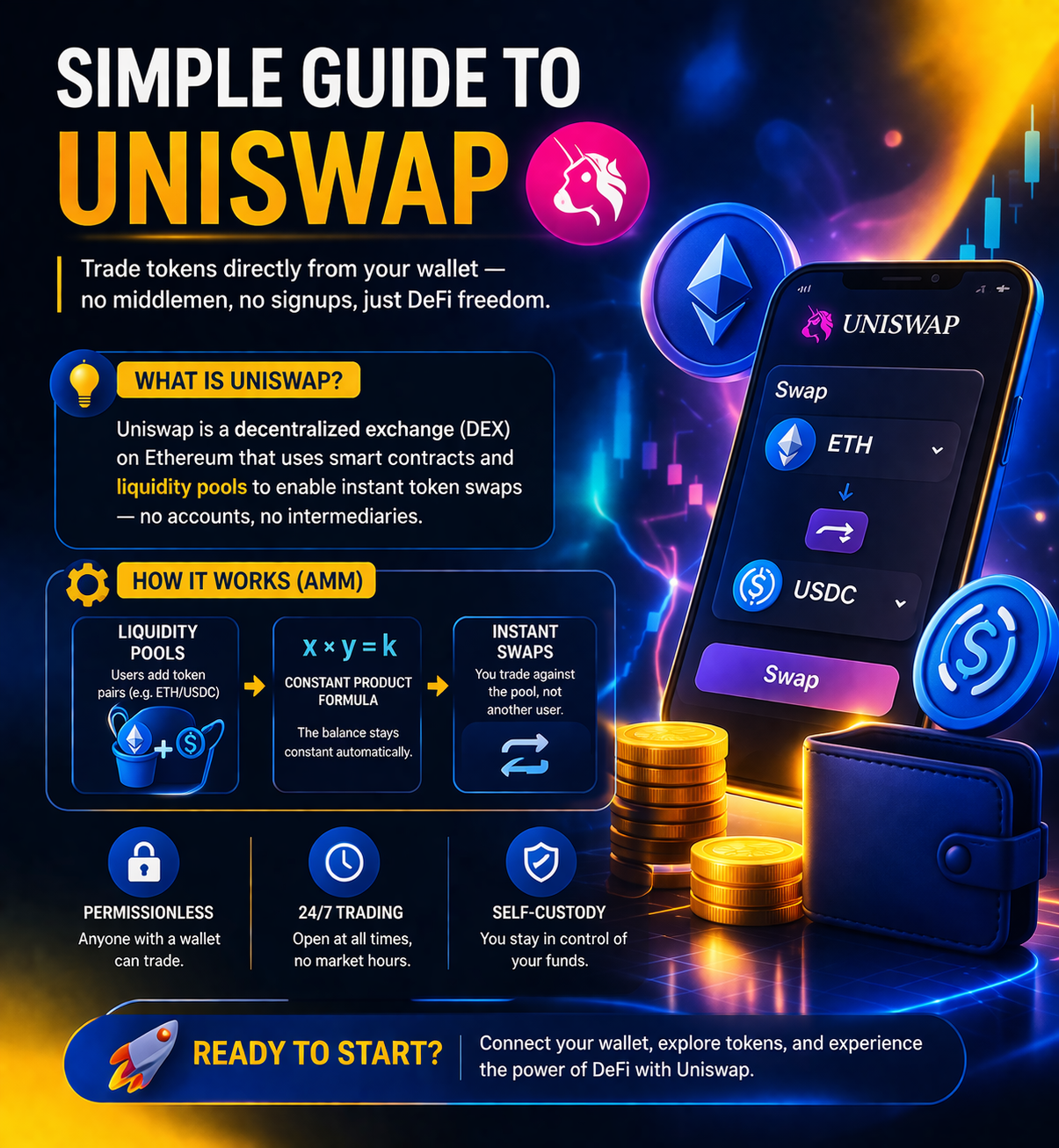
Uniswap is a decentralized exchange (DEX) built on the Ethereum blockchain. Instead of relying on traditional buyers and sellers, it uses smart contracts to automate trading.
This means there is no central authority controlling transactions. Everything runs on code.
Core Mechanics Simplified
Uniswap operates using an Automated Market Maker (AMM) system.
Instead of matching buyers with sellers, trades happen through liquidity pools. These pools contain pairs of tokens—such as ETH and USDC—provided by users.
At the center of this system is a simple formula:
x × y = k
- x- represents the amount of one token in the pool
- y- represents the amount of the other token
- k- remains constant
When someone swaps ETH for USDC, ETH is added to the pool and USDC is removed. The formula keeps the pool balanced automatically.
Think of it like a water tank. Pour water into one side, and water flows out the other to maintain balance.
This system allows trades to happen instantly, 24/7.
Uniswap Versions Explained
Uniswap has evolved over time.
- V1 and V2 spread liquidity evenly across all price levels.
- V3 introduced concentrated liquidity, allowing liquidity providers to focus their funds within specific price ranges. This makes capital more efficient.
- V4 adds customizable features called hooks, which allow developers to add extra functionality to liquidity pools.
For beginners, the good news is simple: the main Uniswap app handles these upgrades automatically.
Why Uniswap Matters
Traditional exchanges often require identity verification and rely on centralized control. They can freeze accounts, restrict withdrawals, or suffer security breaches.
Uniswap works differently.
It is permissionless, meaning anyone with a crypto wallet and internet access can trade.
There are no gatekeepers.
This gives users full control of their assets, following the well-known principle:
“Not your keys, not your crypto.”
With billions locked in liquidity and millions of users globally, Uniswap has become one of the most important platforms in the DeFi ecosystem.
How to Use Uniswap (Step-by-Step)
Getting started is simpler than many people expect.
Always make sure you are using the official site:
app.uniswap.org
1. Set Up Your Wallet
First, install MetaMask, a popular crypto wallet available as a browser extension or mobile app.
Create a wallet and store your seed phrase safely. This phrase controls access to your funds, so never share it.
Next, fund your wallet with Ethereum. You can purchase ETH from exchanges like Coinbase and transfer it to MetaMask.
You’ll also need some ETH to cover gas fees, which are the transaction fees on the Ethereum network.
Once your wallet is ready, visit the Uniswap app and click “Connect Wallet.”
Approve the connection in MetaMask.
Now you’re ready to trade.
2. Make Your First Swap
Choose the token you want to trade from (for example, ETH) and the token you want to receive (such as USDC).
Enter the amount.
Before confirming, adjust the slippage tolerance to around 0.5–1%. This helps prevent failed transactions if prices move slightly.
If it’s your first time trading that token, you’ll need to click “Approve.”
After that, click “Swap” and confirm the transaction in your wallet.
Within seconds, the new tokens will appear in your wallet.
3. Provide Liquidity
You can also earn trading fees by supplying liquidity.
Choose a token pair, such as ETH and USDC, and deposit equal values of both tokens.
For example:
$500 worth of ETH
$500 worth of USDC
In return, you receive LP tokens, which represent your share of the liquidity pool.
Every trade in that pool generates fees. A portion of those fees goes to liquidity providers.
However, there is a risk called impermanent loss, which happens when the prices of the tokens change significantly.
For beginners, it’s best to start with small amounts.
Real-World Examples
Here’s how people use Uniswap in practice.
Quick Trading
Suppose ETH drops during a market dip. You swap 1 ETH for USDC.
Later, ETH rises again. You swap back.
The price difference becomes your profit (minus gas fees).
Passive Income
You provide $10,000 worth of liquidity to an ETH/USDT pool.
If the pool generates $10,000 in daily trading volume with a 0.3% fee, about $30 is distributed among liquidity providers.
Over time, this can generate steady income.
Token Launch Opportunities
When new tokens launch, traders rush to buy and sell.
Liquidity providers in those pools can earn significant trading fees during periods of high activity.
But these opportunities also carry higher risks.
Common Mistakes to Avoid
New users often make a few common mistakes.
Low gas fees can cause transactions to fail or remain pending for a long time.
Phishing websites may imitate Uniswap, so always double-check the official URL.
Some tokens are scams or “rug pulls.” Always verify token contracts before trading.
And remember: impermanent loss is not a fee, it’s the effect of price changes between tokens in a liquidity pool.
Conclusion
Uniswap has changed how people trade crypto.
It allows anyone to swap tokens, earn trading fees, and participate in decentralized finance without relying on centralized platforms.
Start small, double-check transactions, and learn as you go.
The more you explore, the more opportunities you’ll discover in DeFi.
Simple truth
If people understand how these tools work, they can participate in the future of finance with confidence.
How I Help Web3 Projects
Many Web3 platforms struggle because their ideas are powerful but difficult to explain.
I help Web3 projects turn complex blockchain concepts into clear, human-centered content that users actually understand.
If your project needs clear messaging, educational articles, or simplified Web3 explanations, let’s connect. 🚀