Reading a Liquidity Pool Like a DeFi Native STON/USDt as a Case Study
 Mubarak Kabir4 min read·Just now
--
Most people open a liquidity pool page and see numbers.
A DeFi native opens the same page and sees a story.
The difference isn’t experience level. It’s knowing what questions to ask when you’re looking at the data in front of you.
I want to walk you through exactly how I read the STON/USDt liquidity pool on STON.fi every metric, what it actually means, and what it quietly reveals about the health of a DeFi environment.
This isn’t theory. This is a real pool, with real numbers, on a real blockchain.
Let’s get into it.
Why This Pool?
I wasn’t directed here by a recommendation or a trending post.
I was exploring STON.fi’s pool section on my own the way someone browses a bookstore without a title in mind and this pool made me stop.
Not because the numbers screamed for attention. Because they were calm enough to actually study.
That calmness is itself a signal. And we’ll come back to that.
The TVL — What $555,000 Actually Tells You
TVL. Total Value Locked.
It’s one of the first numbers people check and one of the least understood.
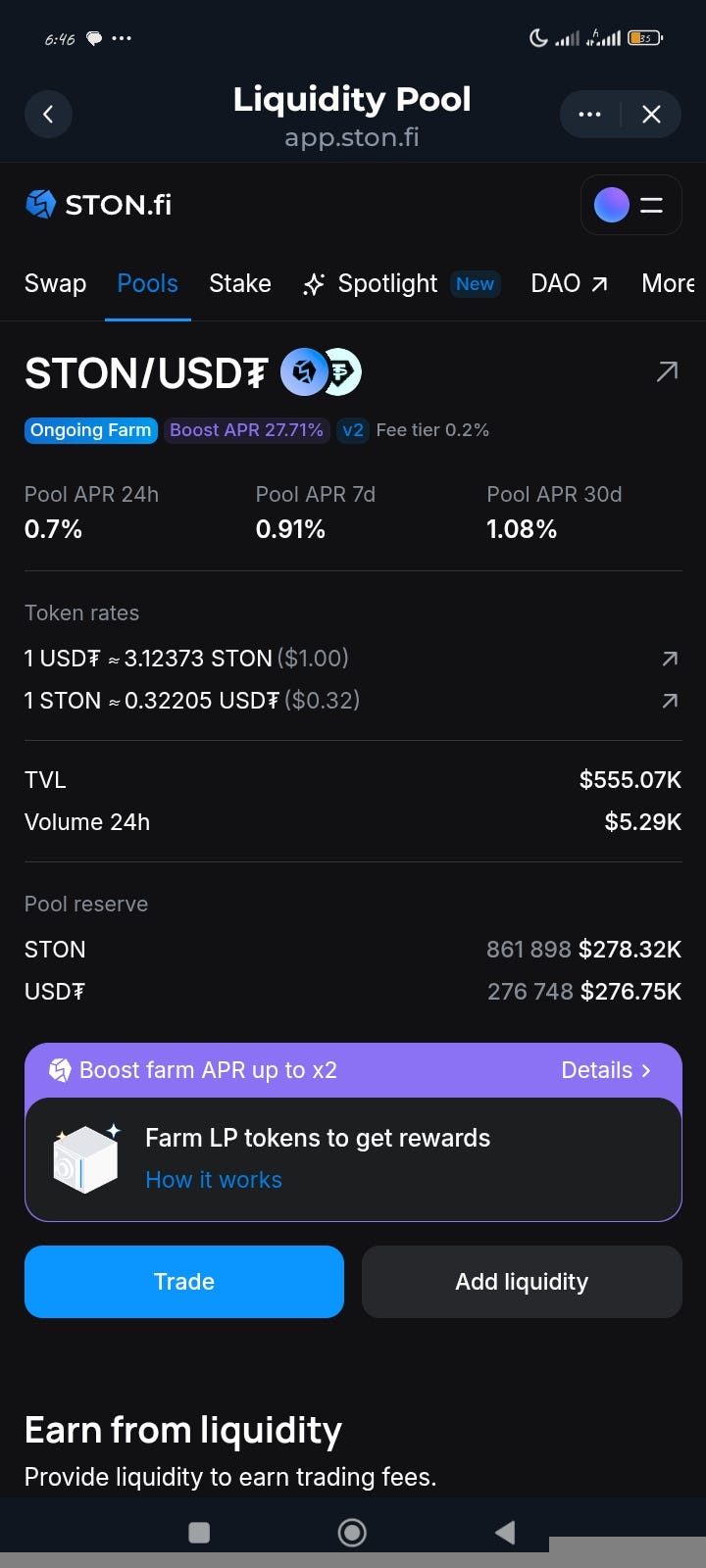
The STON/USDt pool is sitting at $555.07K TVL. On a global DeFi scale, that’s modest. But context matters more than comparison.
TON is a blockchain still in its growth phase. The projects building here are early. The liquidity accumulating here is early capital committed by people who understood the thesis before the crowd arrived.
$555K in TVL on TON today is not the same conversation as $555K on Ethereum in 2023. The trajectory is what you’re reading, not just the number.
Ask yourself when you see any TVL figure: Is this growing, stable, or bleeding? The answer tells you more than the number itself ever will.
The Reserve Balance The Most Underrated Metric.
Here’s what most people skip entirely.
Pool reserve:
STON: 861,898 tokens — $278.32K
USDt: 276,748 tokens — $276.75K
Almost perfectly equal.
That balance matters deeply. In an automated market maker model which is what STON.fi runs on the pool maintains price through the ratio between these two assets. When one side becomes significantly heavier than the other, it signals either strong directional trading pressure or liquidity imbalance.
A near-equal reserve like this tells you the pool is functioning healthily. Traders are moving through it in both directions. Neither side is being drained.
For a liquidity provider, this is a quiet green flag.
The APR Layers — Reading Beyond the Surface Number
This is where most beginners get confused. And honestly, where most intermediate users still make mistakes.
There are two separate yield mechanisms here and they are not the same thing.
Layer one — Pool APR
24h: 0.7%
7d: 0.91%
30d: 1.08%
This is the yield generated purely from trading fees. Every swap that passes through this pool generates a 0.2% fee — distributed proportionally to all liquidity providers automatically.
Notice something. The 30-day APR is higher than the 7-day, which is higher than the 24-hour. That tells you trading volume has been gradually increasing over time. The pool is getting more active — not less.
That trend line matters more than any single APR figure.
Layer two — Boost Farm APR
On top of the trading fee yield sits a 27.71% Boost APR through farming LP tokens.
This is incentive-based yield. When you provide liquidity, you receive LP tokens representing your share of the pool. Stake those LP tokens into the farm and you earn additional rewards separate from and on top of your trading fee income.
The platform also offers a x2 boost multiplier meaning under the right conditions, that farm APR can effectively double.
Two income streams. One position. That structure is what DeFi was designed to make possible.
The 24h Volume The Pulse of the Pool
Volume 24h: $5.29K
Volume is the heartbeat of any liquidity pool. No volume means no trading fees. No trading fees means the pool APR collapses toward zero regardless of what the farm rewards say.
$5.29K in a single day through a pool of this size represents genuine, organic activity. It’s not explosive. But it’s consistent and consistency in volume is exactly what a liquidity provider needs to see.
A pool with $10M TVL and near-zero volume is actually worse for a liquidity provider than a smaller pool with steady daily flow.
Always check the volume. Always.
What the Full Picture Says
When I stepped back and looked at everything together the balanced reserves, the growing APR trend, the layered yield structure, the consistent volume a coherent picture emerged.
This is a pool in a healthy early stage. Not overheated. Not dying. Functioning.
And functioning quietly is one of the most honest things a DeFi pool can do.
What This Exercise Is Really About
I want to be transparent about something.
I didn’t add liquidity to this pool before writing this. I explored it. I read it. I thought about what the numbers were saying.
And that process is the act of reading a pool with genuine curiosity taught me more than most DeFi tutorials I’ve consumed.
Because tutorials teach you definitions. Real data teaches you to think.
The next time you open a liquidity pool on STON.fi or anywhere else don’t just look at the APR and close the tab.
Read the reserves. Check the volume trend. Understand the layers of yield. Ask what the balance between assets is telling you.
That’s how you stop being a spectator in DeFi and start becoming a native.
If this breakdown helped you see liquidity pools differently, share it with someone still trying to make sense of DeFi. The best way to grow this space is to make it legible for more people.
#TON #DeFi #STONfi #LiquidityPool