Quantum Computing vs. Monte Carlo: The Future of American Options
--
The High-Stakes Puzzle of American Options
In the world of finance, “Options” are powerful tools that give investors the right to buy or sell a stock at a specific price. However, American Options come with a twist: unlike their “European” counterparts, which can only be used on a single expiration date, American options can be exercised at any time before they expire.
This flexibility creates a massive computational headache. To price an American option accurately, a bank’s computer must simulate millions of possible futures and constantly ask: “Is it better to cash out now, or wait until tomorrow?”
The Old Way: The “Square Root” Bottleneck
For decades, the industry standard has been Monte Carlo (MC) simulation. Think of it like a scout trying to find the best path through a massive, foggy forest by walking every single trail one by one. To get a clearer picture (higher accuracy), the scout has to walk exponentially more trails.
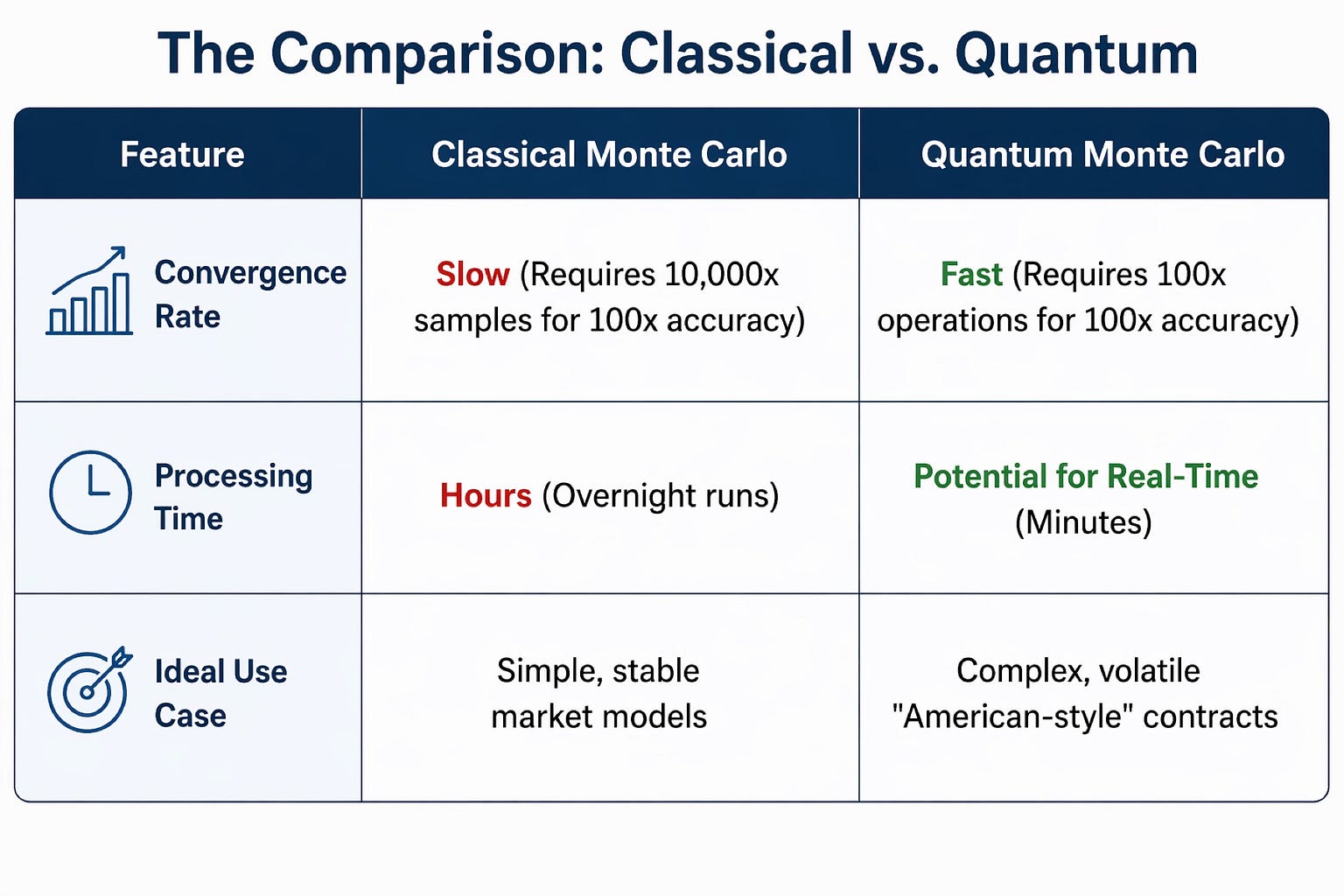
The Problem: To improve your accuracy by 10 times, you need to run 100 times more simulations.
The Result: Large banks often run massive server farms overnight just to get a single risk report by the next morning. If the market crashes at 10:00 AM, their data is already “stale.”
The Quantum Leap: Breaking the Speed Limit
Quantum computers don’t just work faster; they use a different kind of math entirely. While a classical computer checks one path at a time, a quantum computer uses Quantum Amplitude Estimation (QAE) to “wave” through all paths simultaneously.
Why It Matters for You
You might wonder why a faster computer at a big bank matters to the average person. It comes down to Stability. When banks can calculate risk in minutes rather than hours, they are less likely to be caught off guard by market crashes. This speed creates a more “transparent” market where prices reflect the most current information available.
The 2026 Reality: A Hybrid World
We aren’t throwing away classical computers yet. The current era of quantum computing uses a Hybrid Model:
Classical Computers handle the data entry and basic setup.
Quantum Processors handle the “heavy lifting” of the probability math.
This partnership allows firms to solve the “American Option Puzzle” faster than ever before, turning what used to be an overnight marathon into a morning sprint.
The Verdict
Quantum computing isn’t “breaking” finance in a destructive way; it is breaking the time barrier. As these systems move from laboratories to trading floors, the “waiting room” for financial risk data is finally being cleared out.