Position Risk Is Operational Risk in Crypto Trading
 Marcus Reid5 min read·Just now
--
Most traders describe position risk as price risk.
That is only half the picture.
In crypto, a position is not just a directional bet. It is a dependency stack: wallet access, frontend availability, API behavior, margin mode, collateral accounting, order routing, liquidation rules, withdrawal timing, and the trader’s ability to verify what the account actually holds.
When that stack works, people forget it exists.
When it breaks, the trader discovers that the chart was never the whole risk model.
A Position Is A State Machine
The cleaner way to think about a crypto position is not “long” or “short.”
It is state.
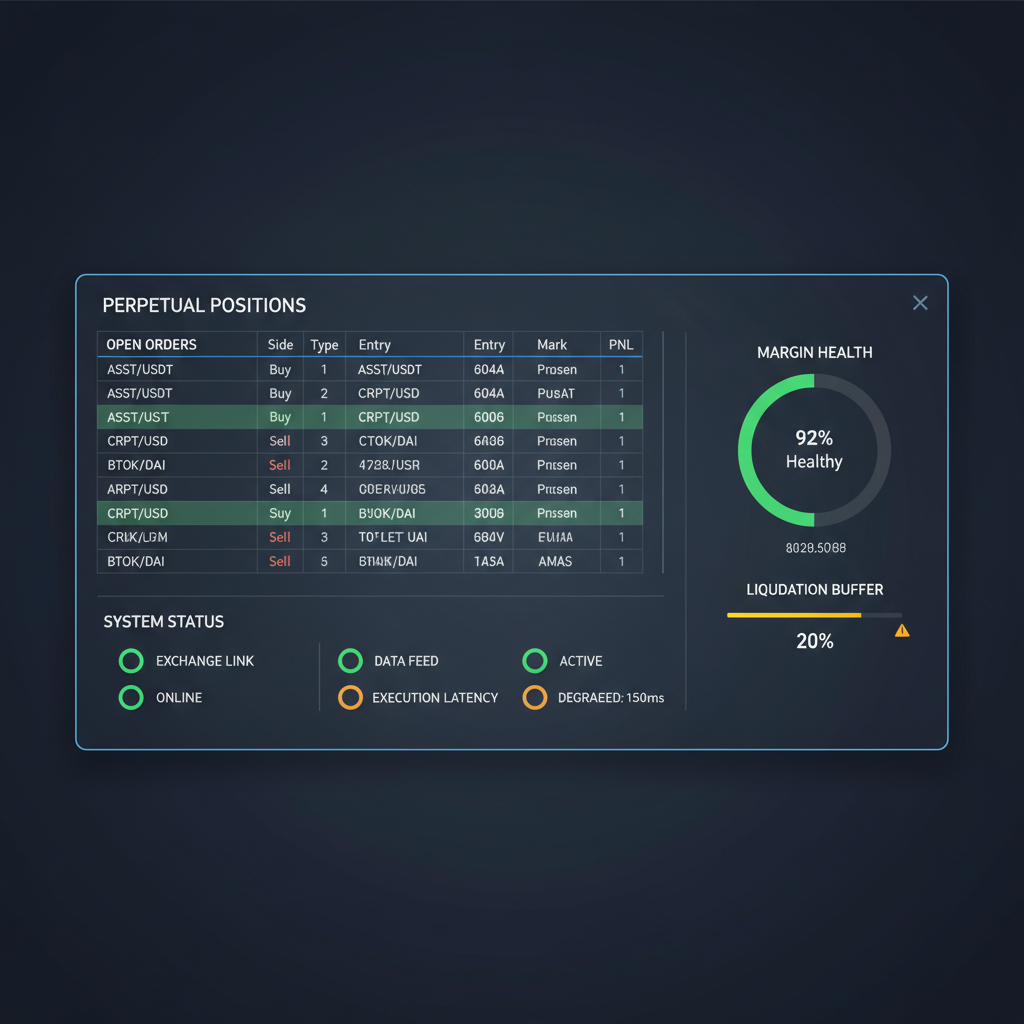
For a perpetuals account, the state includes entry price, size, leverage, margin mode, maintenance margin, unrealized PnL, funding, open orders, collateral transfers, and liquidation buffer. For a spot account, the state may include available balance, locked balance, pending settlement, bridge timing, or withdrawal restrictions. For a vault or structured product, the state may include withdrawal windows, queue position, share price, and manager-controlled execution.
The risk is not just that BTC moves 3% against you.
The risk is that BTC moves 3% against you while the interface is degraded, your cross-margin collateral is unclear, and you do not know whether an old reduce-only order is still open.
That is not a prediction problem. It is an operations problem.
The Moment A Frontend Fails, The Trade Changes
I pay attention to restricted or unavailable interfaces because they change decision quality.
A trader may still control the wallet. The protocol may still have valid account state. The assets may still be visible. But the trader’s normal control surface is gone or unreliable.
That creates a very specific failure mode.
The trader stops asking, “What is my best execution decision?” and starts asking, “How do I make this problem go away?”
Those are different questions.
In that state, users often make predictable mistakes:
- they treat a frontend error as proof of asset loss,
- they forget to separate spot balances from perp exposure,
- they ignore pending orders,
- they do not check whether collateral is cross-margin or isolated,
- they assume a failed withdrawal means protocol-level withdrawal is impossible,
- they follow the first technically confident third party,
- they copy a script before understanding what it will change.
This is why I do not like the phrase “just exit the position” during an access event. Exit through which route? With what slippage? After closing which orders? Against which collateral state? With what destination and confirmation path?
If those questions are unanswered, “exit” is not a plan. It is a wish.
A Simple Perp Example
Imagine a trader has a cross-margin perp account with three exposures:
- a profitable long that looks safe,
- a losing short that is close to liquidation,
- idle USDC that appears available on the account screen.
The frontend starts failing. The trader wants to withdraw the idle USDC first because it feels like the safest asset to move.
But if that USDC is supporting cross-margin exposure, withdrawing it may reduce the liquidation buffer. If there are open orders, they may change effective exposure after the trader thinks the account is stable. If funding has accrued or the mark price moves while the user is troubleshooting, the account state can shift before any withdrawal route is evaluated.
In other words, the visible balance is not the same as safely withdrawable balance.
This is where operational discipline matters. The first task is not to move funds. The first task is to map exposure.
What I Would Record First
During a restricted-access or abnormal-interface event, I would build a short state file before taking action.
It does not need to be elegant. It needs to be precise.
Minimum fields:
- wallet or account identifier,
- UTC timestamp,
- exact warning or failure message,
- chain or venue,
- spot balances,
- open perp positions,
- margin mode,
- liquidation prices or margin buffer,
- open orders,
- vault or locked balances,
- pending deposits or withdrawals,
- relevant transaction hashes,
- screenshots of the account state,
- any support ticket or protocol status message.
This is not paperwork for its own sake.
It prevents the trader from turning a solvable access problem into an execution mistake.
Speed Is Not Always Discipline
Trading culture rewards speed, and often it should. Slow execution can be expensive.
But speed is only useful when the route is known.
There is a difference between prepared execution and reactive execution. Prepared execution is fast because the trader already knows the size, route, fallback, and risk boundary. Reactive execution is fast because the trader is uncomfortable.
During account-access problems, reactive execution usually shows up as:
- rushing to sign an unfamiliar transaction,
- using a tool because someone said it worked for them,
- closing positions without checking order state,
- moving collateral before checking margin dependency,
- changing destination addresses under stress,
- trusting screenshots instead of verifiable state.
The faster the situation feels, the more valuable a checklist becomes.
That is counterintuitive to many traders, but it is the difference between urgency and discipline.
The Access-Risk Checklist
If I had to reduce the process to one checklist, it would be this:
- Identify the account.
Use public identifiers. Do not hand over secrets, signing authority, or wallet recovery material because the interface is stressful.
- Separate exposure from balance.
Balances are not the whole account. List spot assets, perps, open orders, vault exposure, locked funds, and pending settlement separately.
- Locate the immediate risk.
For a trader, the most urgent question is often not “Can I withdraw?” It is “What exposure can worsen while I wait?”
- Check margin dependency.
Before moving collateral, understand whether it supports open positions or pending orders.
- Prefer read-only checks first.
Reading state is safer than changing state. Execution should follow the map, not create the map.
- Write down the route before using it.
If the route cannot be explained in plain language, it is not ready for execution.
- Treat third-party help as review, not authority.
Anyone giving instructions should be able to explain what state they checked and what risk remains.
The Better Mental Model
Trading discipline is usually described as emotional control around entries, exits, and sizing.
That definition is too narrow for crypto.
Discipline also means understanding the operational path between decision and execution. It means knowing whether the interface is the only route or just the normal route. It means knowing which balances are free and which balances are supporting risk. It means not confusing a confident instruction with a verified plan.
When a frontend, account, or protocol interface behaves unexpectedly, the trader is no longer managing only a position.
The trader is managing a system state.
That requires a different tempo: not passive, not panicked, just procedural.
The traders who survive weird infrastructure events are not the ones who move first. They are the ones who can still think in state when everyone else is thinking in exits.
Position risk is operational risk.
And operational risk punishes the trader who acts before understanding the account they are acting from.