OneBullEx X Space Recap: What’s Driving Markets at New Highs in April 2026?
 OneBullEx7 min read·Just now
--
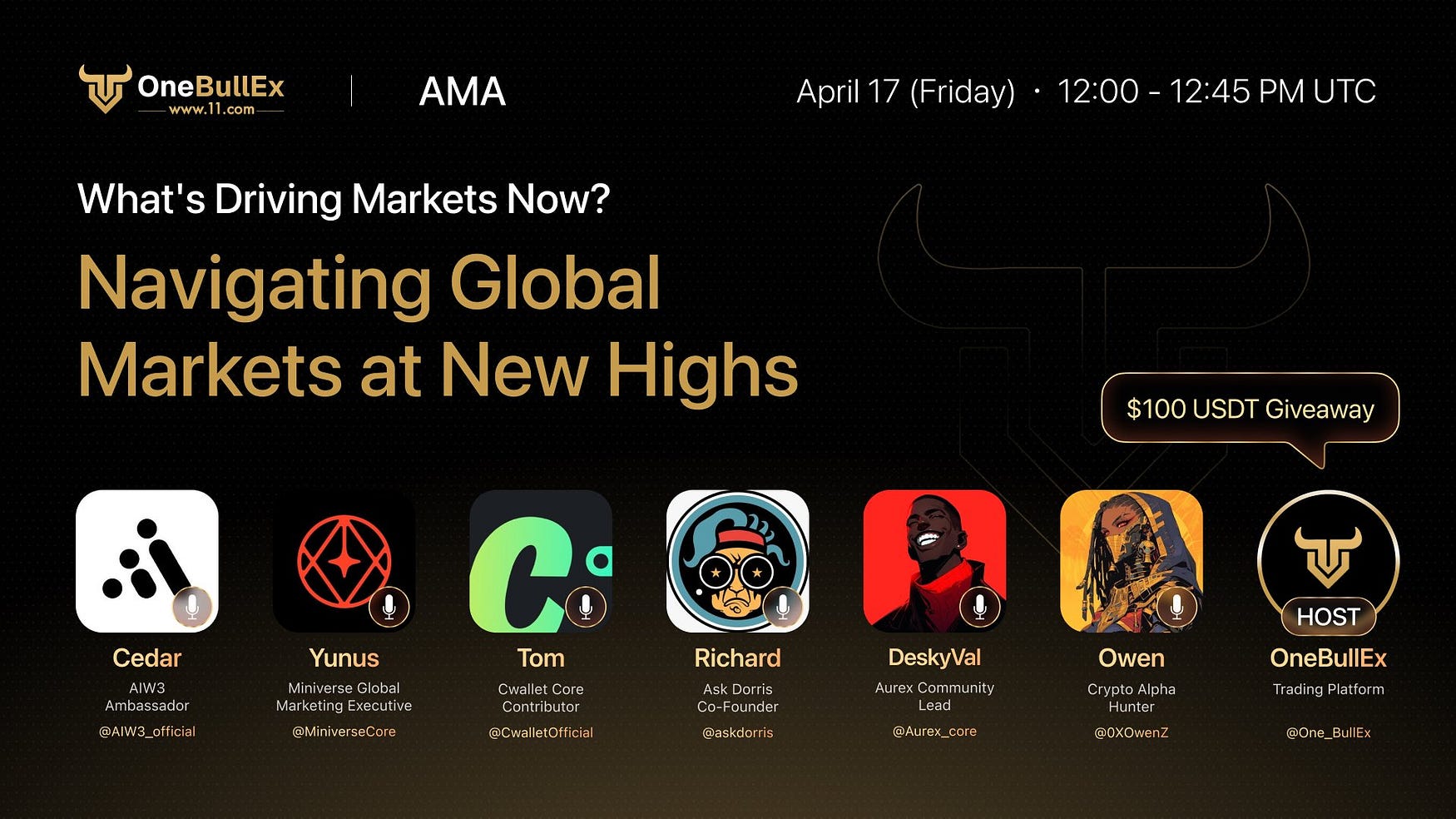
Bitcoin traded above $75,000 on April 17, 2026, marking its highest opening price since early February, while the Nasdaq recovered to levels not seen since before the February 5 sell-off triggered by the U.S.-Iran conflict. OneBullEx hosted an X Space the same day to break down what is actually sustaining this momentum and where traders should focus next. The session brought together five guests spanning AI analytics, digital wallets, on-chain intelligence, and meme coin infrastructure, alongside OneBullEx’s own market analyst. Over 45 minutes, the panel worked through five questions covering market signals, RWA tokenization, regulatory developments, trading infrastructure evolution, and the growing role of AI in execution workflows.
Is This a Sustained Trend or a Short-Term Rally?
The panel opened with the question on every trader’s mind: with U.S. equities adding over $500 billion in a single session and Bitcoin pushing back toward the mid-$70,000s, does the market have staying power?
The consensus leaned cautious. One guest framed the rebound as geopolitically contingent, pointing to ongoing uncertainty around Middle East negotiations and oil supply disruptions as factors that could reverse risk appetite quickly. CoinDesk reported on April 14 that Bitcoin climbed to its highest level since the February 5 crash, with optimism around a ceasefire pushing risk assets higher and oil prices lower, but analysts flagged the $76,000 level as key resistance where a previous rebound stalled.
OneBullEx’s market analyst argued that a few strong sessions do not constitute a trend. The broader tone may feel resilient, with altcoins gaining and sentiment improving, but price confirmation over a longer window matters more than a single week of green candles. The real danger, the analyst noted, is that traders become comfortable too quickly, start chasing entries, and give back gains on the first meaningful pullback.
Another panelist offered a behavioral lens: real trend confirmation comes from how markets react around support levels during corrections, not from the rallies themselves. Volatility tightening and confident recoveries from dips carry more signal than headline moves higher.
The practical takeaway was consistent across speakers. Execution discipline matters more when markets are moving fast because sloppy entries during rallies are where profits disappear. Direction helps, but how you manage risk around that direction is what separates outcomes.
Does RWA Tokenization Have Lasting Trading Opportunities?
Real-world asset tokenization has scaled from a narrative into measurable infrastructure. According to RWA.xyz, distributed on-chain RWA value reached $29.72 billion as of mid-April 2026, up over 8% in the past 30 days alone. The on-chain RWA market crossed $26.4 billion in March 2026, roughly a fourfold increase from $6.6 billion a year earlier, per data from RWA.xyz and PYMNTS. Six individual asset categories, including private credit, tokenized U.S. Treasuries, and gold, each independently exceed $1 billion.
The panel agreed that RWA has moved beyond the short-term narrative phase. Institutions are building real issuance, settlement, and custody infrastructure around tokenized products, which typically signals a transition from experimentation to actual deployment.
Where the speakers diverged was on where the edge sits. The asset layer itself, tokenized T-bills, bonds, and money market funds, is getting crowded. Similar products can appear quickly once the template exists, and pricing power erodes when that happens. One guest argued that the surface layer of tokenizing assets is already commoditized, while making those assets liquid, tradeable, and usable without friction remains the harder and more valuable challenge.
OneBullEx’s analyst pointed to the infrastructure layer around the asset as the more durable opportunity: settlement speed, cross-venue mobility, collateral eligibility, and connections to secondary trading and hedging activity. Those conditions determine whether a tokenized product becomes part of real market workflow or sits dormant on a blockchain. Long-term advantage, in this view, is more likely to build in issuance rails, settlement flow, and collateral handling than in the assets themselves.
Is Regulation Finally Becoming a Tailwind?
The CLARITY Act dominated this part of the discussion. The Digital Asset Market Clarity Act, which passed the U.S. House in July 2025 by a vote of 294 to 134, has spent nearly a year advancing through the Senate. On April 14, 2026, the White House Presidential Advisory Committee on Digital Assets confirmed that a compromise had been reached on the contentious stablecoin yield provision, clearing a path for a Senate Banking Committee markup expected in late April.
The panel treated regulatory clarity as a net positive, though with qualifications. The rules are becoming easier to read than before, and that shift matters for both institutional allocators and active traders. Capital flows more freely when participants have a clearer sense of what is allowed and where the restrictions are.
One guest emphasized the structural consequence: as regulatory uncertainty decreases, the portion of returns that came from navigating unclear rules also diminishes. The competitive edge shifts toward trading costs, risk controls, capital efficiency, and execution quality during volatile periods. Another panelist described it as a trade-off: clearer rules shrink inefficiencies, which makes the market more competitive and raises the bar on operational performance.
OneBullEx’s analyst framed regulation as a tailwind that changes how advantages are built. In a maturing market, consistent operations, disciplined execution, and risk management that holds up under stress become the differentiators, replacing the information arbitrage that characterized earlier, less regulated cycles.
Where Will Liquidity and Competitive Edge Concentrate?
The fourth question asked whether the rise of on-chain trading platforms and continued DeFi innovation signal a new paradigm for where liquidity settles.
No panelist argued for a winner-takes-all outcome between centralized and decentralized venues. The debate, several noted, has moved past the binary CEX-versus-DeFi framing. Centralized platforms retain advantages in deep liquidity, fiat access, and familiar interfaces. Decentralized protocols offer self-custody, on-chain collateral management, and direct access to on-chain liquidity pools. What matters now is how traders move between these environments depending on the type of trade, the capital structure, and the custody preference.
One guest described the future as convergence rather than competition. Hybrid systems that combine the execution depth of centralized venues with the transparency and composability of decentralized infrastructure are where liquidity and edge are concentrating. The differentiator is not simply user count but the ability to deploy capital across venues without operational friction.
OneBullEx’s analyst reinforced this point: liquidity will keep spreading across different venues rather than consolidating in one place. Platforms that help traders move between these environments with less delay and less operational complexity will stand out. The analyst noted that this is why OneBullEx’s approach, integrating execution conditions, collateral access, and settlement flow within a single environment, aligns with how traders actually allocate and move capital.
How Is AI Changing Market Structure and Execution?
The final topic explored the shift from fully human-driven decision-making toward augmented workflows that combine human judgment with AI-driven tools.
One panelist was direct about the timeline: within two years, the majority of active trading will be AI-driven, primarily because the volume and velocity of information in crypto markets are outpacing human processing capacity. Industry data supports the direction, with approximately 70% of global trading volume already executed by algorithms, and a Q2 2025 report showing that 67% of Gen Z traders had activated at least one AI-powered trading bot.
The panel’s more measured view was that AI compresses the gap between idea and execution rather than replacing the trader entirely. Research workflows are already faster: people can process information, identify patterns, and shape a rough thesis in less time than before. The harder part, and the part where infrastructure matters most, is carrying that thesis through validation, refinement, and into live execution without losing fidelity along the way.
OneBullEx’s analyst connected this to the platform’s OneALPHA targeted test, launching April 20 and running through May 3. OneALPHA is designed to let users turn trading ideas into executable strategies using natural language input, without coding. The workflow moves from idea to validation to improvement within a single platform, and 300 SPARTANS extends that further into rule-based automated execution. The integration matters because it eliminates the fragmentation that comes from piecing together separate research tools, backtesting platforms, and execution interfaces.
The broader point across speakers was that the market advantage is shifting from having access to AI tools toward having infrastructure that ties analysis, validation, and execution together seamlessly. When those steps live in one environment, traders spend less time on operational overhead and more time on the decisions that matter.
Key Takeaways
- Bitcoin’s recovery above $75,000 shows improved resilience, but panelists cautioned that geopolitical risks and thin resistance levels mean the trend has not confirmed itself yet. Execution discipline is the priority.
- RWA tokenization has scaled to nearly $30 billion in on-chain value, but the competitive edge is shifting from asset issuance to the infrastructure layer: settlement, collateral, and cross-venue mobility.
- The CLARITY Act’s stablecoin yield compromise in April 2026 signals that regulation is transitioning from obstacle to tailwind. As rules become clearer, the edge moves from navigating uncertainty to operational consistency and execution quality.
- Liquidity is spreading across centralized and decentralized venues. Hybrid models that reduce friction between environments are where competitive advantage is concentrating.
- AI is compressing the idea-to-execution pipeline. Platforms integrating research, validation, and automated execution in a single workflow, such as OneBullEx’s OneALPHA and 300 SPARTANS, reflect where trading infrastructure is heading.