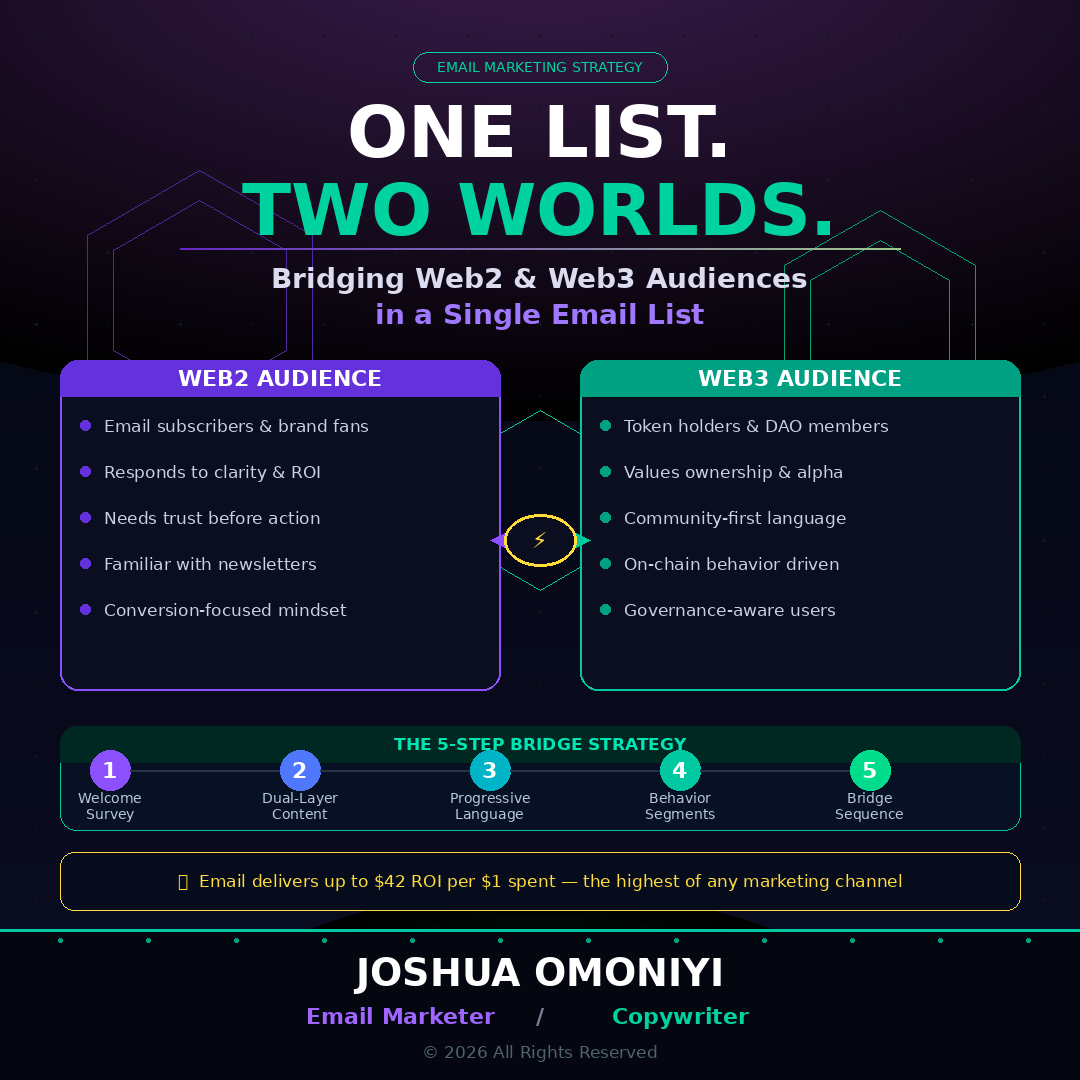
ONE LIST. TWO WORLDS.
The Definitive Guide to Bridging Web2 and Web3 Audiences in Single Email List
 Omoniyi Joshua14 min read·Just now
--
INTRODUCTION
There is a quiet revolution happening in the inboxes of millions of people around the world. On one side, you have Web2 — the internet most of us grew up with: social media platforms, centralized apps, brand newsletters, and e-commerce loyalty programs.
On the other side, you have Web3 — the emerging decentralized internet built on blockchain technology, tokenized ownership, smart contracts, and community governance.
For marketers and brand builders operating at the intersection of these two worlds, a critical question has emerged: How do you serve both audiences without fracturing your brand, doubling your workload, or alienating either group?
The answer, as this guide will show you, is simpler and more powerful than most people realize: You build one email list. But you run it with intelligence, empathy, and a clear strategy for speaking to both sides of the same conversation.
“Email marketing continues to have one of the highest ROIs of any type of content — as much as $36 for every dollar spent.” — Rise Up Media, 2025
This guide is for you whether you are a Web3 founder trying to onboard mainstream users, a traditional marketer curious about blockchain opportunities, a newsletter creator serving a mixed audience, or a brand building at the frontier of the digital economy. By the end of this article, you will understand the fundamental differences between Web2 and Web3 audiences, why they belong on the same email list, and exactly how to make that list work for both of them.
SECTION 1: UNDERSTANDING THE TWO AUDIENCES
Who Is the Web2 Audience?
Web2 users are the majority of internet users today. They are comfortable using email, social media platforms like Facebook, Instagram, LinkedIn, and Twitter, and they regularly interact with traditional e-commerce, SaaS products, and digital content. They trust established brands and institutions. They are motivated by convenience, value, and familiarity.
When it comes to email specifically, Web2 audiences are accustomed to promotional emails, newsletters, and drip sequences. They respond well to subject lines that promise clear benefits, educational content that solves specific problems, and offers with straightforward calls to action.
Their biggest barriers to engaging with Web3 content are unfamiliar terminology, fear of financial risk, and a general distrust of anything that feels ‘too technical’ or ‘too speculative.’
Who Is the Web3 Audience?
Web3 users are the early adopters, builders, and believers in the decentralized internet. They hold cryptocurrency wallets, participate in decentralized finance (DeFi) protocols, collect NFTs, contribute to DAOs (Decentralized Autonomous Organizations), and use blockchain-based applications daily. They are native to communities on Discord, Telegram, Farcaster, and crypto Twitter (now X).
According to Coinbound’s 2026 Web3 Marketing Guide, Web3 audiences are not just consumers — they can be token holders with governance rights, meaning their relationship with a brand goes far beyond a simple purchase. They are skeptical of hype, highly sensitive to inauthentic messaging, and deeply protective of their communities. They’ve seen enough failed projects to spot a red flag from a mile away.
Their approach to email is nuanced. Unlike Web2 users who open emails out of habit or brand loyalty, Web3 users engage with email that delivers genuine alpha (valuable insider information), protocol updates, governance proposals, and community-first communication. They will quickly unsubscribe from anything that feels like a generic marketing blast.
The Critical Overlap
Here is the insight that changes everything: these two audiences are not as different as they appear. Both groups are curious, ambitious individuals who want to understand emerging opportunities and stay ahead of the curve. The primary difference is not mindset — it is vocabulary and context.
A Web2 user who has never heard of DeFi still understands the concept of earning interest on savings. They understand loyalty points. They understand the idea of owning a piece of something valuable. These are the bridges you will use.
SECTION 2: WHY ONE LIST IS BETTER THAN TWO
The Hidden Cost of Separation
When brands maintain two separate email lists for Web2 and Web3 audiences, they create a number of compounding problems. First, there is the operational burden: two separate content calendars, two sets of automations, two different brand voices, and twice the budget spent on list management. For lean teams — which describes most Web3 startups — this is unsustainable.
Second, and more critically, there is the lost opportunity for cross-pollination. Your most engaged Web2 subscribers could become your most passionate Web3 community members — if only you gave them the educational on-ramp to get there. By keeping them in a separate list, you never give them the chance to grow.
Third, separated lists create inconsistent brand experiences. When a subscriber encounters your brand in two completely different voices and contexts, they experience cognitive dissonance.
This erodes trust — the very thing both audiences value most.
The Case for Unified Intelligence
A single, intelligently segmented email list solves all of these problems. It consolidates your data into one source of truth, allowing you to track subscriber journeys from Web2 curiosity all the way through to Web3 adoption. It maintains a consistent brand identity while delivering personalized content. And it creates a natural pipeline: your best Web2 subscribers eventually become your best Web3 advocates.
According to monday.com’s 2026 guide on email segmentation, effective segmentation requires a single, consistent customer view — because disconnected tools create blind spots that lead to outdated or inaccurate segments. The same principle applies here: one list, managed with sophisticated tagging and behavioral tracking, outperforms two isolated lists every time.
SECTION 3: THE ARCHITECTURE OF A UNIFIED EMAIL LIST
Step 1 — The Welcome Survey (Your First Intelligence Tool)
The moment someone subscribes to your email list, you have a brief and powerful window of maximum attention. Use it wisely. Instead of sending a generic welcome email, include a simple one-question survey:
“How familiar are you with blockchain and cryptocurrency?”
Give them three options:
• Complete beginner — I’m just learning about this
• Somewhat familiar — I’ve bought crypto and know the basics
• Experienced — I actively use DeFi, NFTs, or DAOs
Based on their response, tag them in your email platform (ConvertKit, ActiveCampaign,
Mailchimp, Klaviyo, or even EtherMail for Web3-native lists). These tags become the foundation of your entire segmentation strategy. You now have two clearly defined groups living inside one list, ready to receive tailored content without ever leaving the same master database.
What Is Tagging, and Why Does It Matter?
If you are new to email marketing, tagging is simply the practice of adding a label or marker to a subscriber’s profile based on their behavior, preferences, or attributes.
Think of it like color-coding files in a drawer. All the files are in the same drawer (your list), but each one has a colored tab that tells you exactly what it contains and where it belongs. Tags allow you to send the same email broadcast to your entire list while still customizing certain sections or triggering different follow-up sequences based on what each subscriber clicks or engages with.
Step 2 — Dual-Layer Content Architecture
This is the single most powerful technique in this entire guide. A dual-layer email is structured so that the first portion of the email is written for your Web2 audience — clear, benefit-driven, jargon-free language that any internet user can understand. The second portion of the email goes deeper, introducing Web3 concepts, on-chain mechanics, or tokenomics in language that resonates with your more experienced subscribers.
Here is a practical example:
Imagine you are a crypto investment platform. Your email subject line reads: ‘How Smart Money Is Earning While They Sleep.’ The first section explains the concept of passive income using a familiar analogy — a traditional savings account.
The second section introduces yield farming in DeFi, explaining it as a supercharged savings mechanism built on blockchain. The Web2 reader gets value from the first section and may click a link to learn more. The Web3 reader breezes past the basics and dives straight into the alpha. Both readers received value. Neither felt talked down to. And you sent exactly one email.
Step 3 — Progressive Language Shift
Language is the primary barrier between Web2 and Web3. Terms like ‘gas fees,’ ‘liquidity pools,’ ‘smart contracts,’ ‘on-chain activity,’ and ‘wallet addresses’ are second nature to Web3 natives but completely foreign to the mainstream audience.
Progressive language shift is the practice of introducing Web3 terminology gradually, over multiple email touchpoints, using familiar analogies before introducing technical terms. This is how great teachers work. They meet students where they are, build a bridge of familiar concepts, and then walk them across to new understanding.
An example progression for the term ‘smart contract’:
Email 1: ‘Think of it like a vending machine — you put in the right amount, and it automatically gives you what you paid for, no human needed.’
Email 3: ‘These automatic agreements are called smart contracts. They execute exactly as programmed, with no middleman.’
Email 6: ‘You can now interact directly with our smart contract to stake your tokens and earn protocol rewards.’
Step 4 — Behavior-Based Segmentation (The Secret Weapon)
Static segmentation — tagging someone once based on their initial survey response — is a starting point, not a destination. The real power comes from behavioral segmentation: automatically moving subscribers between segments based on how they interact with your emails.
According to EtherMail’s Web3 email marketing research (2025), token-based segmentation and behavioral tracking allow marketers to create highly targeted audience groups that reflect real-time user intent rather than outdated demographic assumptions. The same principle applies even without blockchain data.
Behavioral triggers to watch for:
• A Web2-tagged subscriber clicks a ‘what is DeFi?’ link three times ® Move them to a ‘Web3 Curious’ segment
• A Web3-tagged subscriber only ever opens emails about trading and ignores governance content ® Tag them as ‘Trader’ and customize accordingly
• A subscriber clicks a wallet setup tutorial ® Tag them as ‘Onboarding’ and trigger a hands-on education sequence
Behavior never lies. When you pay attention to what people click, you discover who they actually are — not who they told you they were when they first signed up.
Step 5 — The Bridge Email Sequence
This is a dedicated 5 to 7 email sequence designed specifically to take a curious Web2 reader on a structured, low-friction journey into Web3 concepts. It should be delivered only to subscribers who have shown behavioral interest in learning more — making it permission-based and highly relevant.
Suggested Bridge Sequence Structure:
Email 1 — The Big Picture
What if the internet was designed to give you ownership instead of just access? Introduce the concept of Web3 as the ownership economy using plain language and exciting real-world parallels.
Email 2 — The Problem With Web2
Explain data ownership, platform dependency, and why millions of people are looking for an alternative. Make it personal and relatable.
Email 3 — Enter the Blockchain
Demystify blockchain using the ‘shared Google Doc that nobody can delete’ analogy. No technical jargon. Pure clarity.
Email 4 — Your First Wallet
A step-by-step, beginner-friendly walkthrough of setting up a digital wallet. Frame it as ‘opening a bank account for the decentralized web.’
Email 5 — The Opportunity Right Now
Show them what’s available — DeFi yield, NFT ownership, DAO participation — with clear explanations and low-risk entry points.
Email 6 — Welcome to the Community
Invite them into your Web3 community channels, offer a resource library, and set expectations for the content they’ll receive going forward.
SECTION 4: TOOLS AND PLATFORMS FOR MANAGING A UNIFIED LIST
The right tools make a unified Web2/Web3 email list dramatically easier to manage. Here is a breakdown of the key platforms and how to use them:
ConvertKit / Kit
Excellent for creators and coaches bridging both audiences. Its visual automation builder makes it easy to create tag-based journeys. Ideal for progressive language sequences and behavioral triggers.
ActiveCampaign
The industry standard for sophisticated segmentation. Its CRM integration and deep behavioral tracking make it perfect for managing complex dual-audience strategies at scale.
Klaviyo
The gold standard for e-commerce brands with Web3 products (NFT merchandise, tokenized loyalty programs). Its predictive analytics can identify subscribers likely to convert to Web3 products.
EtherMail
Purpose-built for Web3 email marketing. Allows wallet-based authentication, token-gated content, and on-chain segmentation. Best suited for brands with a primarily Web3 audience that wants to also reach Web2 subscribers.
Mailchimp
The most beginner-friendly option. While it lacks the advanced behavioral capabilities of ActiveCampaign, its simplicity makes it a solid starting point for marketers new to managing segmented lists.
A Note on Data Integration
Regardless of which platform you choose, your segmentation strategy is only as strong as your data. Integrate your email platform with your website analytics, CRM, and — if applicable — your on-chain analytics tools (Dune Analytics, Formo, Etherscan). This creates the single, consistent customer view that drives accurate, real-time segmentation rather than relying on stale assumptions.
SECTION 5: CONTENT STRATEGY FOR A DUAL AUDIENCE
Writing Emails That Speak to Both Groups
The craft of writing for a dual audience is fundamentally about clarity, structure, and empathy. You must simultaneously respect the intelligence of your advanced Web3 subscribers while never making your Web2 newcomers feel left behind.
Four Content Formats That Work for Both Audiences:
The Analogy Bridge
Start every new concept with a real-world analogy that any adult can understand, then bridge to the Web3 equivalent. ‘Just like a stock represents ownership in a company, a governance token represents ownership and voting rights in a protocol.’ This works because Web2 readers understand the analogy, while Web3 readers appreciate the framing for use in their own conversations.
The Two-Track Newsletter
Structure your newsletter with a clear visual divider: ‘For Everyone’ (plain language insight) and ‘Going Deeper’ (advanced Web3 analysis). Subscribers self-select which section they read, and you collect behavioral data from their click patterns.
The Case Study Format
Real stories of people transitioning from Web2 to Web3 are magnetic to both audiences. Web2 readers see someone like themselves taking a journey they’re considering. Web3 readers see social proof and community growth. A single story serves both purposes.
The Glossary Drop
Once a month, dedicate a section of your email to defining three Web3 terms in the simplest language possible. This adds consistent value for Web2 readers while reminding Web3 natives why clear communication matters for mass adoption.
Email Frequency Guidelines
According to EtherMail’s 2025 research on Web3 email best practices, the optimal frequency
depends on audience engagement level:
• Active users (opened last 3 emails): 1–2 emails per week
• Passive users (opened in last 30 days): 1 email per week
• Re-engagement candidates (inactive 30–60 days): A monthly digest or win-back sequence
These guidelines apply equally to Web2 and Web3 segments. The key is consistency — disappearing for months and then flooding inboxes is the fastest way to lose subscribers from both worlds.
SECTION 6: COMMON MISTAKES AND HOW TO AVOID THEM
Mistake 1: Assuming Crypto Curiosity Means Crypto Readiness
Just because a subscriber clicked a link about Bitcoin doesn’t mean they’re ready to set up a DeFi wallet tomorrow. Curiosity and readiness are different stages. Respect the journey. Use progressive sequences, not a single overwhelming onboarding email.
Mistake 2: Jargon Without Context
Dropping terms like ‘L2 rollups,’ ‘yield optimization,’ or ‘cross-chain liquidity’ without explanation signals to Web2 readers that your content isn’t for them. Every technical term needs either an inline definition or a link to a beginner-friendly explainer. No exceptions.
Mistake 3: Ignoring the Web3 Subscriber’s Intelligence
Going too basic too often will frustrate your Web3 natives. Balance is key. Use your segmentation data to know when to go deep, and always offer an ‘advanced track’ for those who want more.
Mistake 4: Treating the List as Static
People grow. Their crypto knowledge evolves. Their interests shift. A subscriber who was a complete beginner six months ago may now be running a DeFi portfolio. Your segmentation must move with them, driven by their behavior, not your initial assumption.
Mistake 5: Skipping the Trust-Building Phase
Web3 users in particular have been burned by projects that over-promised and under-delivered. Before asking for any action — wallet connection, token purchase, community join — invest in multiple trust-building touchpoints. Consistency, transparency, and educational generosity are the currencies of trust in this space.
SECTION 7: MEASURING SUCCESS ACROSS BOTH AUDIENCES
How do you know if your unified list strategy is working? You track different metrics for each segment — and you also track the transition rate between them.
Web2 Segment KPIs:
• Open rate (benchmark: 25–35% for well-targeted lists)
• Click-through rate on educational content (benchmark: 3–6%)
• Bridge sequence completion rate (% who complete all 6 bridge emails)
• Segment migration rate (% moving from ‘Web2’ to ‘Web3 Curious’ tags)
Web3 Segment KPIs:
• Open rate on governance/protocol update emails (benchmark: 35–50% for engaged communities)
• Wallet connection rate from email CTAs
• On-chain action rate (token staking, DAO votes triggered by email)
• Community referral rate from email subscribers
The Most Important Metric: Migration Rate
This is the percentage of Web2-tagged subscribers who, over time, migrate to your Web3-aware segments through behavioral engagement. A healthy migration rate — even 3–5% per month — means your bridge strategy is working. You are not just serving two audiences; you are growing one.
SECTION 8: THE FUTURE OF EMAIL IN A DUAL-WORLD ECONOMY
The convergence of Web2 and Web3 is not a trend. It is an irreversible structural shift in how the digital economy operates. As blockchain infrastructure matures — with Layer 2 solutions making transactions affordable and wallet UX improving dramatically — the line between Web2 and Web3 users will continue to blur.
According to Cointraffic’s 2025 Web3 marketing analysis, by 2024–2025 the infrastructure had matured enough for projects to build sustainable marketing engines, with on-chain analytics tools enabling targeting based on actual user behavior rather than demographic guesses. This maturation will only accelerate.
Email, in this environment, becomes more valuable — not less. While social platforms continue to restrict crypto advertising and decentralized platforms fragment audiences across Discord, Telegram, and Farcaster, email remains the one owned channel that marketers control.
The inbox is the last bastion of direct, unfiltered communication with your audience. The brands and creators who invest now in building intelligent, unified email lists will have an extraordinary competitive advantage as mass Web3 adoption accelerates. They will already have the trust of their audience. They will already have the segmentation infrastructure. They will already have the brand identity that spans both worlds.
CONCLUSION: BUILD THE BRIDGE
The question is no longer whether Web2 and Web3 will converge. They already are. The question is whether your email marketing strategy is positioned to serve the audience that emerges from that convergence — or whether you will still be running two separate lists and two separate strategies while the opportunity passes you by.
Here is what we have covered in this guide:
• The fundamental difference between Web2 and Web3 audiences — and the critical overlap that makes a unified strategy possible
• Why a single intelligently segmented email list outperforms two isolated lists in every dimension
• The five-step architecture: Welcome Survey ® Dual-Layer Content ® Progressive Language Shift ® Behavioral Segmentation ® Bridge Sequence
• The best tools and platforms for managing a unified list with sophistication
• Content formats that serve both audiences simultaneously
• The most common mistakes and exactly how to avoid them
• How to measure success and track migration from Web2 curiosity to Web3 engagement
• Why email is the most valuable marketing channel in a converging digital economy
One email list. Two audiences. Infinite leverage.
The brands that win the next decade of digital adoption will not be the ones who chose a side.
They will be the ones who understood that Web2 and Web3 are not competing futures — they are the same future at different speeds. And they will be the ones who built the bridge early enough to matter.
Start building your bridge today. Your audience is waiting on both sides.
© JOSHUA OMONIYI | Email Marketer / Copywriter
Originally published on LinkedIn Articles & Medium
All rights reserved. This content is original and may not be reproduced without written permission.