The Conversation Is the Product: How ORO Redefined the DeFi Interface
 Bells4 min read·Just now
--
DeFi has a problem it has never honestly acknowledged.
It is not a liquidity problem. The protocols are deep. It is not a yield problem. The returns are real. It is not a security problem not primarily. The fundamental, load-bearing problem that has kept decentralized finance from becoming genuinely mass-market is that it has always demanded too much translation from the person trying to use it.
You arrive with a thought. “I want to put my USDC to work.” You leave forty-five minutes later having visited six interfaces, signed four transactions you only half understood, paid three separate gas fees, and still not entirely sure whether you deployed into the right vault. The thought you arrived with was clean and simple. The process that followed it was not.
ORO was built on the premise that the translation layer between human intent and onchain execution was not a necessary cost of doing DeFi it was a design failure. And the fix was not a better dashboard. It was removing the dashboard entirely and replacing it with a conversation.
The Architecture of Clarity
what ORO built is deceptively simple to describe and genuinely difficult to build. you open the interface. you type what you want. ORO reads your intent, maps the execution path across whatever chains and protocols your instruction requires, constructs the transaction sequence, and presents it for your approval. you sign. or you do not. the choice is always yours.
the elegance of that loop intent, path, execution, confirmation is that it compresses what used to be a multi-protocol, multi-tab, multi-hour workflow into a single session. type “withdraw 1 USDC from Permapod, swap it for ZIG, and stake it with a top validator” and ORO builds the full multi-step strategy before asking you to approve a single thing. what previously required three separate protocol interfaces, each with their own confirmation mechanics and its own learning curve, becomes one instruction.
this is not simplification at the cost of control. ORO is non-custodial. your keys never leave your wallet. every transaction requires your explicit approval before it touches the chain. the complexity is absorbed by the system. the authority stays with you.
What Ten Integrations in Three Weeks Actually Signals
the breadth of what ORO has connected in a short period is not incidental. it is structural. Wormhole bridges capital across 30+ chains through a typed command. Lido Finance puts $21.3 billion in ETH staking infrastructure behind “stake my ETH.” Kamino Finance, the dominant lending protocol on Solana with $3.5 billion in TVL, executes through a sentence. Morpho for Ethereum yield, Raydium for Solana liquidity, Nawa Finance for Shariah-compliant yield certified by Amanie Advisors, KPK for institutional vault strategies, Permapod for lending and borrowing, OnRamp Money for fiat-to-DeFi entry, Core Wallet for Avalanche users, Phantom for Solana natives, QuickNode RPC powering every execution with institutional-grade infrastructure underneath.
every integration represents a protocol that previously required its own interface, its own onboarding, its own mental model. ORO has pulled all of them into the same conversation.
the result is something that was not possible before: a user who has never interacted with a single DeFi protocol can type “show me the highest APY vaults across Ethereum, Solana, and ZIGChain” and receive an organized breakdown by chain, by protocol, by strategy then act on it, in the same window, without ever leaving to look something up.
The Numbers That Validate the Thesis
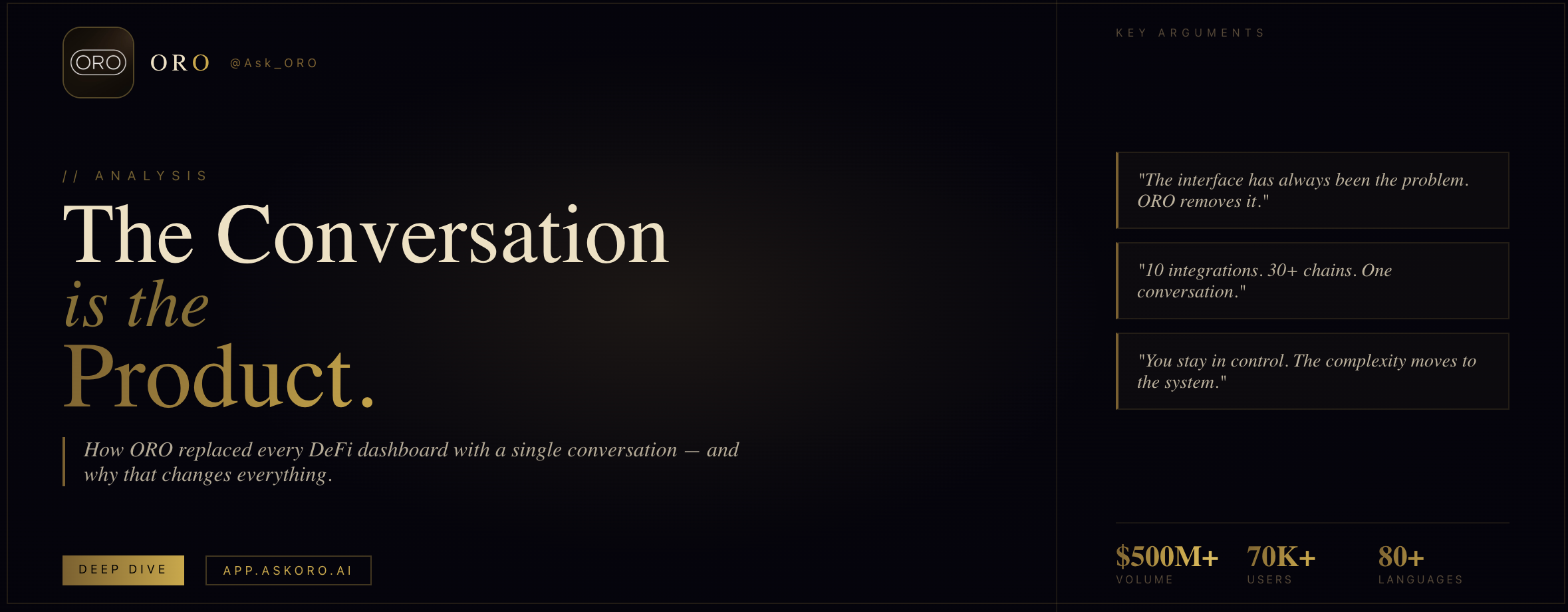
this is not theoretical. $500 million in cumulative volume processed. 70,000+ users worldwide. support for over 80 languages meaning the conversational layer meets users in the language they actually think in, not in the English-heavy jargon of crypto Twitter. social login via X, Google, Discord, and Apple, meaning the wallet setup barrier that has blocked millions of potential DeFi users is simply gone.
these are the metrics of a product that works. the thesis behind ORO that the interface has always been the problem is proving out in real usage numbers, across real chains, with real capital.
Why This Moment Matters More Than It Looks
there is a broader context that makes ORO’s timing significant. the mainstream technology industry, from Google’s agentic Gemini announcements to the broader shift toward AI that executes rather than AI that merely suggests, is converging on exactly the model that ORO has been running for onchain finance. the idea that you state a goal and an intelligent system maps the path and executes it is no longer speculative. it is the direction the entire software industry is moving.
ORO built that model for DeFi before it became fashionable to describe it. and while the broader AI industry is still defining what agentic finance looks like in theory, ORO already has $500 million in volume proving what it looks like in practice.
the conversation is the product. and the conversation has been live, open, and working since day one.
try it at app.askoro.ai
$ORO | ORO