NVIDIA H200 at $2.16/hr: Why Ocean Network Might Be the Cheapest Real H200 Access Available Today
--
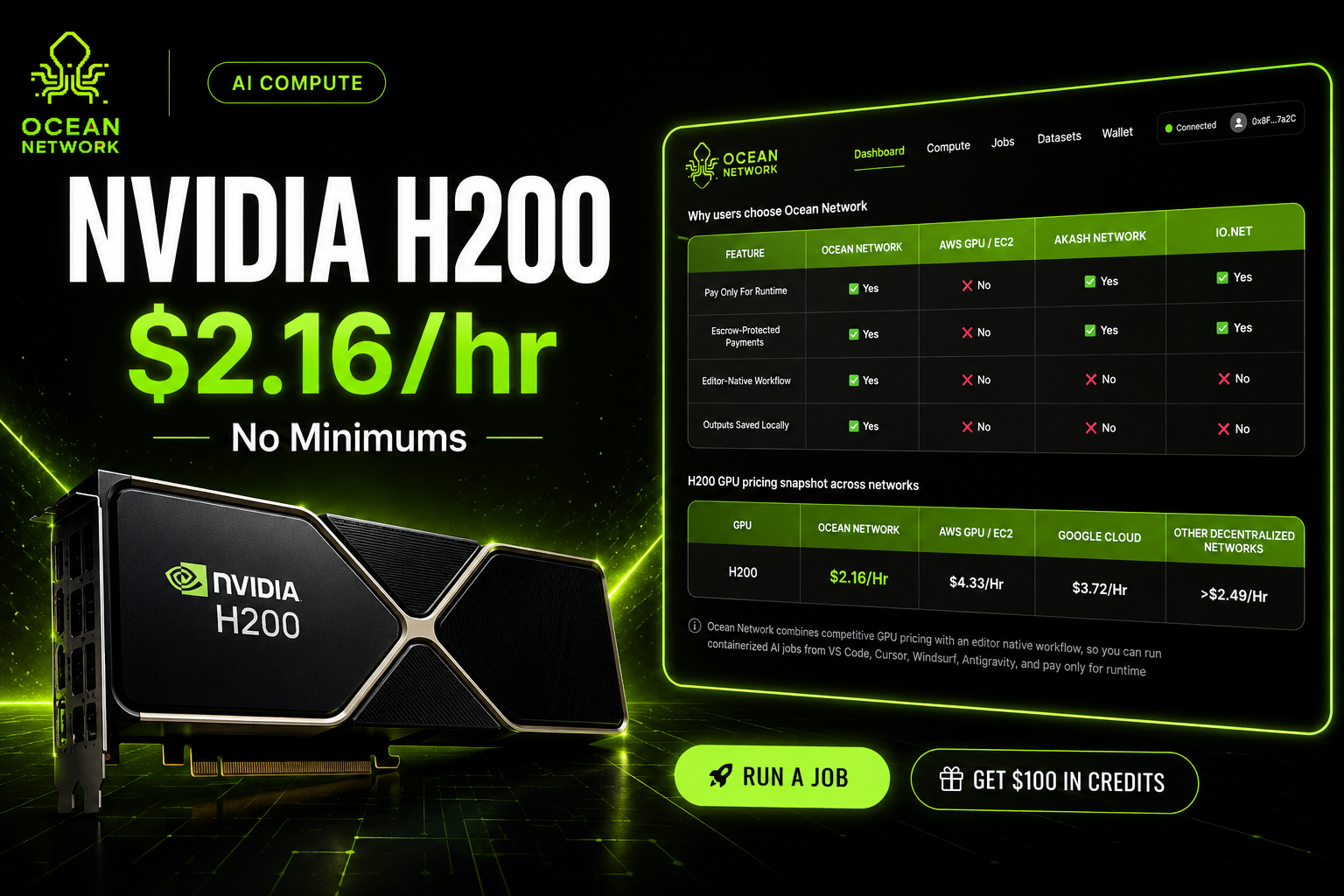
Access to NVIDIA H200 GPUs is still difficult for smaller teams and independent developers. Most cloud providers either charge enterprise level pricing or lock users into multi-GPU deployments that are expensive to test with. While researching current H200 availability, I found ocean network offering verified H200 access starting around $2.16 per hour with no long-term commitment, containerized job support through Ocean Orchestrator, and an escrow based payment model that only releases funds after successful job completion.
1-WHY H200 MATTERS
in 2026, the NVIDIA H200 became one of the most important GPUs for AI because modern models started demanding far more memory and bandwidth than before.
The biggest upgrade was its 141GB HBM3e VRAM and 4.8 TB/s memory bandwidth, which made it much better for running large AI models and long-context inference. As models like LLaMA 4 and DeepSeek evolved, they needed more memory to handle larger context windows, faster token generation, and more complex reasoning tasks.
This is where the H200 stood out. It could manage massive KV caches and long prompts more efficiently, reducing slowdowns and memory bottlenecks during inference.
Meanwhile, the NVIDIA H100 still remained powerful, but it sometimes struggled with newer workloads because of lower memory capacity and bandwidth. For many AI teams in 2026, the challenge was no longer just raw compute power it was handling larger models and longer contexts efficiently.
That shift is what made the H200 so important for modern AI infrastructure.
2-THE ACTUAL OCEAN H200 NODE
Instead of vague GPU listings, Ocean Network exposes detailed node information directly through the dashboard, showing exactly what each compute unit is capable of before you deploy anything.
Each node is explicitly defined with production-grade hardware and runtime constraints:
- GPU: NVIDIA H200
- VRAM: 141GB HBM3e
- CPU: Intel Xeon Platinum 8460Y+
- RAM: 440GB
- Storage: 1000GB
- Location: Kyoto, Japan
- Price: ~$2.16/hr
- Runtime: 1 minute/12 hours
- Status: Verified
- Jobs Completed: 2.2K
This is not just a specification sheet. The node is verified, meaning the hardware identity and performance profile are validated before being exposed on the network. It is benchmarked, so compute performance is measured under real workloads rather than theoretical claims.
Workloads run as containerized jobs, ensuring every execution is isolated, reproducible, and portable across nodes. This removes environment drift and makes GPU execution predictable at scale.
Instead of trusting a hidden backend, users interact through an escrow based system, where payment is only released when compute tasks are correctly executed and validated. This creates a trust layer between buyers and compute providers.
At the center of orchestration is the Ocean Orchestrator, which handles scheduling, job distribution, and resource allocation across nodes. It decides where workloads run based on availability, performance, and constraints like runtime limits (1 minute to 12 hours), ensuring efficient utilization of high-end hardware like the NVIDIA H200 cluster in Kyoto.
3-PRICE COMPARISON
In this comparison, pricing differences across H200 compute providers reveal how fragmented GPU infrastructure has become.AWS requires large nodes and complex provisioning, which increases effective cost for single GPU workloads.
Microsoft Azure remains expensive for most workloads compared to alternatives.
RunPod delivers straightforward single GPU access with predictable pricing for developers.
Jarvislabs.ai offers similar flexibility, making it attractive for small scale inference tasks.
Spheron Network emphasizes decentralized compute allocation, improving availability across regions.
Ocean Network stands out with minute billing, escrow support, and true single GPU access.
AWS requires large nodes
Azure expensive
Ocean minute billing
Ocean escrow
Ocean single GPU access
What stood out most wasn’t only the pricing difference. Most providers still structure H200 access like enterprise infrastructure.This gap highlights how decentralized GPU markets are reshaping access to high performance inference workloads. Traditional hyperscalers optimize for enterprise contracts, while newer platforms optimize for flexibility and hourly efficiency. Developers increasingly prefer providers that allow granular scaling without long term commitments. Ocean’s model combines minute billing with escrow protection, which reduces friction for independent AI teams. This is particularly relevant for H200 usage where cost efficiency per minute can significantly impact training and inference economics. Among all providers, Ocean Network positions itself closest to on demand GPU ownership rather than traditional cloud renting. This shift signals a broader trend toward decentralized compute marketplaces where pricing transparency becomes a competitive advantage. Ultimately, H200 access is no longer defined only by raw performance but by accessibility, billing granularity, and deployment freedom. We observe a clear divide between enterprise locked ecosystems and open GPU networks designed for rapid iteration and experimentation. Choosing the right provider therefore depends less on peak specs and more on operational flexibility and cost control over time. In practice this determines real world efficiency.
4-WHAT YOU CAN RUN
With modern GPU providers like Ocean Network, the focus is no longer just raw compute power, but what you can actually deploy in real workflows. On systems equipped with H200-class performance, you can comfortably run large scale AI workloads that previously required enterprise clusters.
LLM inference workloads like LLaMA 4 70B can run directly on a single H200-class GPU, with 141GB of VRAM allowing full-precision execution without relying on tensor parallelism or multi-GPU splitting. This makes deployment simpler and significantly reduces orchestration overhead, especially for production inference endpoints.
For fine-tuning, the setup becomes even more practical. With 440GB of system RAM and a 40-core Xeon CPU, you get enough headroom to handle heavy data preprocessing, tokenization, and dataset streaming while the GPU focuses entirely on training. This balance between CPU and GPU resources helps avoid bottlenecks during iterative training runs.
Containerized ML jobs are a key part of the workflow. Instead of manually configuring clusters or dealing with SSH-based server management, you submit jobs directly through Ocean Orchestrator. Everything can be triggered from tools like VS Code or Cursor, making the development loop feel native to your coding environment rather than a separate infrastructure layer.
Batch workloads also become more efficient. With 1-minute minimum billing, short experiments, evaluations, or dataset processing tasks don’t waste compute budget. You run exactly what you need, for exactly the time required, and stop immediately after completion.
Research and experimentation benefit the most from this model. There is no long-term infrastructure commitment, so you can spin up environments for quick tests, benchmarking runs, or prototype validation, then shut them down instantly when finished.
LLM Inference: Run LLaMA 4 70B in full precision on a single H200. 141GB VRAM handles it without tensor parallelism.
Fine-tuning: 440GB RAM + 40-core Xeon gives CPU headroom for data preprocessing alongside GPU training.
Containerized ML Jobs: Submit via Ocean Orchestrator directly from VS Code or Cursor, no SSH, no cluster config.
Batch workloads: 1-minute minimum billing means short jobs don’t waste budget.
Research & experimentation: No long-term commitment means you spin up for a test run, pay for exactly that, and stop.
The overall workflow feels closer to submitting a compute task than managing a GPU server manually.
5-ESCROW PAYMENT
This model changes the way trust works in GPU computing by separating access from payment risk.
First, the user submits a job and the funds are locked in USDC escrow. The money is not sent directly to the provider at this stage, which removes the risk of paying upfront for uncertain execution.
Next, the compute job runs on a verified H200 node. The infrastructure is already allocated, but payment is still held in escrow while the workload is being executed. This ensures the system is focused on completion, not just uptime.
Once the job finishes successfully, the result is verified and the funds are released to the node provider. This creates a clear link between successful computation and payment.
If the job fails, the user does not pay. That single rule changes the entire incentive structure. It pushes reliability and execution quality to the center of the system instead of raw availability.
Unlike AWS or Azure, billing does not immediately start the moment infrastructure spins up. On traditional clouds, you pay for uptime whether your workload succeeds or fails, which shifts all risk to the user.
This is the core shift: you’re not paying for uptime. You’re paying for results.
FAQ
Does Ocean Network offer NVIDIA H200 GPUs?
Yes. Ocean Network provides verified NVIDIA H200 GPU nodes available on-demand through its dashboard. These GPUs are supplied by distributed infrastructure providers and do not require long-term contracts. Users can launch H200 compute jobs for AI training, inference, fine-tuning, embeddings, and agent workflows, paying only for the exact compute time used.
Can I run LLaMA 4 on Ocean Network’s H200?
Yes. The H200 GPUs available on Ocean Network are suitable for large-scale AI models, including Meta LLaMA 4. With 141GB of HBM3e VRAM, users can run high-context inference, larger batch sizes, and advanced fine-tuning. The environment supports containerized workflows, allowing developers to deploy and execute models directly without complex infrastructure setup.
How does escrow payment work?
Ocean Network uses an escrow-based payment system to ensure trust between users and GPU providers. When a job starts, USDC is locked in escrow instead of being paid upfront. After successful job completion and verification that compute resources were delivered correctly, funds are released automatically to the provider. If the job fails, payment is not released.
Do I need 8 GPUs minimum?
No. Ocean Network does not require multi-GPU minimums. Users can rent a single NVIDIA H200 GPU per job, making it accessible for small teams, researchers, and independent developers. Runtime can be as short as a few minutes depending on availability. This removes the barrier of large cluster commitments common in traditional cloud providers.
Where are the nodes located?
H200 nodes on Ocean Network are distributed globally through a decentralized provider network. One verified deployment is located in Kyoto, Japan, serving East Asia workloads. Additional nodes may be contributed from other regions over time, allowing users to select compute resources based on latency, compliance needs, and regional availability.
What hardware comes with the node?
A typical H200 node on Ocean Network includes enterprise-grade infrastructure beyond the GPU. This includes an Intel Xeon Platinum 8460Y+ CPU, around 440GB of RAM, and approximately 1TB of storage. This configuration supports heavy AI workloads requiring both GPU acceleration and strong CPU and memory performance for data processing, orchestration, and container execution.
After comparing multiple H200 providers, Ocean Network feels more accessible for developers who need short-term GPU access without dealing with traditional enterprise cloud setups. The key shift is that H200 compute is no longer limited to hyperscaler ecosystems or strict 8-GPU minimum commitments. Instead, it is available on-demand at around $2.16/hr with verified nodes and an escrow-based payment flow that only releases funds when jobs complete successfully. This makes experimentation and small-to-mid scale workloads more practical, especially for teams testing long-context inference or models like LLaMA 4 or DeepSeek variants. It doesn’t replace large cloud contracts, but it does fill a gap between casual GPU rentals and enterprise infrastructure.