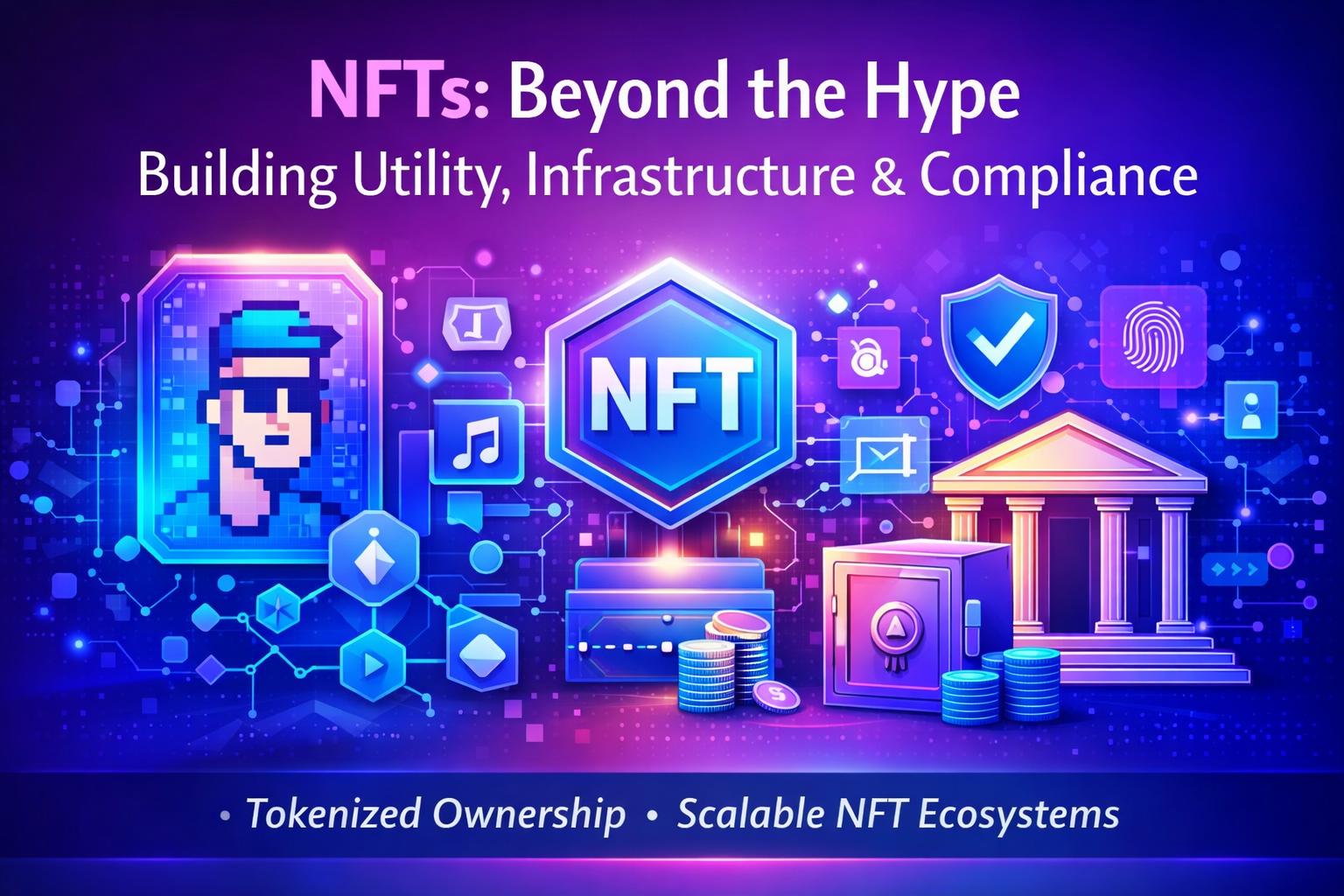
NFTs: Beyond the Hype, Building Real Utility, Infrastructure & Scalable Digital Ownership
The NFT wave started with art, collectables, and viral million-dollar JPEG headlines. But beneath the speculation cycle, a much bigger structural shift is unfolding.
 Alok Singh5 min read·Just now
--
Non-Fungible Tokens (NFTs) are not just digital collectables. They represent programmable ownership, automated rights management, digital identity layers, and tokenised access control.
If you are building in fintech, gaming, digital content, ticketing, luxury goods, real-world assets, or Web3 infrastructure — understanding NFTs from an infrastructure and compliance perspective is now critical.
Because the next NFT cycle won’t be driven by hype.
It will be driven by utility.
What Exactly Is an NFT (In Practical Terms)?
An NFT (Non-Fungible Token) is a unique digital token stored on a blockchain that represents ownership of a specific asset.
Unlike cryptocurrencies such as Bitcoin or Ether, which are interchangeable, NFTs are unique and non-replicable.
But here’s the deeper layer:
NFTs are programmable ownership certificates.
They can represent:
- Digital art
- Music rights
- Gaming assets
- Event tickets
- Membership access
- Intellectual property
- Real-world assets
- Identity credentials
And increasingly, financial instruments.
Why NFTs Matter Beyond Art
The first NFT boom focused on collectables. The next phase focuses on infrastructure.
Here’s why NFTs are strategically important:
- Proof of Ownership
Blockchain verification removes disputes over authenticity. - Programmable Royalties
Creators can earn automatically on secondary sales. - Access Control
NFTs can act as digital keys to communities, products, or services. - Fractionalization
High-value assets can be divided into smaller ownership shares. - Cross-Platform Portability
Assets can move across ecosystems if standards align.
The real revolution is not the image attached to the NFT.
It’s the ownership logic embedded inside it.
The Infrastructure Behind Successful NFT Projects
Many NFT launches fail not because of demand, but because of weak infrastructure.
A serious NFT ecosystem requires:
- Smart contract security audits
- Gas optimization strategies
- Marketplace integration
- Wallet compatibility
- KYC/AML frameworks (in regulated jurisdictions)
- Payment gateway integration (fiat on-ramps)
- Royalty enforcement systems
- Cross-chain compatibility
Launching an NFT collection without scalable backend infrastructure is like launching a fintech app without compliance.
It may trend temporarily — but it won’t sustain.
Utility-Driven NFTs: The Next Growth Phase
We are now seeing NFTs used for:
Gaming
In-game skins, characters, weapons, interoperable assets.
Ticketing
Fraud-proof digital tickets with programmable resale limits.
Luxury Goods
Authentication certificates for high-end products.
Education
Blockchain-verified degrees and certifications.
Finance
Tokenised real-world assets (RWAs).
These use cases demand robust compliance and infrastructure layers.
Speculation alone is no longer enough.
Mid-Article Question (Important)
If you are:
- Planning to launch an NFT marketplace
- Building a gaming ecosystem with NFT assets
- Exploring real-world asset tokenisation
- Integrating NFT ticketing solutions
- Or seeking compliant NFT infrastructure
Are you interested in seeing our offerings and how we structure scalable NFT ecosystems?
You can reach us directly:
Contact us: [email protected]
Direct DM: [email protected]
Telegram: @CoreConnect9
Insights Channel: https://t.me/+nD86Oc4mJtEyOTM9
We regularly share insights on NFT infrastructure, digital asset compliance, and scalable blockchain models.
Compliance & Regulatory Considerations
One of the most overlooked aspects of NFTs is regulatory exposure.
Depending on structure, NFTs can be classified as:
- Securities
- Digital assets
- Utility tokens
- Financial instruments
Improper structuring may trigger:
- Securities law violations
- AML breaches
- Consumer protection investigations
- Tax complications
If NFTs include revenue-sharing, fractional ownership, or investment-like promises — regulatory scrutiny increases significantly.
The infrastructure must be aligned with jurisdictional laws.
Monetization Models for NFT Platforms
Beyond primary sales, NFT platforms can generate revenue through:
- Marketplace transaction fees
- Royalty sharing
- Premium listing models
- White-label NFT launchpads
- Token-gated subscription models
- Brand partnerships
However, monetisation must be designed with scalability and compliance in mind.
Revenue models built during hype cycles often collapse during market corrections.
Infrastructure-first models survive volatility.
Common Mistakes NFT Founders Make
- Launching Without Utility
Pure hype projects struggle to maintain value. - Ignoring Smart Contract Audits
Security flaws can destroy trust instantly. - Overlooking Gas Fees
High transaction costs reduce user adoption. - No Fiat On-Ramp
Mainstream users struggle without simple payment options. - Regulatory Blind Spots
Global expansion becomes impossible without compliance planning.
NFTs must be treated as financial infrastructure — not social media trends.
The Convergence: NFTs + Fintech + Payments
The most powerful NFT ecosystems integrate:
- Fiat payment gateways
- Crypto on-ramps
- Stable-coin settlements
- Wallet-as-a-service models
- KYC frameworks
- Cross-border payout systems
When NFTs integrate directly with digital banking and payment infrastructure, adoption scales dramatically.
This convergence is where long-term value lies.
Enterprise & Institutional NFT Adoption
Large corporations are exploring NFTs for:
- Supply chain authentication
- Loyalty programs
- Digital identity
- Membership management
- Intellectual property tracking
But enterprise adoption requires:
- Compliance
- Security audits
- Governance structures
- Interoperability
Institutional players will not engage with poorly structured NFT systems.
The next phase of growth depends on professional infrastructure.
NFTs & Real-World Asset Tokenisation
Perhaps the most transformative opportunity lies in tokenising real-world assets:
- Real estate
- Commodities
- Bonds
- Art
- Equity instruments
NFT frameworks can represent ownership rights tied to legal agreements.
But this demands:
- Legal structuring
- Custody arrangements
- Regulatory alignment
- Transparent governance
Without these layers, tokenisation becomes legally vulnerable.
The Future of NFTs
Looking ahead, NFTs are likely to evolve toward:
- Identity-linked NFTs
- AI-integrated smart contracts
- Multi-chain operability
- Regulated asset tokenisation
- Institutional-grade marketplaces
- Embedded finance integration
The speculative phase was the introduction.
The infrastructure phase is the future.
Final Thoughts: NFTs Are Digital Ownership Infrastructure
The NFT narrative is shifting.
From:
Collectable hype.
To:
Programmable digital ownership systems.
Businesses that approach NFTs with a strategic, compliance-aware, infrastructure-first mindset will dominate the next wave.
Those who repeat hype-cycle mistakes will disappear with market corrections.
If you are building in NFTs, tokenization, digital assets, or Web3 ecosystems — structure it correctly from day one.
Let’s Connect
If you’re exploring:
- NFT marketplace development
- White-label NFT platforms
- Real-world asset tokenization
- NFT + payment integration
- Compliance-ready NFT ecosystems
Reach out:
Contact us: [email protected]
Direct DM: [email protected]
Telegram: @CoreConnect9
Insights Channel: https://t.me/+nD86Oc4mJtEyOTM9
Before you go —
Are you interested in seeing our NFT infrastructure offerings and discussing how we can support your Web3 expansion?
Let’s build digital ownership the right way — secure, scalable, and compliant.